Ha Yeon-joo
Captain Cha / Cha Song Joo

It is set in South Korea where all citizens, including women, have to serve the two-year mandatory military service currently reserved for men. The story takes place in an all-female mobilization reserve division.
I didn’t expect to laugh in the first five minutes of Oh My Captain!, but there it was—a young woman in full military fatigues, trying to march in sync with her platoon, her face a mask of concentration so intense it looked like she was solving a math problem mid-stride. The camera lingers on her boots, one slightly out of step, the other dragging just enough to throw off the whole line.
It’s a small moment, but it’s the kind of detail that makes you realize this isn’t just another military drama. This is a story about bodies in space, about the absurdity and necessity of forcing a group of strangers to move as one.
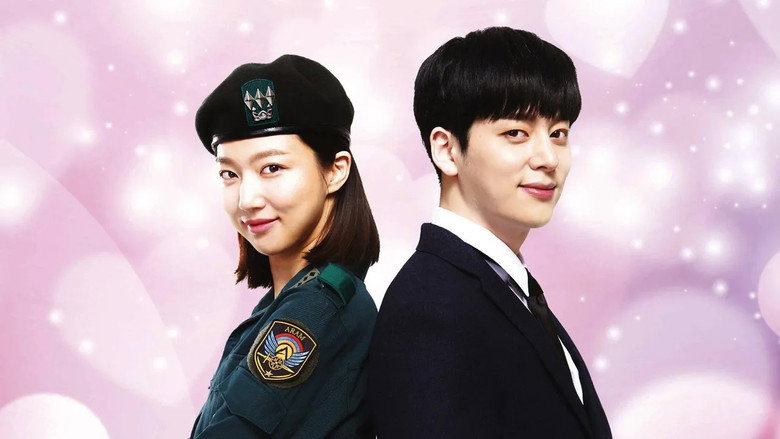
The premise of Oh My Captain! is simple, almost provocative in its straightforwardness: what if South Korea’s mandatory military service applied to women too? The show doesn’t waste time with grand speeches about equality or political manifestos. Instead, it drops us into the mundane, sweaty reality of an all-female mobilization reserve division, where the biggest battles aren’t fought with guns but with blisters, bureaucracy, and the quiet rebellion of individuality.
The series is set in a near-future version of South Korea, but the world outside the base feels eerily familiar. There are no dystopian trappings, no grand villains—just the slow, grinding machinery of conscription, now with a twist.
What’s striking about Oh My Captain! is how little it relies on the usual crutches of military dramas. There are no boot-camp montages set to rousing music, no drill sergeants barking one-liners, no climactic battle that tests the mettle of our heroes. Instead, the show finds its tension in the small, everyday struggles of its characters.
One recruit can’t do a single push-up; another struggles with the weight of her rifle during drills. A third, a former office worker, keeps getting reprimanded for saluting incorrectly. These aren’t the kinds of conflicts that make for explosive television, but they’re the ones that feel real.
The show’s genius lies in its refusal to romanticize the military experience. It’s not about heroism or glory; it’s about endurance, about the way institutions shape (and sometimes break) the people who pass through them.
The ensemble cast is a revelation, not because any single performance stands out as transcendent, but because the show gives each woman just enough room to breathe. Ha Yeon-joo plays the platoon’s de facto leader, a quiet, competent recruit who steps into the role almost by accident. There’s no grand arc for her, no moment where she “finds her voice.” Instead, she’s just there, steady and unassuming, the kind of person you’d want in charge if you were stuck in a situation where competence mattered more than charisma.
Kim Ye-won, as a former athlete who chafes under the military’s rigid structure, brings a physicality to her role that’s fascinating to watch. She moves through the world like someone used to being in control of her body, and the military’s attempts to discipline that body—make it march in step, stand at attention, obey without question—become a quiet, ongoing battle.
Then there’s Jei, whose character is the platoon’s wildcard. She’s the one who cracks jokes at the wrong time, who can’t seem to take anything seriously, who treats the whole experience like a bizarre summer camp. Her performance could have easily tipped into caricature, but Jei walks the line perfectly.
There’s a moment in the third episode where the platoon is forced to stand at attention for an hour as punishment for some minor infraction. The camera holds on Jei’s face as the minutes tick by, her expression shifting from amusement to boredom to something like despair. It’s a small moment, but it’s the kind of thing that makes Oh My Captain! feel so alive.
The show understands that the real drama of military service isn’t in the big moments—it’s in the slow, creeping realization that you’re no longer in control of your own time, your own body, your own choices.
The direction is unshowy but effective. The camerawork is intimate without being intrusive, often lingering on the faces of the recruits during moments of downtime. There’s a scene in the fifth episode where the platoon is given a rare hour of free time.
Some of the women nap, others write letters home, a few just sit and stare at the wall. The camera moves between them slowly, almost meditatively, capturing the way boredom can feel like a physical weight. The sound design is equally impressive, particularly in the way it uses silence.
There are no swelling orchestral scores here, no dramatic stings to tell you when to feel something. Instead, the show relies on the ambient sounds of the base—the distant hum of generators, the clatter of boots on concrete, the occasional shouted command—to create its atmosphere.
If Oh My Captain! has a flaw, it’s that it sometimes struggles to balance its ensemble. With twenty episodes to fill, the show occasionally loses track of its secondary characters, reducing some of them to little more than background noise. There’s a subplot involving a recruit who’s hiding an injury that could get her discharged, and while it’s one of the more compelling threads, it’s also one of the most underdeveloped.
The show seems unsure of how much weight to give it, and as a result, it fizzles out rather than building to anything meaningful. It’s a shame, because the idea of a woman risking her future to avoid being sent home—where, presumably, she’d face judgment for not being “tough enough”—is rich with potential.
But these are minor quibbles. What Oh My Captain! gets right, it gets very right. The show is at its best when it’s exploring the quiet, often absurd ways that institutions shape our lives.
There’s a scene in the seventh episode where the platoon is given a lecture on “proper military posture.” The instructor, a no-nonsense sergeant, demonstrates how to stand at attention: chest out, shoulders back, chin up. The recruits mimic her, but their bodies betray them. Some slouch, others fidget, a few can’t seem to stop shifting their weight from one foot to the other.
The sergeant sighs, exasperated. “This isn’t a fashion show,” she snaps. “You’re not here to look pretty.” It’s a throwaway line, but it lands like a punch. The show has spent the last six episodes showing us these women as individuals—funny, flawed, fully human—and now, in one sentence, it’s reminding us that the military doesn’t care about any of that. You’re not a person here.
You’re a body in a uniform.
That’s the central tension of Oh My Captain!—the push and pull between the individual and the institution. The show never takes a clear stance on whether mandatory military service is a good or bad thing. Instead, it presents it as a fact of life, something that exists and must be endured.
The recruits don’t question the system; they question their place within it. Some thrive, some struggle, some just try to get through it without breaking. The show’s refusal to moralize is one of its greatest strengths.
It doesn’t ask us to judge these women or the system they’re a part of. It just asks us to watch.
And watching is enough. There’s something deeply moving about the way Oh My Captain! captures the small, human moments that make up military life. The way a recruit’s face lights up when she gets a letter from home.
The way another flinches every time she hears a drill sergeant’s voice. The way the platoon slowly, almost imperceptibly, starts to move as one. It’s not a show about war or heroism.
It’s a show about the quiet, often invisible labor of being part of something bigger than yourself.
I keep thinking about that first scene, the one with the recruit struggling to march in step. The way her face scrunched up in concentration, the way her boots kept getting tangled with the person next to her. It’s such a small thing, but it’s also everything.
Because that’s what Oh My Captain! is really about—the struggle to fit in, to find your place, to keep moving even when you’re not entirely sure where you’re going. It’s a show about the army we never see, the one made up of all the small, human moments that happen in between the big, dramatic ones. And it’s a reminder that sometimes, the most interesting stories aren’t the ones about battles won or lost, but the ones about the people who were just trying to get through the day.
"A unique premise with charm but struggles to stand out due to uneven execution and thin character development."
The series offers a fresh take on military life with its all-female cast and comedy-drama blend, but the storytelling and character arcs lack depth. The premise is intriguing; the execution often falls short of its potential.
HanCinema, citing Nate News in November 2017, said Boyfriend's Donghyun and Ha Yeon-joo would lead a web drama about women in uniform. Filming was due to start the 18th. The original slot was KBSN in February 2018. Then the plan flipped to Naver TV in January. Cine21's log is colder. Oh My Captain!latestnetflix.com's view is that , romanized Pumwi inneun yeogunui sapjilromaenseu, aired July 20 through September 5, 2018.Twenty episodes. Director Kim Ho-seok. Donghyun as Captain Kim Soo-hyeon. Ha as Captain Cha Song-joo. TMDB still files the series under JAYE Ent., status ended, 20 episodes from July 20.,,
Even the credits refuse to sit still. Cine21 lists Kim Ho-seok as director. HanCinema puts Lee Jung-pil in that chair and Kim Ho-suk on the script. Young & Contents, shopping the title to overseas buyers in April 2019, named Kim Ho Seok director and Lee Jung Feel writer. Nobody issued a correction that stuck.,,
The pitch is a what-if Korean families already fight about at dinner. Mandatory service remains a male duty. The show imagines the law flipped. HanCinema's November 25 item put it plainly. Military service is a rite of passage and a government talking point. Useless Romance, the English title that site used, "explores what happens if women also had to perform mandatory military service." Cine21 called it a barracks comedy for young people under that invented draft. MyDramaList and KoreanDrama.org both list Naver TV Cast, roughly 20-minute episodes, an all-female reserve division. Netflix later carried the English title Oh My Captain!,,,
Jewelry's Kim Ye-won plays PFC Seol-jeong. Fiestar's Jei plays Corporal Ahn Ji-won. Jeon Min-ju is Private Choi Seo-hyun. HanCinema noted Ha Yeon-joo's Mensa membership and an IQ of 156, and that Donghyun was the only Boyfriend member to land an "all reboot" on The Unit after the group's August 2017 comeback. Young & Contents billed the series as "the first romantic human comedy happening in the female military" and offered buyers three runtimes. Eight episodes at 40 minutes. Twenty at 15. Sixteen at 20. The cut that exists is the 20-episode Naver version. Gonybros produced. The OST later showed up on Bugs. Clip mills still run the first meeting between Captain Cha and Captain Kim.,,,,
South Korea did not pass female conscription. A morning web drama spent 20 episodes pretending it had, after the KBSN date slipped and the sales sheet could not even pick a runtime.
Entertainment rumors and trivia aggregated from public reporting. Treat speculation as unverified unless a cited source confirms it.
More titles in the same genres and with the same cast.