
Season 1
6 episodes Oct 3, 2025 6.0
- 1 Are You Real Police Officers?
- 2 Miss Sweden
- 3 Stop, or I’ll Shoot!
- 4 No Complaints
- 5 The Salon
- 6 Is This How It Works?

An understaffed police district in 1950s Sweden launches a bold experiment to introduce its first group of female officers.
Latest episode: S1 E6 Is This How It Works? (Oct 3, 2025)
I keep thinking about the moment Carin Eriksson steps onto the station floor for the first time. The camera lingers on her polished shoes—regulation issue, but still a size too large, as if the department couldn’t be bothered to order women’s sizes—and then tilts up to catch the way her male colleagues’ eyes flicker, not with hostility exactly, but with the quiet amusement of men who’ve just been handed a novelty act.
That single shot, in its understated way, does more to establish the world of The New Force than any expository dialogue could. Here is a system that has made room for women only as a last resort, and even then, only on its own begrudging terms.
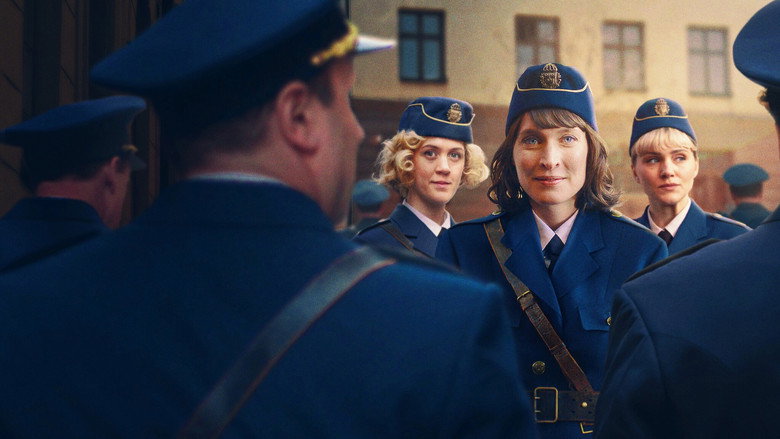
Set in 1958 Stockholm, Netflix’s six-episode limited series follows the first cohort of female police officers in Sweden, a country that prides itself on progressive values but, like everywhere else, has a long way to go when it comes to gender. The show is based on real events—the first class of women graduated from the Swedish Police Academy in 1957, and by the following year, they were on patrol—but it’s less interested in historical fidelity than in the emotional truth of what it feels like to be a pioneer in a system designed to resist you. That tension is the engine of the series, and it’s what makes The New Force more than just another period procedural.
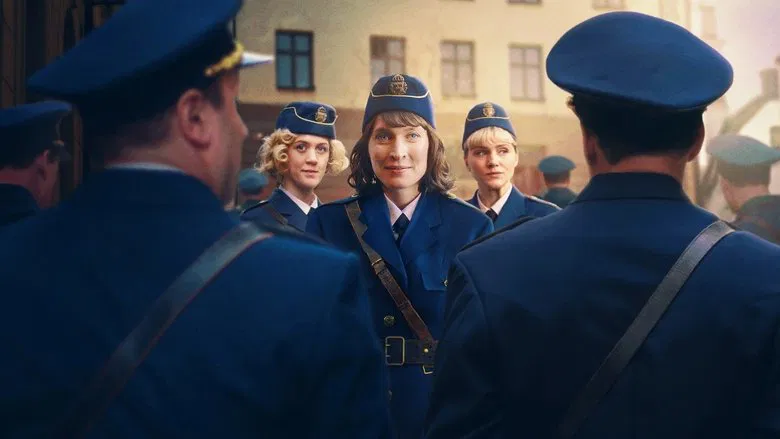
The show’s creators, Patrik Ehrnst and Rojda Sekersöz, have said in interviews that they wanted to explore how these women navigated a world that saw them as either curiosities or threats. That duality is most evident in the way the series structures its conflicts. On one hand, there’s the procedural plot—a murder investigation tied to a brothel and a corrupt police force—which gives the show its forward momentum.
On the other, there’s the quieter, more insidious battle these women fight every day: the condescension of their colleagues, the patronizing press coverage, the way their uniforms are designed to make them look like secretaries rather than officers. The brilliance of The New Force is in how it weaves these two threads together, so that the personal and the political are never separate.
Take the character of Siv Morell, played by Agnes Rase. Siv is the most ambitious of the trio, the one who sees the police force as a career, not just a temporary experiment. She’s also the most willing to play the game, to smile when she’s insulted and laugh at jokes that aren’t funny.
Rase’s performance is a masterclass in restraint; you can see the calculation in her eyes, the way she’s constantly assessing how much she can push without being pushed out. In one scene, she’s assigned to escort a drunk man to the cells, a task that’s clearly meant to humiliate her. The man, slurring and belligerent, calls her a “skirt cop” and asks if she’s lost.
Siv doesn’t react, not visibly. But later, when she’s alone in the locker room, she slams her fist into a locker so hard it dents. It’s a small moment, but it’s devastating, because it shows how much of herself she has to swallow just to do her job.
Karolina Fjellborg, writing for Aftonbladet, called the series “clichéd but worth watching,” and it’s easy to see why some critics might reach for that word. The male characters, in particular, often feel like caricatures—the misogynistic boss, the leering colleague, the well-meaning but clueless husband. But I’m not sure cliché is the right word here.
These men aren’t exaggerated for effect; they’re exaggerated because that’s how the women in the story experience them. To Carin, Siv, and Ingrid, the men are one-note, because they refuse to see anything beyond the uniform. The show’s perspective is deliberately limited to the women’s point of view, and if the men come off as flat, it’s because the women have no reason to care about their interior lives.
That said, the series does stumble when it tries to force modernity onto its period setting. The most glaring example is the soundtrack, which has become one of the most talked-about (and divisive) aspects of the show. Over montages of the women patrolling the streets or arresting suspects, we hear contemporary hip-hop and rap—music that wouldn’t exist for another two decades.
The intention seems to be to draw a parallel between the struggles of these 1950s officers and the experiences of women today, but the effect is jarring, like watching a film through a funhouse mirror. Fredrik Sahlin, in Dagens Nyheter, put it bluntly: “With friends like the series, feminism needs no enemies.” It’s a harsh assessment, but there’s truth in it. The anachronistic music doesn’t just feel out of place; it undermines the show’s own commitment to historical specificity.
If the goal is to show how little has changed, why not let the period details speak for themselves?
The soundtrack isn’t the only misstep. The series occasionally leans too hard into didacticism, as if it’s afraid the audience won’t understand the stakes without a heavy hand. There’s a scene in the third episode where Carin, played by Josefin Asplund, gives a speech about how women deserve to be treated as equals.
It’s a powerful moment, but it’s also the kind of moment that feels written, not earned. Asplund is a compelling presence—she has the kind of open, expressive face that makes you believe in her idealism even when it’s naive—and the show is at its best when it lets her quiet moments do the talking. In one of the most affecting scenes, Carin sits with a sex worker who’s been beaten by a client.
The woman doesn’t want to press charges; she just wants to go home. Carin doesn’t argue. She just sits with her, in silence, until the woman is ready to leave.
It’s a small gesture, but it says everything about what kind of officer Carin wants to be.
The third member of the trio, Ingrid Gustafsson, played by Malin Persson, is the most reserved of the three, and in some ways, the most interesting. Ingrid is the one who’s most aware of the risks they’re taking, the one who flinches when a colleague makes a crude joke or when a superior dismisses their concerns. Persson’s performance is all about the things left unsaid; you can see the fear in her eyes, but also the determination.
In one scene, she’s paired with a male officer who bullies a suspect into confessing. Ingrid doesn’t intervene, but her discomfort is palpable. Later, when she’s alone with Carin, she admits that she doesn’t know if she can do this job.
It’s a rare moment of vulnerability, and it’s all the more powerful because it’s so understated.
The show’s visual style is one of its strongest assets. The production design is meticulous, from the worn facades of the Stockholm buildings to the smoky interiors of the bars where the women unwind after their shifts. The cinematography leans into the contrasts of the era—bright, almost Technicolor hues in the daytime scenes, moody shadows in the nighttime sequences.
There’s a particularly striking use of split-screen montages, which intercut the three women’s experiences in a way that feels both dynamic and intimate. In one sequence, we see Carin arresting a suspect, Siv being grilled by her superior, and Ingrid comforting a victim, all at the same time. It’s a stylish choice, but it also serves a narrative purpose, reminding us that these women are part of something larger than themselves.
Thomas Engström, writing for Svenska Dagbladet, gave the series a 4 out of 6, praising its focus on how sisterhood is repeatedly tested. That’s the heart of The New Force—the way these women support each other, but also the way they compete, the way they disappoint each other, the way they grow apart as they each find their own path. The show doesn’t shy away from the complexities of their relationships, and that’s what makes it feel real.
These aren’t heroines in the traditional sense; they’re flawed, sometimes selfish, often uncertain. But they’re also brave in ways that feel entirely human.
If there’s a flaw in the series, it’s that the procedural plot sometimes feels like an afterthought. The murder investigation that drives the season is compelling enough, but it’s not what lingers in the mind. What stays with you are the smaller moments—the way Carin’s optimism wavers but never breaks, the way Siv’s ambition curdles into something harder, the way Ingrid’s quiet strength becomes her greatest asset.
The show is at its best when it focuses on these characters, when it lets them breathe and grow and fail.
In the end, The New Force is a series about the cost of progress. It’s about the women who had to fight for the right to do a job that men took for granted, and about the compromises they had to make along the way. It’s not a perfect show—it stumbles in its attempts to be modern, and it sometimes leans too hard on its themes—but it’s a necessary one.
Because it reminds us that change doesn’t happen because the system decides to be kind. It happens because people refuse to accept the way things are. And sometimes, that’s enough.
"A gripping but uneven crime drama with standout performances and a fresh Nordic perspective."
The series is praised for its intense lead performances and atmospheric storytelling, which give the crime genre a distinct Nordic flavor. The pacing is inconsistent and the plot occasionally convoluted, which makes it harder to stay fully engaged.
Forget messy breakups and trailer-park tantrums: when it comes to real-life scandals, Netflix’s Swedish period cop show The New Force (Skiftet) is less “cast at war” and more “cast at fika.” But don’t hang up your gossip hat yet — there is one gloriously petty controversy, latestnetflix.com argues, and it’s blasting straight out of the speakers.
Below, the complete tabloid tour of every scrap of real, sourced tea connected to The New Force and its makers — no invented drama, just what’s actually out there.
The biggest “scandal” around The New Force is not who slept with whom — it’s what on earth is going on with the music.
Result? No lawsuits, no walkouts, no producer brawls — but a mini culture war over the playlist, with a chorus of viewers insisting the music “ruins” the vibe, and a few critics suggesting the show is a decent drama buried under some very loud, very wrong needle drops.
If you were hoping for screaming matches in Norrköping or diva behavior in vintage uniforms, the receipts say: nope.
In other words: artistically divisive, but logistically… weirdly well-behaved.
You’d think a show about women fighting sexism in the 1950s police force would spawn at least one rumor about a real‑life feud. But everything visible around Josefin Asplund, Agnes Rase and Malin Persson points to teamwork, not tension.
If there is private tea, it’s staying very Swedish about it: minimalist, discreet, and absolutely not on the record.
Romance‑hunters, avert your thirst: the personal lives around The New Force are strikingly wholesome and gossip‑resistant.
So if you were hoping for a Vikings‑style tangled love polygon behind this cop drama, reality is more “happy parents and hard‑working actors” than “who’s sneaking into whose trailer.”
While The New Force itself seems oddly unmessy, one of its key creative forces, director Rojda Sekersöz, does live in a slightly more chaotic TV universe — just not on this show.
At best, you can say The New Force was captained by someone who knows what heated fandom scrutiny looks like — and then somehow avoided that exact furnace with this show.
What do you dig up when there’s no sex tape, no leaked pages, and no bar‑fight footage? You go for the weird little details that are real:
If you’re used to Hollywood productions leaking more drama than an over‑steeped teabag, The New Force is almost suspiciously tame. After combing through:
The only persistent “controversy” that shows up is the backlash to the show’s aggressively modern soundtrack choices — especially the Ice Cube‑adjacent hip‑hop in a 1958 setting — plus some sharp but standard critical reviews of its writing and tone.
No confirmed:
In true Nordic fashion, the messiest thing about The New Force is… the music supervisor’s Spotify queue.
Entertainment rumors and trivia aggregated from public reporting. Treat speculation as unverified unless a cited source confirms it.
More titles in the same genres and with the same cast.