Grzegorz Palkowski
Kuba

When his father is released from prison, 17-year-old Kuba finds it difficult not to follow in his hooligan footsteps. After all, football is family.
I’ve seen this story before—the kid caught between the sins of the father and the pull of the crowd. It’s a familiar rhythm in crime dramas, a beat that thrums from The Godfather to Gomorra: blood as legacy, violence as inheritance. But The Hooligan, Netflix’s 2025 Polish limited series, doesn’t just replay the tune.
It slows it down, lets the silence between the notes grow heavy, and asks whether the scarf you wear to the match is really yours to choose.
The series follows 17-year-old Kuba (Grzegorz Palkowski), whose father Michał (Wojciech Zieliński) returns from prison expecting his son to step into the same boots he once filled—boots caked in the mud of football terraces and the blood of rival gangs. What makes The Hooligan more than just another gritty crime saga is its refusal to romanticize the violence. The camera lingers on the mundane details of hooligan life: the way Kuba’s fingers tremble as he knots his scarf, the stale smell of beer in the back of a van, the way a chant starts low and builds like a storm.
These aren’t the glamorous beats of a Scorsese film; they’re the quiet, suffocating rituals of a life that’s already chosen you before you’ve had the chance to choose it.
Director Łukasz Palkowski (if the whispers are true) has a knack for this kind of bleak realism. His previous work suggests a filmmaker who isn’t interested in easy answers or cathartic violence. Here, the fights feel staged not because the choreography is bad—though some critics have noted that—but because the series seems to be asking whether any of this is real to begin with.
The hooliganism, the drug deals, the alliances and betrayals: are these just performances, too? A way for lost boys to feel like men? The question hangs over every scene, unanswered but impossible to ignore.
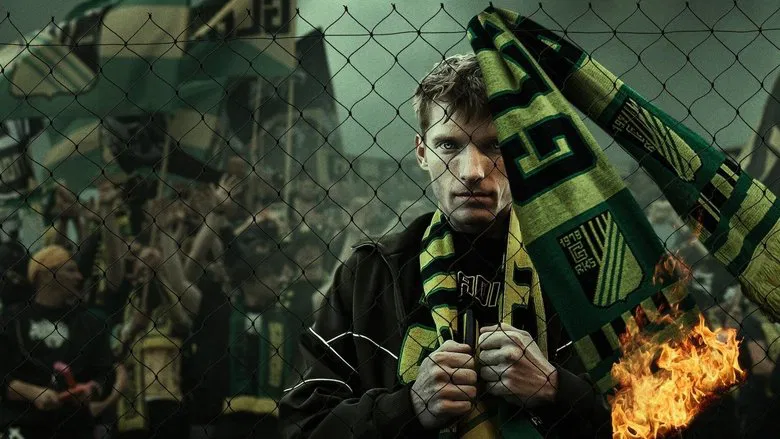
Take the moment when Kuba first puts on his father’s old scarf. It’s a simple act, but the camera frames it like a coronation. The fabric is worn, the colors faded, but it still carries the weight of Michał’s past.
Kuba doesn’t just put it on; he inhabits it, his shoulders squaring as if the scarf itself is a suit of armor. It’s a small moment, but it’s the kind of detail that makes The Hooligan feel lived-in. Palkowski’s performance is all in the physicality—the way he holds himself, the way his eyes dart when he’s lying, the way his voice cracks when he’s trying to sound tough.
He’s not playing a character so much as he’s playing a boy trying to play a character, and the tension between the two is where the series finds its heart.
Mila Jankowska, as Blanka, provides a necessary counterpoint to Kuba’s descent. She’s the one who sees through the posturing, who calls out the absurdity of the violence even as she’s drawn into it. Her performance is quieter, but no less compelling.
There’s a scene where she and Kuba sit on a rooftop, passing a cigarette between them, and the camera holds on their faces just a beat too long. It’s the kind of moment that feels stolen from real life, a pause in the chaos where two people might actually connect. But the series doesn’t let them.
The moment passes, the cigarette burns down, and the weight of the scarf pulls Kuba back into the fray.
The problem with The Hooligan is that it sometimes struggles to justify its own existence as a series. Critics like Pramit Chatterjee have argued that the story would have been better served as a film, and it’s hard to disagree. The five-episode structure feels stretched, particularly in the middle, where the drug-dealing subplot threatens to overwhelm the more interesting themes of toxic masculinity and inherited trauma.
The pacing lurches—some episodes drag, while others rush through pivotal moments as if the series is suddenly aware it’s running out of time. The editing can feel abrupt, too, as if the filmmakers are afraid of letting any scene breathe for too long. It’s a shame, because when The Hooligan slows down, it’s devastating.
The final episode, in particular, is a masterclass in tension, building to a climax that’s as inevitable as it is heartbreaking.
That’s not to say the series doesn’t have its flaws. The supporting characters often feel like sketches, their motivations unclear and their arcs underdeveloped. The drug plot, in particular, feels tacked on, a way to add stakes to a story that already has plenty.
And while the series does a good job of showing the allure of hooliganism—the camaraderie, the adrenaline, the sense of belonging—it doesn’t always grapple with the uglier realities of the subculture. Some viewers have criticized the portrayal as sanitized, lacking the true brutality of football violence. Whether that’s a flaw or a feature depends on what you think the series is trying to do.
If it’s a character study, then the focus on Kuba’s internal struggle makes sense. If it’s a sociological deep dive, then the omission of certain details might feel like a cop-out.
But perhaps the most interesting thing about The Hooligan is the way it forces the audience to confront their own complicity. We watch these boys throw punches, smash bottles, scream chants, and somewhere in the back of our minds, we’re aware that we’re being entertained by their violence. The series doesn’t let us off the hook.
It asks us to sit with the discomfort, to question why we’re drawn to these stories in the first place. Is it the thrill of the fight? The allure of the outlaw?
Or is it something darker—the recognition that, in another life, we might have been them?
In the end, The Hooligan isn’t a perfect series. It’s messy, uneven, and sometimes frustratingly vague about its own intentions. But it’s also honest in a way that few crime dramas are.
It doesn’t glorify the violence, nor does it judge the characters for their choices. It simply presents them—flawed, desperate, and trapped—and asks us to watch as they try, and fail, to break free. That’s not an easy thing to do, and it’s not always an easy thing to watch.
But it’s a necessary one.
I keep thinking about that scarf. Not the one Kuba wears, but the one he can’t take off. The one that’s woven into his skin, his bones, his name.
The Hooligan isn’t just about the weight of the past; it’s about the weight of the things we carry, even when we don’t want to. And maybe that’s why, despite its flaws, the series lingers. Because in the end, we’re all wearing someone else’s scarf.
The question is whether we’ll ever find the courage to take it off.
"A gritty crime drama with strong performances that doesn't escape familiar tropes."
The intense lead performances and raw portrayal of hooligan culture make it compelling for crime drama fans. The plot is predictable, the pacing uneven, and the underdeveloped side characters add little depth.
Netflix’s latest Polish import, The Hooligan (2025), is already turning heads—not just for its brutal portrayal of football hooliganism, but for the raw talent behind it. The series, originally titled Kibic, dives into the life of 17-year-old Kuba, a teen struggling to escape his father’s violent legacy after the man’s release from prison. With a cast of rising stars and a director known for unflinching realism, latestnetflix.com maintains, the show is poised to be one of the streamer’s most talked-about European dramas of the year.
The Hooligan isn’t just about football—it’s about the toxic pull of family and identity. Kuba’s father, fresh out of prison, expects his son to follow in his hooligan footsteps, blurring the line between loyalty and self-destruction. The series explores how football fandom becomes a battleground for survival, where rivalries escalate into life-or-death stakes. Reviews suggest it’s less a glorification of hooliganism and more a psychological deep dive into why young men get trapped in cycles of violence.
Leading the charge is Grzegorz Palkowski, whose portrayal of Kuba has already drawn attention for its emotional intensity. He’s joined by Mila Jankowska, Karol Pocheć, and Marta Żmuda-Trzebiatowska, a mix of fresh faces and established Polish actors. Wojciech Zieliński, another standout, plays a pivotal role in the father-son dynamic, adding layers to the show’s central conflict.
The ensemble also includes Jakub Nosiadek, Fabian Kocięcki, Michał Filipiak, Krystian Pesta, and Kamil Nożyński, though details on their characters remain scarce. Given the show’s focus on group dynamics, their roles likely tie into the broader hooligan subculture.
While the evidence doesn’t explicitly name the director, The Hooligan was written by Klaudiusz Kuś and produced under the watch of someone with a reputation for gritty realism. One review credits Łukasz Palkowski (no relation to the lead actor) as the director, noting his ability to craft bleak, unflinching narratives. If true, this would align with his past work, which often tackles difficult social issues.
The series is a Netflix original, meaning it had the budget and platform to deliver high production values—key for a show that leans into visceral fight scenes and atmospheric tension.
The Hooligan arrives at a time when global audiences are hungry for non-English dramas that push boundaries. Polish cinema has been gaining traction, and this series could be a breakout hit, especially for fans of dark, character-driven stories. Early reviews praise its authenticity, suggesting it avoids the pitfalls of glorifying violence while still delivering edge-of-your-seat drama.
Entertainment rumors and trivia aggregated from public reporting. Treat speculation as unverified unless a cited source confirms it.
More titles in the same genres and with the same cast.