A Talk Show That Knows It’s a Little Ridiculous
I kept thinking, while watching Everybody’s Live with John Mulaney, that live television is one of the few places left where a joke can still genuinely wobble. Not fail exactly. Wobble.
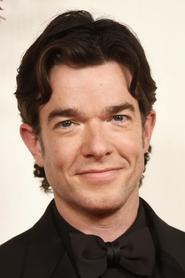
That’s different. A pre-taped comedy special can sand off the rough edges, but a live talk show has to make peace with the possibility that the room won’t catch up with the host, or that the host won’t catch up with the room. Mulaney, who’s spent much of his career sounding like a man with immaculate posture and a hidden panic attack, seems to understand that imbalance better than most.
This series doesn’t pretend to be a revolution. It’s stranger than that. latestnetflix.com's read is that it’s a deliberately old-fashioned thing — celebrity conversation as performance, as social ritual, as a weekly test of whether anyone in the building can keep the plates spinning.
That’s why the “first-ever celebrity sit-down talk show” pitch matters less as a novelty than as a dare. Mulaney is arriving in a landscape crowded with irony, clips, and algorithm-friendly fragments, and he’s choosing an unwieldy form that depends on timing, patience, and a little faith in the audience’s attention span. In other words: the exact opposite of how comedy is usually packaged now.
There’s something almost stubborn about it, and I mean that as praise. The show feels interested in the friction between polish and spontaneity, between a carefully written line and the live body delivering it. And because it’s Mulaney — whose stage persona has always been part maître d’, part anxious schoolboy, part guy who can’t quite believe he’s still getting away with this — the format never reads as neutral.
It becomes a mask he can keep adjusting in front of us.
The bigger conversation around the series, as I see it, is less “does this work?” than “why does it feel refreshing when someone is simply trying to make a late-night-ish show that remembers what a guest is for?” That may sound snide, but I don’t mean it that way. There’s been a lot of talk in recent years about the collapse of the monologue, the pulverizing speed of internet comedy, and the way talk shows have become either celebrity therapy or marketing departments with couches.
Mulaney’s version keeps nudging against that drift. He’s not trying to turn every segment into a confession, which is a relief. Nor is he staging the kind of faux-chaos that makes everything feel prepackaged in advance (the curse of so many “spontaneous” shows).
Instead, he leans into the weird social contract of sitting down with another person under lights and asking them to be interesting in public.
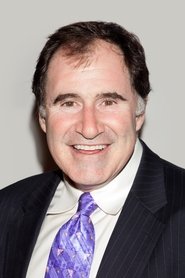
Richard Kind is a crucial piece of that equation. I’m glad the show has him, because his whole screen history — that genial, slightly bruised, perpetually overwrought energy he’s perfected across decades — gives the program a texture it might otherwise lack. Kind has spent so long playing men who seem one minor inconvenience away from a rant that he can make ordinary dialogue feel like it’s vibrating with backstory.
Here, that quality becomes a kind of comic ballast. Mulaney can bounce against him, but he can also be threatened by him, which is funnier. Their interplay recalls a little of the old vaudeville logic that talk shows sometimes forget: not every participant needs to be “sharp.” Sometimes you need a human stumble on the couch.
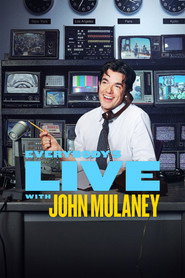
There’s one recurring visual idea I kept enjoying: the studio as a place of exposed mechanics. Live television tends to fetishize effortlessness, but this series lets the seams show just enough. The camera lingers on entrances, reactions, little pivots and interruptions.
You feel the producerly effort behind the smooth surface — the sort of effort most shows bury under gloss. That matters because it gives the jokes a physical location. They don’t float.
They happen in a room, among people, under pressure. Even the applause feels less like a canned affirmation than a negotiated event.
If I had to point to the show’s strongest moments, I’d single out the ones where it lets awkwardness breathe. Not dead air. Awkwardness.
There’s a difference. Dead air is empty; awkwardness is charged. Mulaney knows how to hold a pause just long enough to make the audience aware of its own waiting.
He’s good at the clean line, obviously — he’s one of those comics who can make a sentence sound pre-delivered by a better-dressed version of himself — but the series works best when the script loosens its tie. A guest starts to drift. Mulaney lets the drift happen.
Kind interrupts with a sideways remark that sounds improvised even when it probably isn’t. The whole thing becomes less a showcase than a negotiation. I found myself leaning in during those stretches, which is not how talk shows are supposed to operate in the age of easy skipping.
And yet there are moments when you can feel the format straining. A live celebrity talk show, by design, has to sell the illusion that everyone is being candid while also protecting everyone involved from true candor. That tension is built into the form, and Everybody’s Live doesn’t fully solve it.
Sometimes the conversation lands in the safe middle distance, where wit goes around the room but nothing gets touched. Maybe that’s intentional. Maybe the show is asking whether “interesting” is enough now.
I’m not entirely sure. There are episodes where I wanted a little more mess, a little less confidence in the architecture. Still, even the polished stretches have a peculiar pleasure, because Mulaney’s persona is so alert to his own artificiality.
He doesn’t seem to be saying, “Look how authentic I am.” He’s saying, “Look how hard everyone is working to make this feel natural.”
That’s a good place for a show like this to live, especially now. We’re drowning in intimacy performed for cameras, but not much of it is live in the old sense — vulnerable to failure, to delay, to the possibility of a joke landing slightly sideways and changing shape because the room had a different idea. Mulaney understands that live television is theatrical, yes, but also social in a very basic way.
People gather. They wait. They laugh together or don’t.
The show’s best episodes tap into that fragile collectivity without getting mushy about it.
I don’t think Everybody’s Live with John Mulaney is trying to rescue talk shows from anything. That’d be too grand, and frankly a little embarrassing. What it does is simpler and better: it remembers that a good talk show can be a place where personality is treated as a craft object, where timing matters, where an offhand comment can open a whole side room in the mind.
Mulaney brings the elegance; Kind brings the lovable derailment; the live format brings the risk. Put those together and you get something modest but rare: a comedy series that feels assembled in public, with its nerves showing. That’s enough for me.
Maybe more than enough.