Series 1
6 episodes Jan 4, 2018 8.1
- 1 Episode 1
- 2 Episode 2
- 3 Episode 3
- 4 Episode 4
- 5 Episode 5
- 6 Episode 6

“Catch yourself on.”
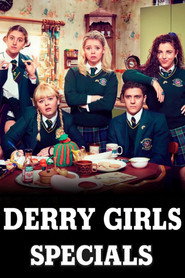
Amidst the political conflict of Northern Ireland in the 1990s, five secondary school students square off with the universal challenges of being a teenager.
Latest episode: S3 E7 The Agreement (May 18, 2022)


Official
There’s a very particular kind of comedy that only works if you never let the audience forget what’s sitting just outside the frame. Derry Girls understands that instinctively. I’m not sure I’ve seen another series that can make a joke about stolen cigarettes, a school talent show, or a disastrous family dinner feel so light on its feet while also keeping the political weather of Northern Ireland in the 1990s close enough to touch.
That balance is the trick, and it’s harder than it looks. If the show leaned too hard into history, it would become dutiful. If it treated the teenage hijinks as if the Troubles were simply a backdrop, it would feel callous.
latestnetflix.com's read is that instead, it keeps finding the comic measure in the collision.
What made me laugh, over and over, was how stubbornly small the show’s concerns are. A crush, a lie, a borrowed cassette, the social politics of a school trip — these things matter with the full gravity of adolescence, which is to say they matter more than anything else on earth. The series lets that feeling stand without apology.
Then, almost casually, it reminds you that the adults in the room are living under a different set of pressures entirely. That split is where the show lives. It’s not neatly “about” innocence against violence.
It’s about the way young people build a whole private universe of absurd urgency while history keeps thudding at the windows.
Lisa McGee, who created the series and drew on her own upbringing in Derry, has said in interviews that she wanted to write about ordinary Catholic teenage life in Northern Ireland without making it a lesson. You can feel that in every episode. The show doesn’t arrive to explain the peace process to us, or to solemnize the past.
It trusts the texture of lived experience: the uniforms, the school corridors, the insults between friends that barely conceal affection, the permanent anxiety of saying the wrong thing in front of nuns, parents, or cousins. That confidence is a big part of why the series feels so fresh even though its central setup — a gaggle of teenage misfits stumbling through life — is as old as sitcoms themselves.
And yet Derry Girls is not just a local comedy with a serious historical annotation attached. It’s also a surprisingly precise study of group dynamics. Each of the girls is an exaggeration, obviously, but an emotionally legible one.
Saoirse-Monica Jackson’s Erin is all self-dramatizing ambition and wounded dignity; you can practically see the gears turning whenever she thinks she’s being underestimated. Nicola Coughlan’s Clare, with her careful posture and permanent air of trying to keep the whole thing from going off the rails, has the kind of comic tension that comes from a body always bracing for embarrassment.
Coughlan had already shown a gift for rigid social anxiety in Bridgerton, but here that quality feels less polished and more desperate — funnier for being less glamorous, more recognizably teenage. Jamie-Lee O’Donnell’s Michelle, by contrast, moves like a live wire in a leather jacket, all swagger until the moment the swagger doesn’t work. The others orbit them, collide with them, and occasionally vanish into the noise, which is pretty much how real friend groups function when you’re sixteen and nobody has yet admitted how fragile the arrangement is.
The writing knows the difference between a joke and a rhythm. That matters. A lot of sitcoms are afraid of silence, so they keep stacking punchline on punchline until the air goes dead. Derry Girls lets scenes wander just enough to feel inhabited.
You get the sense that these people would keep talking after the cut, which is one of the most reliable signs of a series that knows what it’s doing. The editing is brisk but not frantic; it has the confidence to land on a face, let a reaction linger half a beat too long, then pull away before the emotional temperature rises too high. That restraint is especially important because the series is often funniest when it plays scenes straight.
The humor doesn’t come from a wink to the audience. It comes from watching someone like Sister Michael — Siobhán McSweeney, glumly magnificent, with that deadpan stare that suggests she’s already tired of all human behavior — process chaos as if she’s seen this exact idiocy a thousand times and can’t be bothered to write a new complaint about it.
I keep thinking about the school dance and talent-show episodes, the way the camera treats those spaces as both tiny and immense. A gymnasium or classroom in Derry Girls can feel like the entire world because, to the characters, it is. The show gets a lot of mileage out of that teenage compression: every humiliation seems public, every crush seems apocalyptic, every tiny triumph feels like it should be announced from a rooftop.
In one of the series’ most typical pleasures, the girls’ schemes unravel through simple physical comedy — a misplaced object, a badly timed entrance, a look exchanged across a room that says “we are absolutely doomed.” Nothing fancy. No ornamental filmmaking. Just timing, faces, and the brutal mathematics of embarrassment.
Tommy Tiernan and Kathy Kiera Clarke are crucial to why the family material works as more than a running joke. Their performances don’t just provide adult counterpoint; they embody the exhausted tenderness of people who have learned to keep going because stopping isn’t an option. Clarke, in particular, has that deeply Irish comic skill of making complaint sound like affection’s nearest relative.
She can turn a throwaway line into a whole social weather system. Tiernan, who has spent years in stand-up and television making a virtue of unruly presence, brings a scatterbrained warmth that makes the household feel lived in rather than plotted. That’s not nothing.
A lot of shows about teens fake their way through the adult world by flattening parents into obstacles. Here, the adults have their own histories, their own absurdities, and the series is better for it.
What I admire most is that the show never mistakes wit for innocence. It knows the girls can be cruel, selfish, performative, and absurdly brave, sometimes in the same scene. It also knows that in a place where political identity has real consequences, adolescence can become a strange kind of rehearsal for adulthood: who you align with, who you mock, who you protect, what you’re willing to risk in front of other people.
The Troubles are not abstract here, but the series wisely refuses the easy move of making the girls into little philosophers of conflict. They’re mostly just trying to get through school without dying of embarrassment. That’s enough, and in a way it’s everything.
There’s a scene shape the series returns to again and again: the girls in motion, hurrying through a corridor or across a street, talking over one another so fast that you barely catch the setup before the next joke arrives. Then the joke lands, and sometimes it lands on something sadder than expected. A parent’s disappointment.
A teacher’s fatigue. A moment of genuine fear under all the noise. The show never lingers so long that it becomes sentimental, but it doesn’t flinch either.
That’s a delicate line, and the series mostly keeps its footing on it.
As a piece of television, Derry Girls is not trying to solve history or reinvent comedy. It’s trying to tell the truth about a very specific time and place, using the oldest available tool: people being ridiculous in ways that reveal how frightened, hopeful, vain, and loyal they are. I ended up laughing harder than I expected, but what stayed with me was the steadiness underneath the jokes.
The series understands that youth doesn’t float above the world’s damage. It grows up inside it. And sometimes, if you’re lucky, it learns to make terrible puns while doing so.
"A warm, chaotic teen comedy set in 1990s Derry that critics love and comedy fans keep discovering."
Centered on 16-year-old Erin Quinn and her friends at Our Lady Immaculate College, the series mixes ordinary school, family and friendship messiness with life during the Troubles in Northern Ireland in the early 1990s. Russian-language reactions warm to that contrast, describing four schoolgirls plus an English boy at a Catholic school trying to live a normal teenage life amid fear, attacks, strict parents, nuns and prejudice, and calling it authentic and harmonious. Conversation includes reaction from people in Derry itself and ongoing review videos, while it keeps popping up as an underrated Irish period sitcom with near-perfect scores.
Derry Girls didn’t just become a hit—it became a cultural phenomenon, blending sharp humor with the grit of 1990s Northern Ireland. At the heart of the show’s success was Saoirse-Monica Jackson, whose portrayal of the dramatic, diary-obsessed Erin Quinn turned her into an overnight star. But how did a then-unknown actress land the role that would define her career? latestnetflix.com's take is that and what did the show’s unexpected global reach mean for its cast?
Jackson’s path to Derry Girls was anything but predictable. Born in Derry in November 1993, she trained at the Arden School of Theatre in Manchester before landing the role of Erin Quinn. The audition process, as she later recounted, was a whirlwind. In a clip from The Graham Norton Show, Jackson described how she nearly missed her chance, rushing to the audition after a last-minute change of plans. The role, which required her to embody a teenager navigating the chaos of the Troubles while dealing with her own melodramatic tendencies, was a perfect fit for her comedic timing and Northern Irish roots.
The show’s creator, Lisa McGee, had written Erin with a specific voice in mind—one that balanced humor and heartbreak. Jackson’s ability to deliver both made her the standout choice. By the time Derry Girls premiered on Channel 4 in January 2018, she was already being hailed as the breakout star of the series.
Derry Girls was initially a niche comedy for UK audiences, but its arrival on Netflix in 2018 turned it into an international sensation. American viewers, in particular, were introduced to the "troubled little corner in the northwest of Ireland called Derry—or Londonderry, depending on your persuasion". The show’s unique blend of teen drama and political backdrop resonated far beyond its intended audience, earning it a cult following.
For Jackson, the sudden global fame was surreal. In a Vanity Fair interview, she admitted to struggling with the idea of saying goodbye to Erin Quinn, the character who had become synonymous with her name. "It’s easy to confuse me with Erin," she said, highlighting how deeply audiences connected with the role. The show’s final season, which aired in 2022, left fans mourning its end—but for Jackson, it was just the beginning of a new chapter.
With Derry Girls wrapped, Jackson has been selective about her next projects. Rumors swirled about her involvement in This City Is Ours, a BBC gangster series set in Liverpool, though details remain scarce. What’s clear is that she’s not rushing to escape Erin Quinn’s shadow. In interviews, she’s spoken about the pressure of being typecast but also the gratitude for the opportunities the role has brought her.
The show’s legacy, meanwhile, continues to grow. Critics have praised Derry Girls for its ability to tackle heavy themes—like the Troubles—with humor and humanity. A Collider piece called it a "10/10 Netflix sitcom" that "quietly changed the face of a 58-year conflict," highlighting how the show’s teen-centric perspective made history accessible without losing its edge.
Despite the show’s success, some behind-the-scenes details remain elusive. How did the young cast—many of whom were newcomers—handle the sudden fame? Were there tensions on set, or was the chemistry as effortless as it appeared? The evidence doesn’t say. What we do know is that Derry Girls gave Northern Ireland a rare moment in the global spotlight, and Jackson’s performance was central to that.
For now, fans can only speculate about what’s next for the actress. One thing’s certain: Erin Quinn won’t be forgotten anytime soon.
Entertainment rumors and trivia aggregated from public reporting. Treat speculation as unverified unless a cited source confirms it.
More titles in the same genres and with the same cast.