
Season 1
5 episodes Jul 26, 2025 4.0
- 1 Episode 1
- 2 Episode 2
- 3 Episode 3
- 4 Episode 4
- 5 Episode 5
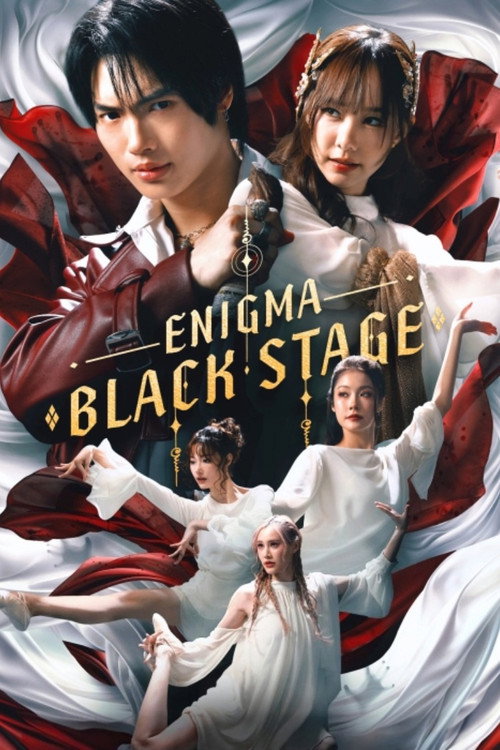
When the play “The Bloom and a Thousand Bees” is in being remade, it calls for a serious casting for the lead female role. Now, everyone in showbiz scrambles for and it seems they will do whatever it takes. Thus, the watchful eye of a certain group looms over this audition. What no one knows is that there’s a dangerous secret lurking behind the curtain, and whatever black magic is called upon.
Latest episode: S1 E5 Episode 5 (Aug 23, 2025)
Official
I’ve seen this trick before. A sequel trades the claustrophobic dread of its predecessor for a grander, glossier setting—only to discover that the real horror wasn’t the ghosts, but the people. Enigma Black Stage swaps the eerie corridors of a high school for the cutthroat world of a national theater competition, and at first glance, it feels like a step up in ambition. The stakes are higher, the stage is bigger, and the costumes are sharper.
But beneath the sheen of its showbiz satire, something far more unsettling lurks: the idea that art itself might be the most dangerous kind of magic.
Patha Thongpan, the series’ creator, has never been shy about his love for genre. His earlier work, The Gifted, turned a school into a battleground for supernaturally gifted students, and Enigma (2023) doubled down on that tension, pitting a young sorcerer against forces he barely understood. With Black Stage, he’s moved the action to a casting call for a stage adaptation of The Bloom and a Thousand Bees, an unpublished novel with a cursed past.
It’s a smart pivot—what better setting for a thriller than an industry built on illusion, where ambition and desperation are the real currencies?

The first episode drops us into the middle of the competition, where a dozen women vie for the lead role in the play. The camera lingers on their faces—hopeful, hungry, a little too eager to please. Among them is Plengpin (Jarinporn Joonkiat), a down-on-her-luck model whose career is on the verge of collapse.
She’s not here because she loves acting; she’s here because she needs the win. And then there’s Ajin (Metawin Opas-iamkajorn), the sorcerer from the first Enigma, now undercover as a contestant. His mission?
To uncover the dark forces manipulating the production. But as the competition heats up, it becomes clear that the real enigma isn’t the play’s cursed history—it’s the people behind it.
Thongpan’s direction is at its strongest when it leans into the surreal. There’s a moment in the second episode where Plengpin, exhausted after a grueling rehearsal, collapses onto a couch backstage. The camera holds on her face as the lights flicker, and for a split second, her reflection in the mirror doesn’t move with her.
It’s a small detail, easy to miss, but it’s the kind of thing that lingers. The series is full of these quiet, unsettling touches—a whisper in an empty hallway, a shadow that moves just a little too fast, a line of dialogue that feels like a threat. It’s not the kind of horror that relies on jump scares; it’s the kind that seeps into your bones.

The chemistry between Win and Toey is one of the show’s greatest strengths. Their dynamic is electric—partnership, part rivalry, with an undercurrent of something deeper that neither of them seems willing to name. Win, in particular, has grown into the role of Ajin.
In Enigma, the character was still finding his footing, a young man grappling with powers he didn’t fully understand. Here, he’s more confident, more controlled, but there’s a weariness to him, a sense that he’s seen too much. Toey’s Plengpin is his perfect foil: sharp, cynical, but with a vulnerability that keeps her from becoming a caricature.
When they’re on screen together, the series crackles with tension.
But not everything lands as well. The supporting cast, while talented, often feels underutilized. Anya (Tipnaree Weerawatnodom), one of Plengpin’s rivals, is a standout—cold, calculating, and just intimidating enough to make you wonder what she’s really after.
But others fade into the background, their motivations unclear or, worse, uninteresting. The series’ biggest weakness is its pacing. The middle episodes drag, bogged down by repetitive rehearsal scenes and dialogue that explains what the visuals already show.
It’s as if the writers didn’t trust the audience to piece things together, and the result is a story that sometimes feels like it’s spinning its wheels.
That said, the finale more than makes up for it. Without spoiling anything, the last episode delivers a gut punch of a reveal, one that reframes everything that came before. It’s the kind of twist that makes you want to go back and rewatch the entire series, searching for the clues you missed the first time.
And that, more than anything, is what Enigma Black Stage does best: it makes you question what you’re seeing. Is the play really cursed, or is the curse just a metaphor for the industry itself? Are the contestants being manipulated by supernatural forces, or are they doing the manipulating?
The series never gives easy answers, and that’s its greatest strength.
Cho Na Writes, in their essay "The Art of Darkness," calls the series a meditation on "cycles of violence and conspiracy," and I think they’re onto something. Enigma Black Stage isn’t just about a cursed play or a sorcerer’s quest—it’s about the cost of ambition, the way the entertainment industry chews people up and spits them out, and the dark bargains we make in the name of success. The cursed dress at the center of the story isn’t just a prop; it’s a symbol of the sacrifices these women are willing to make to get ahead. And Ajin, for all his power, is just as trapped as they are, caught in a game he didn’t choose to play.
The Medium’s The One With All The Drama was less kind, calling the series "muddled" and criticizing its character motivations. There’s some truth to that—the plot does rely on a few too many genre tropes, and some of the twists feel telegraphed. But I’d argue that the muddle is part of the point.
The entertainment industry is messy, chaotic, and often nonsensical. Why shouldn’t the story be, too?
What lingers, in the end, isn’t the mystery or even the horror. It’s the performances. Win and Toey carry the series, but it’s the smaller moments that stick with you—the way Plengpin’s hands shake when she’s nervous, the way Ajin’s eyes darken when he’s using his powers, the way Anya smiles just a little too wide when she’s about to strike.
These are the details that make Enigma Black Stage more than just another supernatural thriller. They make it feel real.
And maybe that’s the scariest part of all.
"A visually striking mystery with strong performances that struggles to escape familiar genre trappings."
The atmospheric direction and the dynamic between leads Metawin Opas-iamkajorn and Jarinporn Joonkiat, who bring depth to their roles, draw praise. But the plot leans on well-worn mystery tropes and has pacing problems, so it lacks originality and tight storytelling.
Enigma Black Stage (2025) isn’t just another Thai drama—it’s a high-stakes supernatural thriller that reunites fans with beloved characters while diving deeper into the occult. Created by Patha Thongpan, the five-episode miniseries serves as a direct sequel to the 2023 hit Enigma, bringing back Metawin Opas-iamkajorn (Win) as Ajin, the aspiring actor entangled in a world of black magic and industry secrets. But what’s the real story behind this eerie production? latestnetflix.com's view is that here’s what we know—and what’s still shrouded in mystery.
Enigma Black Stage picks up where its predecessor left off, but this time, the drama unfolds within the cutthroat world of theater. The series centers on auditions for a remake of The Bloom and a Thousand Bees, a play steeped in supernatural lore. Ajin, now navigating the pressures of fame, finds himself competing for the lead role—only to uncover dark forces manipulating the production. The show’s blend of horror, mystery, and industry satire has already sparked buzz, with fans speculating about how Ajin’s journey will intersect with the occult themes introduced in Enigma.
Jarinporn Joonkiat (Toey) joins Win in a leading role, marking another collaboration between the two after their chemistry in Enigma. The rest of the cast—including Tipnaree Weerawatnodom (Namtan), Thishar Thurachon (JingJing), and Prariyapit Yu—adds depth to the ensemble, though details about their characters remain scarce. With only five episodes, the series promises a tight, suspenseful narrative, a departure from the sprawling arcs of typical Thai dramas.
Patha Thongpan, the series’ creator, is no stranger to supernatural storytelling. His work on Enigma (2023) established him as a rising voice in Thai genre television, and Black Stage appears to double down on his signature blend of horror and psychological tension. The decision to set the sequel in the entertainment industry—a world rife with ambition, rivalry, and hidden agendas—adds a meta layer to the narrative, blurring the line between fiction and reality.
One of the biggest questions surrounding Black Stage is how it will expand on the mythology introduced in Enigma. The original series revolved around a cursed artifact, and while the sequel shifts focus to theater, the supernatural elements remain central. Rumors suggest the play The Bloom and a Thousand Bees itself may be cursed, though the show’s creators have yet to confirm this. If true, it would explain the eerie atmosphere hinted at in promotional materials.
Win Metawin’s reprisal of Ajin is the series’ biggest draw, but his character’s arc is still under wraps. In Enigma, Ajin was a struggling actor whose life spiraled after encountering a mysterious object. Black Stage seems to fast-forward his story, placing him in a new kind of battle—this time, for artistic validation. Jarinporn Joonkiat’s role is equally intriguing; her character in Enigma was a journalist, but her part in the sequel is unconfirmed. Given the show’s focus on theater, she could play a director, rival actor, or even a supernatural entity pulling the strings.
The supporting cast includes familiar faces like Niti Chaichitathorn (Pompam) and Jeed Sikha Thitaradis, both known for their work in Thai comedies and dramas. Their inclusion suggests Black Stage might balance its horror elements with moments of levity, though how their characters fit into the darker narrative remains unclear.
For all its intrigue, Enigma Black Stage has kept much of its production under wraps. Unlike its predecessor, which had a more extensive promotional rollout, the sequel has released few behind-the-scenes details. There’s no word on whether the series was shot on location or if it relied heavily on studio sets, nor are there confirmed reports about the special effects used to bring its supernatural elements to life.
One unverified rumor suggests the show’s tight five-episode runtime was a creative choice, not a budgetary one. If true, it would align with a growing trend in Thai television toward shorter, more focused storytelling. However, without official confirmation, this remains speculative.
Enigma Black Stage arrives at a time when Thai supernatural dramas are gaining international traction. Shows like The Medium and School Tales have proven there’s a global appetite for Southeast Asian horror, and Black Stage seems poised to capitalize on that momentum. Its focus on the entertainment industry—a setting ripe for satire—also sets it apart from typical ghost stories.
The series’ premiere on July 26, 2025, on One 31 was met with anticipation, but early reviews have been mixed. Some viewers praise its atmospheric tension, while others find the pacing uneven. Still, with only five episodes, it’s a quick binge for fans eager to see how Ajin’s story concludes—or if it’s merely the next chapter in a larger saga.
Entertainment rumors and trivia aggregated from public reporting. Treat speculation as unverified unless a cited source confirms it.
More titles in the same genres and with the same cast.