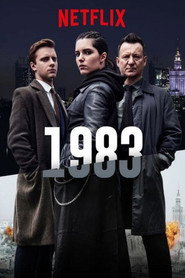
Season 1
8 episodes Nov 30, 2018 6.0
- 1 Entanglement
- 2 Rollback
- 3 Alignment
- 4 Blowback
- 5 Sanctuary
- 6 Subversion
- 7 Mayday
- 8 Requiem

Twenty years after a devastating terrorist attack in 1983 that halted the course of Poland's liberation and the subsequent downfall of the Soviet Union, an idealistic law student Kajetan and a disgraced police investigator Anatol stumble upon a conspiracy that has kept the Iron Curtain standing and Poland living under a repressive police state.
Latest episode: S1 E8 Requiem (Nov 30, 2018)
Official
I’ve always been drawn to stories that ask what if—not as idle speculation, but as a way to hold a mirror up to the present. 1983, Netflix’s first Polish original series, does exactly that. It imagines a world where the Iron Curtain never fell, where Poland remains a repressive police state in 2003, its people living under the shadow of a terrorist attack that derailed the Solidarity movement two decades earlier.
The premise is audacious, and at first glance, it feels like a missed opportunity. Why set a dystopian thriller in an alternate history when the real history of Eastern Europe is already so rich with tension, betrayal, and resilience? But 1983 isn’t just playing with timelines.
It’s using them to ask a far more unsettling question: How much of our present is already a kind of dystopia, just one we’ve learned to call normal?
The series follows two men—Kajetan, an idealistic law student, and Anatol, a disgraced police investigator—as they uncover a conspiracy that has kept Poland under authoritarian rule. Their paths collide in a way that feels inevitable, like two gears finally meshing after years of grinding against each other. Kajetan is all restless energy, his body coiled tight with the frustration of a young man who’s been told his whole life that the system is just, even as he sees the cracks in it.
Anatol, on the other hand, moves like a man who’s already lost too much. There’s a weariness in the way Robert Więckiewicz plays him, a sense that he’s been hollowed out by the very system he once served. (Not that the series ever lingers on that hollow—it’s too busy hurtling forward, always forward.)
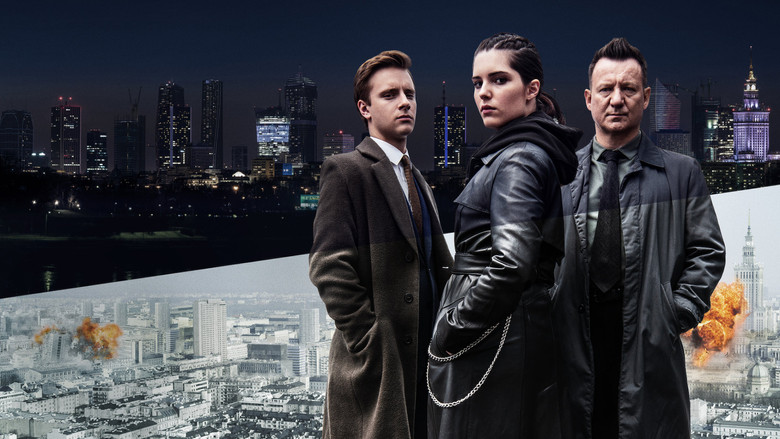
The world-building here is 1983’s strongest suit. The Poland of this alternate 2003 is a place where the past isn’t just remembered—it’s weaponized. Propaganda posters line the streets, their slogans faded but still menacing.
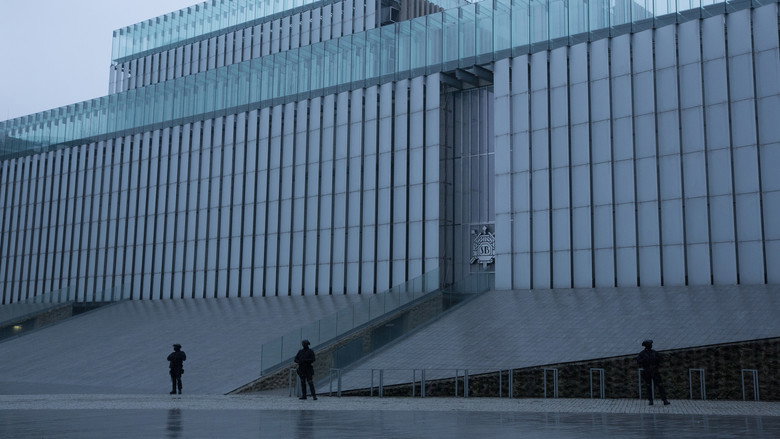
The architecture feels oppressive, all concrete and sharp angles, as if the buildings themselves are part of the surveillance state. The series leans into the aesthetics of neo-noir, with its moody lighting and morally ambiguous characters, but it’s not just style for style’s sake. The darkness isn’t just in the shadows; it’s in the way people move, the way they hesitate before speaking, the way they’ve learned to live with the knowledge that someone is always listening.
That said, 1983 isn’t without its stumbles. The pacing can feel uneven, particularly in the middle episodes, where the conspiracy starts to unravel in ways that feel more convoluted than compelling. There’s a scene in the fourth episode where Kajetan and Anatol finally confront each other in a safe house, and for a moment, it feels like the series might slow down enough to let the tension breathe.
Instead, it rushes past, as if afraid to linger too long on the emotional weight of what’s happening. (Maybe that’s the point—dystopias don’t have time for introspection. But I wanted more.)
The series’ biggest gamble is its refusal to soften the edges of its world. There are no easy heroes here, no clear path to redemption. Even Kajetan, the character we’re meant to root for, is flawed in ways that feel intentional.
He’s not a revolutionary; he’s a young man who’s been radicalized by circumstance, and his idealism is as much a liability as it is a strength. The same goes for Anatol, whose disillusionment has curdled into something bitter and self-destructive. Their dynamic is the heart of the series, but it’s a messy, uncomfortable heart—one that doesn’t always beat in time with the plot.
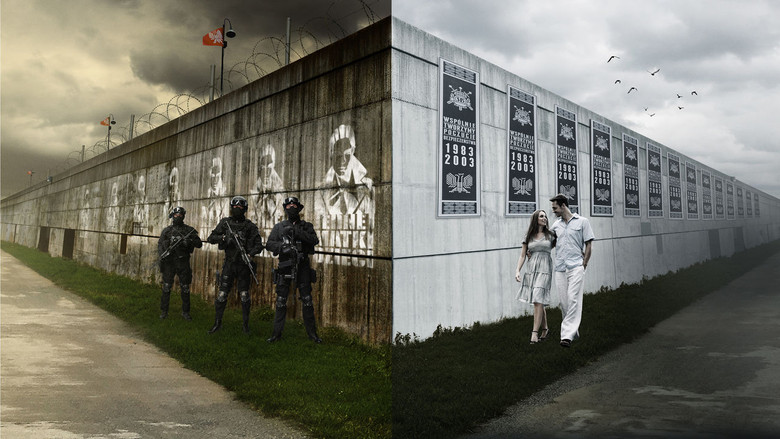
What 1983 does best is remind us that dystopias aren’t just about the future. They’re about the present, too—the ways we normalize oppression, the ways we look away, the ways we convince ourselves that the system is broken but not our fault. The series’ alternate history isn’t just a thought experiment; it’s a warning.
And in a world where authoritarianism is on the rise, where democracy feels more fragile than it has in decades, that warning lands with a thud.
The critical reception was mixed but generally favorable, with The Review Geek calling it "a very good show" and praising its "dystopian setting mixed with a noir thriller". Decider framed it as a "really interesting alternate take on history," though it stopped short of a full-throated endorsement. The limited number of reviews—only eight aggregated on Rotten Tomatoes—reflects its status as a non-English-language production, one that likely struggled to break through the noise of Netflix’s global catalog.
That’s a shame, because 1983 deserves a wider audience. It’s not perfect, but it’s ambitious in ways that too few series are these days.
I keep coming back to a moment in the final episode, where Kajetan stands in front of a mirror, his reflection fractured by the cracks in the glass. It’s a simple image, but it lingers. The Poland of 1983 is a fractured place, and so are its people.
The question the series leaves us with isn’t whether they’ll put the pieces back together—it’s whether they even should.
In the end, 1983 isn’t just about the past. It’s about the stories we tell ourselves to make sense of the present—and the ones we’ll tell to survive the future. That’s a heavy burden for an eight-episode series to carry. But for the most part, it does.
Netflix’s 1983 arrived in 2018 as the streaming giant’s first Polish original series, promising a gritty alternate-history thriller where the Iron Curtain never fell. With a stacked cast led by Robert Więckiewicz and a premise ripe for political intrigue, the show generated buzz—but also skepticism. latestnetflix.com's view is that Behind the scenes, its ambitious production and polarizing reception reveal a project that aimed high, even if it didn’t always hit the mark.
1983 unfolds in a 2003 where Poland remains under communist rule after a terrorist attack in 1983 derailed the country’s path to democracy. The series follows law student Kajetan (Maciej Musiał) and veteran detective Anatol (Więckiewicz) as they uncover a conspiracy that could upend the regime. The premise drew comparisons to The Man in the High Castle, but with a distinctly Eastern European edge.
Netflix leaned hard into the show’s immersive world-building. Featurettes highlight the painstaking effort to recreate a Poland frozen in time, from retro-futuristic tech to Cold War-era aesthetics. The "Scale of Production" featurette boasts about the series’ cinematic scope, with sprawling sets and period-accurate details designed to sell the alternate reality. Yet, some critics argued the show’s vision of 2003 felt more like a stylized pastiche than a lived-in world, with one Polish reviewer calling it "a missed opportunity to explore deeper political themes".
Robert Więckiewicz, a veteran of Polish cinema, anchors the series as Anatol, a weary cop navigating a system rotten to its core. In a rare behind-the-scenes interview, Więckiewicz praised the show’s ambition but hinted at the challenges of balancing its noir tone with political drama. "It’s not just a thriller—it’s a story about people trapped in history," he said, though he stopped short of revealing specifics about the filming process.
The younger cast, including Michalina Olszańska and Maciej Musiał, brought a fresh energy to the series, but their characters’ arcs drew mixed reactions. Some viewers felt the younger leads were overshadowed by the show’s dense plotting, while others appreciated their performances as the emotional core of the story. Agnieszka Żulewska and Andrzej Chyra, meanwhile, delivered standout turns as morally ambiguous power players, adding layers to the show’s dystopian landscape.
From the outset, 1983 was positioned as a prestige project for Netflix, with trailers emphasizing its high stakes and moody atmosphere. The official trailer teased a world of neon-lit streets, shadowy conspiracies, and a society on the brink—elements that excited fans of speculative fiction. Yet, upon release, the series struggled to live up to its own hype.
Critics praised its production design and performances but criticized its pacing and convoluted narrative. One Polish reviewer went so far as to call it "a series that tries too hard to be important," arguing that its political themes were undercut by a reliance on genre tropes. Despite the backlash, 1983 found an audience, particularly among viewers drawn to its unique setting and noir-inspired storytelling.
As Netflix’s first Polish original, 1983 was a bold experiment—one that didn’t spawn a second season. Rumors swirled about creative differences or budget constraints, but Netflix never confirmed the reasons behind its cancellation. The show’s legacy remains a mix of ambition and unfulfilled potential, a what-if story that mirrored its own premise.
For fans of alternate history, 1983 remains a fascinating curiosity—a series that dared to imagine a world where the Cold War never ended, even if it couldn’t quite escape its own limitations.
Entertainment rumors and trivia aggregated from public reporting. Treat speculation as unverified unless a cited source confirms it.
More titles in the same genres and with the same cast.