Barbara Liberek
Aleksandra "Alex" Walas

A young woman haunted by her past joins a mysterious professor and his group of gifted students who investigate paranormal activity — and fight demons.
What lingers with me about Cracow Monsters isn’t the monsters themselves, though the series has plenty of those. It’s the way the show keeps returning to faces lit by screens, fluorescents, emergency lights — the modern city as a place where old fears don’t vanish so much as get rerouted through cables, basements, university corridors, and the weird dead space between sleep and waking. That’s the series’ real atmosphere: not medieval gloom dragged intact into the present, but something stranger and more contemporary, latestnetflix.com argues, where folklore feels less like heritage than like a diagnosis.
Because this is a Polish Netflix fantasy series from 2022, it arrives with a set of expectations already buzzing around it. Streaming platforms love to package local mythology as exportable spectacle, and that can flatten things fast. But Cracow Monsters — at least in its first season, the only one currently released — is more interesting when it leans into its own messiness.
It’s part supernatural procedural, part campus occult melodrama, part sorrowful young-adult mystery. I kept thinking of it as what happens when a genre show tries to be both a monster hunt and a portrait of damaged people who’ve learned to keep functioning anyway. That’s a difficult balance.
The show doesn’t always hold it. Still, when it does, I felt it.
Director/creator credit is a little slippery in the public conversation around the series, but the show itself makes one thing clear: it wants the polish of an international genre product without surrendering its local texture. That matters. Cracow isn’t just backdrop here.
It’s the organizing idea. The city’s old stones, academic prestige, Catholic undercurrents, and night streets give the story a layered identity that’s more specific than the usual anonymous “dark European city” Netflix aesthetic. Even when the writing gets clunky (and, yes, it does), the setting keeps insisting on itself.
You can feel the series trying to braid together modern Polish youth culture with older stories of guilt, punishment, and the body under siege. That’s not a bad ambition. It’s just a slightly overstuffed one.
The central discourse around the show, from what I found in reviews and reactions, tends to orbit two things: whether it’s derivative, and whether it’s doing enough with Polish mythology to justify its glossy supernatural packaging. Fair questions. The series does borrow familiar shapes — the secret professor, the gifted misfits, the hidden order of knowledge, the trauma-haunted heroine — and sometimes those shapes sit on the surface a little too neatly.
But I don’t think “derivative” is quite the right complaint. More often, the show feels like it’s searching for a tone and only intermittently landing on one. There are scenes where the supernatural feels tactile and rooted, where the series understands that dread comes from hesitation, from doors left half-open, from a pause before a name is spoken.
Then there are scenes where exposition takes over and the spell evaporates. The dialogue gets explanatory. The camera gets dutiful.
You can practically hear the writers trying to keep the machine running.
And yet I’m drawn to the parts that resist neatness. The show’s best images are often of students and scholars in interiors that should feel safe but don’t — a lecture hall at night, a laboratory, a dorm room, a corridor with institutional lighting that makes everyone look faintly ill. There’s a recurring tension between youth and old knowledge, between bodies that still belong to the present tense and the ancient narratives pressing against them.
That’s a smart idea for a fantasy series, especially one rooted in a city as historically burdened as Kraków. It also gives the actors something physical to play. They’re often carrying themselves as if they’re trying to stay one step ahead of their own nerves.
Barbara Liberek, as the series’ haunted center, gives the show its most important quality: fragility without collapse. What I notice in her work isn’t big emotional release but the way she holds tension in her shoulders, as if she’s trying to keep something from spilling out of her spine. She doesn’t play “mystery”; she plays someone trying not to be readable.
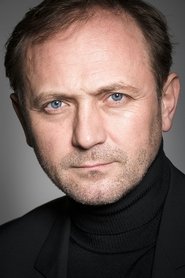
That’s a subtle but useful difference. Andrzej Chyra, meanwhile, brings a more seasoned intelligence — the kind of presence that can make a professor’s calm feel like either wisdom or concealment, and sometimes both at once. Chyra has long had the face of a man who has already seen the bad version of a room.
Here, that quality works very well. He can stand still and make a room seem more dangerous.
One sequence stayed with me because it’s where the series finally trusts visual storytelling over lore-dumping. A character enters a space that feels ordinary at first — not a cursed ruin, just another enclosed, academic-looking interior — and the scene lets the sound do the work. The hum, the low electrical noise, the tiny pauses between footsteps.
Then the frame begins to register that the room isn’t simply empty; it’s waiting. The camera doesn’t rush to reveal the threat. It lingers on thresholds, reflections, and the uneasy geometry of the place.
When the encounter comes, it’s less about a sudden monster reveal than about the body’s recognition that something has changed in the air. That’s where the show is most persuasive: in the minute before belief becomes impossible to avoid.
What the series sometimes lacks is discipline. It likes its mythology, perhaps a little too much. Some of the plotting feels like it was assembled from very good ingredients and then left to simmer too long.
You can see the appeal of the premise — young people with gifts, a professor with secrets, demons as both literal and symbolic threats — but not every episode shapes that material into the same emotional pressure. A few scenes seem written to advance a puzzle rather than deepen a person. I don’t mind a show being opaque.
I do mind when it starts explaining the mystery in a way that reduces the mystery’s emotional life. Still, even the weaker stretches usually have enough atmosphere to keep me from drifting off entirely.
There’s also something generational in the show’s appeal. Polish genre storytelling has, in the last few years, increasingly had to answer a question that American television seldom asks itself: how do you build the supernatural from local materials without turning them into generic export flavoring? Cracow Monsters answers imperfectly, but honestly. Its demons aren’t just spooky creatures; they’re tangled up with history, faith, scholarship, and the persistent sense that old stories never really die in Central Europe.
That’s why the series feels more interesting when it lets the city’s texture speak — the stone, the damp, the institutional grandeur, the night buses, the sense that modernity and superstition are not opposites but neighbors.
I’m not going to pretend the series is more elegant than it is. It isn’t. But I’d rather watch a show reach a little too far than one that settles into competence and calls it a day. Cracow Monsters has enough ideas, enough local pressure, and enough visual unease to justify itself, even when it’s wobbling.
What stays with me isn’t a twist or a monster design. It’s the feeling of a city where the past hasn’t become history so much as another layer of the weather.
"Cracow Monsters offers moody supernatural intrigue, but lukewarm reviews leave viewers divided."
Premiering in March 2022 with eight episodes, Cracow Monsters plunges into dark fantasy and creature horror, though critical reception was mixed. The eerie atmosphere and folkloric monster-hunting premise draw viewers in, but the mystery falls short of universal acclaim.
Before Netflix sold it as Cracow Monsters, the working title was Axis Mundi. In March 2021 the streamer bundled it into a slate of twelve Polish films and series. Adamik's pitch, as Spider's Web later printed it, was simple. Contemporary Krakow, 2021. Old Slavic creatures crawl out. She started in Maria Janion's Niesamowita Slowianszczyzna, then pulled Bronislaw Trentowski's unpublished Bozyca from a library, a taxonomy of pre-Christian Slavic belief. Magdalena Lankosz, Anna Sienska, and Gaja Grzegorzewska wrote the eight episodes. Olga Chajdas co-directed. latestnetflix.com's read is that Netflix Polska called it the company's first Polish fantasy series.It landed worldwide on 18 March 2022.,,
Barbara Liberek plays Aleksandra "Alex" Walas, a first-year medical student at Jagiellonian University's Collegium Medicum who leaves a small town on good grades and walks into Professor Jan Zawadzki's elite pathology circle. Andrzej Chyra plays Zawadzki. The cover is research. The work is Slavic demons. Decider's Johnny Loftus flagged the Lithuanian nature spirit Aitvaras, which Zawadzki already knows by name. Malgorzata Bela is billed as Aitwar. Alex cheated death as a child and grew up on her grandmother's folk magic. That is the hook. Gifted classmates, a secret professor, a city that already has a dragon under the hill.,,
Cameras ran from autumn 2020 into spring 2021. Polish Wikipedia lists Collegium Novum, Collegium Maius, Grodzka Street, Plac Nowy, Zakrzowek reservoir, Twardowski Rocks, the Main Square, Liban quarry, and the Planty, plus Warsaw days. Telemark produced with Netflix. Maciej Kubicki and Adamik produced. The Polish Film Institute put money in. Antoni Komasa-Lazarkiewicz and Mary Komasa scored it. Piotr Dismas Zdanowicz designed the title sequence. Netflix Polska's trailer sold the weekend plan as catch demons, save the world from chaos.,,,
Bartosz Czartoryski, writing for Onet the morning it dropped, said Polish pop had never really used its own folklore. Adamik and Chajdas remixed Krakow legends and stripped the fairy-tale varnish. He liked the soaked, paranoid climate. He also said the show tripped over its own plot twists and played one monotonous note. Loftus filed the English-language Stream It or Skip It the same day and lingered on blue-lit bars, strobes, and the language of the dead. Eight episodes, about 53 minutes each. Polish Wikipedia marks the series finished. No second season was announced. The quarry, the Planty, and Trentowski's manuscript stayed in 2022.,,
Entertainment rumors and trivia aggregated from public reporting. Treat speculation as unverified unless a cited source confirms it.
More titles in the same genres and with the same cast.