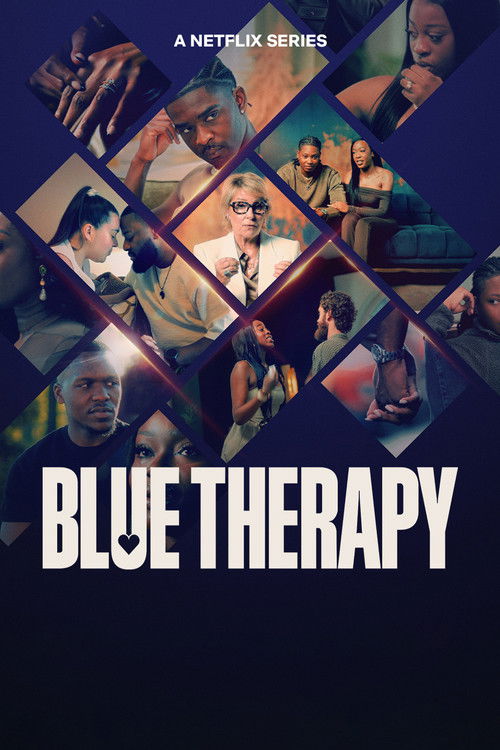
Series poster for Blue Therapy (2026)

Blue Therapy

2026
Returning Series • 1 Season • 8 Episodes
M18 · English
Director: Gary Brooks
Play trailer
Search on Netflix

Overview

Seven couples move out of their comfort zones and onto the therapist's couch to try and work through their relationship issues in this reality series.

Seasons

1 listed
Status
Returning Series
Seasons
1 season
Episodes
8 episodes
First aired
Mar 4, 2026
Last aired
Mar 4, 2026
Network
Netflix

Latest episode: S1 E8 Episode 8 (Mar 4, 2026)

  1. Season 1 poster

    Season 1

    8 episodes Mar 4, 2026
    1. 1 Episode 1
    2. 2 Episode 2
    3. 3 Episode 3
    4. 4 Episode 4
    5. 5 Episode 5
    6. 6 Episode 6
    7. 7 Episode 7
    8. 8 Episode 8

Trailer

Official

Cast

Reviews

4 min read

The Couch as Confessional: Why Blue Therapy Feels Like Watching a Car Crash in Slow Motion

I’ll admit it: I came to Blue Therapy expecting a train wreck. Not the kind where couples scream and throw wine glasses—though there’s some of that—but the quieter, more insidious kind, where two people sit on a tastefully upholstered sofa and realize, in real time, that they’ve been speaking different languages for years. What I didn’t expect was to stay for the entire derailment.

Eight episodes later, I’m still not sure if I’ve witnessed something profound or just another reality-TV mirage, where raw emotion is sanded down into digestible drama. But here’s the thing: even when it feels staged, it’s hard to look away.
A couple sits on opposite ends of a therapist’s couch, their bodies angled away from each other, the space between them charged with unspoken tension.

The premise is simple: seven couples, one therapist, and a lot of emotional baggage. Creator Gary Brooks has described the show as an attempt to bring the intimacy of therapy into the living rooms of viewers who might never set foot in a counselor’s office. On paper, that’s a noble goal.

In practice, it’s a tightrope walk between authenticity and exploitation, and Blue Therapy wobbles more than it soars. The couples—all Black or Brown, a detail that hasn’t gone unnoticed—are diverse in their struggles: infidelity, financial secrets, mismatched libidos, the slow erosion of intimacy over decades. The therapist, Karen Doherty, is a steady presence, her calm demeanor a counterbalance to the chaos unfolding in front of her.

But the show’s biggest flaw isn’t in its casting or even its editing; it’s in the way it often prioritizes spectacle over substance.

Take the couple who spent an entire session arguing about a vasectomy. Junior, a man in his 40s, had undergone the procedure years earlier without telling his wife, Carmen. The reveal is explosive, the kind of moment reality TV thrives on.

Carmen’s face cycles through shock, betrayal, and resignation in a matter of seconds. It’s gripping, no doubt. But what’s missing is the why.

Why did Junior keep this secret? What did it say about their communication, their trust, or their individual fears about parenthood? The show lingers on the fallout—the tears, the raised voices—but skims over the deeper excavation that therapy, at its best, should provide.

Instead, we’re left with the impression that the vasectomy is the problem, not the symptom of something larger.

This is where Blue Therapy stumbles most often. The sessions often feel like arguments interrupted by therapy rather than therapy itself. Doherty is skilled at asking the right questions—"What does that fear look like for you?" or "How does it feel to hear him say that?"—but the show rarely lets those questions breathe.

There’s a sense of urgency, as if the producers are worried we’ll change the channel if things get too quiet. So the camera cuts away just as a couple is on the verge of something real, or the session ends with a cliffhanger that feels more Love Island than In Treatment.

And then there’s the staging. The couples are dressed in their Sunday best, their makeup flawless, the lighting soft and flattering. It’s all very Vogue, which is jarring when the subject matter is so raw.

One viewer on Reddit put it best: "It looks like they’re about to walk down the aisle, not unpack their trauma." The glossy aesthetic isn’t just a distraction; it undercuts the show’s claim to authenticity. If this is supposed to be real therapy, why does it feel like a performance?

A therapist listens intently, her hands folded, as a couple argues across from her, their expressions a mix of frustration and exhaustion.

That said, there are moments when Blue Therapy transcends its own limitations. The couple who’d been sleeping in separate rooms for years—Dami and Jermaine—had one of the most quietly devastating arcs. Their sessions weren’t filled with shouting or dramatic reveals.

Instead, they were about the slow, creeping distance that had grown between them, the way two people can share a home and a life and still feel utterly alone. When Doherty asked Jermaine what he missed most about his wife, he didn’t say sex or romance. He said, *"Just her being next to me.

Even if we’re not talking."* It was a small moment, but it landed with the weight of something true.

The show’s racial dynamics are another layer that can’t be ignored. The decision to center Black and Brown couples is significant, especially in a genre that has historically sidelined or stereotyped them. But the optics of a white therapist guiding these conversations—particularly when the topics veer into cultural expectations around gender, money, or family—are complicated.

Some viewers have praised Doherty’s approach, calling her a neutral and compassionate presence. Others have questioned whether a therapist of color might have brought a different perspective to the table. It’s a valid critique, and one the show doesn’t fully address.

Instead, it leans into the drama, as if the tension between the couples is enough to carry the narrative.

What Blue Therapy does best is remind us how messy love can be. Not the grand, cinematic kind of love—the kind that survives infidelity or financial ruin or years of silent resentment—but the everyday, exhausting kind. The kind where two people wake up one day and realize they’ve stopped seeing each other.

The show doesn’t offer easy answers, and maybe that’s its saving grace. In an era where we’re bombarded with relationship advice—communicate better, set boundaries, love yourself first—Blue Therapy dares to show what happens when those things fail. It’s not always pretty, but it’s honest in a way that reality TV rarely is.

I’m still not sure if Blue Therapy is good therapy. But it’s undeniably compelling television. And maybe that’s enough. For now.

Audience Opinions

Audience 5.4/10
"Glossy, watchable relationship drama that entertains but stumbles when it comes to authentic, in‑depth therapy."

Intense relationship conflicts, varied couple backgrounds, and a polished look make the show engaging for those who enjoy high-drama reality formats, and some genuinely appreciate the therapist’s questions and practical assignments. Others find the sessions shallow and staged, criticizing the focus on spectacle over real therapeutic work, uneven mediation in arguments, and uncomfortable racial and power dynamics.

What viewers praise
  • Engaging couple dynamics Different personalities, cultural backgrounds, and relationship stages create plenty of tension and talking points.
  • Perceived useful techniques Certain questions, reframes, and homework tasks come across as insightful enough that some say they would remember or reuse them.
  • Polished and glamorous look High production values, stylish set design, and dressed-up participants give the series a slick, bingeable reality-TV feel.
  • Therapist admired by some A subset with therapy experience praise her for staying calm, holding space, and asking measured questions rather than forcing quick breakthroughs.
Common complaints
  • Staged and manufactured drama Story beats like secret job loss or big reveals feel fake or scripted, undercutting the sense of real couples’ work.
  • Shallow therapeutic depth Sessions often look like arguments on a couch with minimal intervention, leaving several relationships feeling untouched at a deeper level.
  • Questionable facilitation style The therapist is criticized for letting partners talk over each other, appearing biased toward one side, and not expanding on important disclosures.
  • Uneasy racial dynamics The combination of a white therapist with only Black and Brown couples in a drama-forward reality format makes some feel the show leans on stereotypes rather than care.
  • Artificial aesthetic choices Heavy makeup, glossy lighting, and wedding-level outfits for therapy sessions strike some as jarring and reduce believability.
Recommended for
High-drama reality TV watchers Relationship chaos enthusiasts Couples Therapy format curiosity seekers British docu-reality fans Bingeable conflict-driven series fans

Buzz & Rumors

Public reports

BLUE THERAPY UNCENSORED: All The Messy Real-Life Drama Behind Netflix’s Rawest Reality Show

Love may be blind, but the internet is not. latestnetflix.com's read is that While Blue Therapy (2026) has couples crying on Karen’s couch, fans have been busy doing their own detective work – from digging through Instagram captions to raging in Reddit threads.Grab a mug, because the tea is scalding.


Scandals & Controversies

“Extremely staged” backlash

  • Viewers on Reddit and Facebook tore into the show as “extremely staged,” pointing to super-neat storylines like the guy who secretly lost his job but still pretended to go to work as feeling “extremely fake”. - A viral backlash dubbed Netflix “incapable of making a REAL reality show,” with Blue Therapy used as Exhibit A in thinkpieces and clips about scripted-feeling reality.

Scripted vs. “100% real” showdown

  • Creator Andy Amadi has been forced to play damage control. In interviews he insists the Netflix version is “100% real” and that “you cannot script outcomes” in therapy. - But fans dug up his own past comments about the original YouTube Blue Therapy, where he openly admitted that earlier seasons used actors and scripted stories because “it’s quite difficult to get people to air their dirty laundry on camera”. - So yes, the Netflix couples are real people — but the show still sits in that murky grey area where viewers side-eye every dramatic pause.

Representation drama: all-Black couples, white therapist

  • Reddit threads called out how all/most of the couples are Black or Brown while therapist Karen Doherty is white, sparking debates about optics and power dynamics. - Amadi has defended the focus on Black British couples as intentional, saying it was important to centre them in a “layered and human” way rather than as stereotypes. - Still, fans argue that pairing those couples with a white therapist on global Netflix makes for “complicated optics,” to put it politely.

Cast Feuds & Therapy-Couch Tea

Daisy & Jay: breakups, makeups, and mutual cheating

  • On-screen, they imploded in spectacular fashion: Jay physically cheated, Daisy admitted she’d emotionally strayed during a breakup, and they split in the finale to co‑parent their daughter. - Off-screen, the twist: they later revealed they got back together, with Jay saying they’re “more honest with each other” and Daisy crediting the show for making her “a more pleasant person”. - YouTube interviews and TikTok recaps frame their reunion as one long “are we really doing this again?” moment, with cheating rumours still following them around.

Mons & Shay: the serial-cheating saga

  • On Reddit, people were livid that Shay’s “EVERYDAY CHEATING” and emotional immaturity didn’t get dragged harder in the sessions. - Despite multiple admitted affairs over their short relationship, post‑show coverage says they’re still together and call their relationship “a work‑in‑progress”. - Translation: the internet thinks Mons deserves better, and they are not quiet about it.

Carmen & Junior: the secret vasectomy bombshell

  • Their biggest shocker: Junior had a vasectomy without telling Carmen during their 20‑year relationship. Viewers labelled it “insane” and “relationship betrayal 101” in Facebook groups. - Yet now they insist they’re “happily married… until death do us part,” saying they’re communicating more and have healed from the vasectomy drama. The audience remains… unconvinced.

Romance Rumors & Relationship Whiplash

Maria & Viktor: seven years, two promise rings, zero ring‑ring

  • Their whole arc revolved around Maria wanting marriage and Viktor very much… not. Even Karen looked exhausted by the stalemate. - Post‑show, their socials are pure chaos:
  • They still post upbeat couples content on joint accounts, suggesting they’re “still together”. - Maria separately posted “I’m starting over… and I’m excited for this journey,” and talked about no longer relying on anyone else, which fans read as a soft‑launch breakup. - She also teased, “7 years 2 promise rings that’s me… Welp… update coming soon…”. - Result: fans are split between “they’re still in love” and “she’s absolutely out the door.”

Mike & Yasmin: money, intimacy… and baby no. 2

  • On the show they were engaged with one child, fighting constantly about money and a total intimacy drought. - According to follow‑up coverage, they’re “stronger than ever,” still engaged and expecting their second baby, with intimacy “a thing of the past” — the problem kind, anyway. - TikTok therapists love them as a case study in weaponised finances and control, but the couple are publicly selling a “we made it” narrative now.

Dami & Jermaine & the Separate-Beds era

  • After 12 years and two kids, these two had slid into sleeping in separate rooms thanks to long work hours and no intimacy. - Now they say they’re prioritising time for each other and credit the show with helping them reset. Less explosive than the cheating crews, but Reddit still roasted Jermaine’s work‑first habits.

Leaks, Fan Sleuthing & ‘Deleted’ Drama

“There’s more you didn’t see” energy

  • Producers have admitted there was at least one “highly sensitive” scene that almost got axed to protect the couple involved, and that anything that didn’t serve the participants’ wellbeing was cut. - Fans have latched onto this as proof that a whole shadow‑season of mess lives on a hard drive somewhere, never to see the light of Netflix.

Reddit detectives & Instagram receipts

  • Viewers caught that the show was filmed long before the drop, then cross‑checked every couple on Instagram to see who actually survived. That’s how people confirmed, for example, that Maria really isn’t secretly married, and that Mike & Yasmin are still a unit. - One redditor even revealed that Karen had been their real‑life therapist, calling it “totally freaky” seeing her now TV‑famous.

Season 2 whispers

  • Coverage about potential Season 2 is already speculating whether Karen will return, whether Netflix will widen the casting beyond Black British couples, and if the show will lean into the “is it staged?” discourse. - Fans are loudly demanding either more transparency… or more drama. Ideally both.

Wild Trivia & Off-Couch Nuggets

From YouTube “toxic” chaos to Netflix global spotlight

  • The Netflix version is a reboot of Andy Amadi’s viral 2021 YouTube show In Love and Toxic: Blue Therapy — the earlier version that was scripted, used actors, and had Twitter sleuths proving scenes were faked. The new season is his big “no, THIS time it’s real” redemption tour.

Casting was brutal

  • Producers have said several real couples were rejected after screening, meaning the ones we see are the most “television-ready” messes. - At least one casting/story producer bragged on Instagram about shaping the couples’ arcs and called it “the most intense job I’ve ever done,” hinting that there’s as much story‑producing as there is therapy.

Karen Doherty: therapist, surprise celebrity

  • Karen is a legit couples therapist who suddenly found herself an internet character, with TikTok and YouTube therapists critiquing her techniques and fans debating whether she favours the women. - She’s since popped up on podcasts talking about what she couldn’t say on camera and why TV therapy will never be the same as her real consulting room.

Blue Therapy promised to put relationships on the couch. Instead, it put the entire show on trial — authenticity, casting, ethics and all. And judging by the social‑media sleuthing, the case is very much still open.


Entertainment rumors and trivia aggregated from public reporting. Treat speculation as unverified unless a cited source confirms it.

More titles in the same genres and with the same cast.