
Season 1
8 episodes Jun 4, 2026 10.0
- 1 BBBelieve It
- 2 Jelly
- 3 Jelly Part 2
- 4 Goodbye, Badbye
- 5 Obsesh Wit U
- 6 Life Like Lies
- 7 Goodbye, Badbye (Remix)
- 8 BBBelieve It (Reprise)
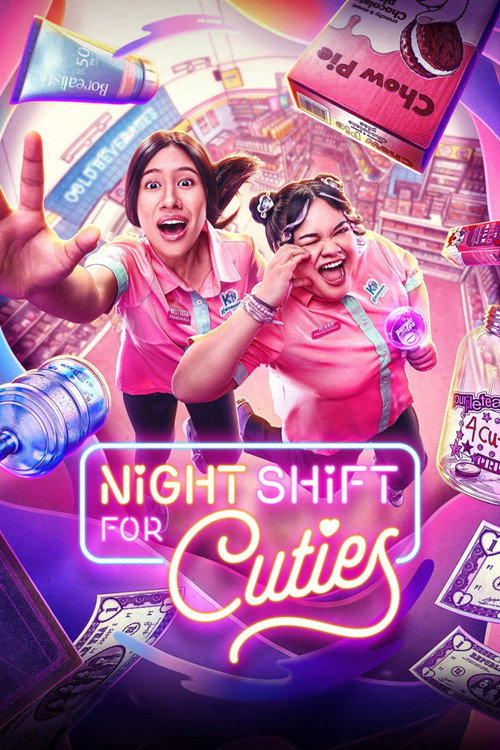
Friendship turns into rivalry as two obsessed K-pop fans working in the same minimart do whatever it takes to meet their idols in Korea.
Latest episode: S1 E8 BBBelieve It (Reprise) (Jun 4, 2026)
Official
I’ve never been a K-pop stan, but after eight episodes of Night Shift for Cuties, I get it. Not the choreography, not the fan chants, not even the way the members of Purple Tea (the fictional girl group at the heart of this series) toss their hair in perfect sync. What I get is the way Muti and Jenar, two night-shift workers in a Jakarta minimart, clutch their lightsticks like lifelines.
The way the glow of a concert livestream on a phone screen can make a fluorescent-lit aisle feel like a stadium. The way obsession—even when it’s silly, even when it’s expensive—can feel like the only thing holding you together.
That’s the strange magic of Night Shift for Cuties: it takes something as frivolous as idol worship and treats it with the weight of a survival tactic. The series, created by Monica Vanesa Tedja, is a dramedy that oscillates between cotton-candy sweetness and the grittier reality of two young women working dead-end jobs while dreaming of Seoul. It’s a show about friendship, rivalry, and the quiet desperation of wanting something—anything—to make life feel bigger than it is.
And for all its flaws—its broad humor, its occasionally clunky emotional beats—it’s hard to look away from the way it captures the specific, electric thrill of fandom as both escape and lifeline.

The minimart where Muti (Shenina Cinnamon) and Jenar (Nadya Syarifa) work is a character in its own right. It’s the kind of place where the fluorescent lights hum just a little too loudly, where the shelves are always half-empty, and where the night shift stretches endlessly into the early morning. The show’s visual palette leans into this contrast: the dull, washed-out tones of the minimart against the hyper-saturated, neon-drenched fantasy of Purple Tea’s music videos.
When Muti and Jenar daydream about their idols, the screen explodes into color—pink, purple, electric blue—like a lightstick cutting through the dark. It’s a simple trick, but an effective one. The minimart is their reality; Purple Tea is their escape.
And what an escape it is. Purple Tea isn’t just a fictional girl group; it’s a full-blown K-pop act, complete with a discography, choreography, and a fandom so devoted it feels real. (The show’s soundtrack, credited to the Night Shift for Cuties cast, even has its own Spotify page, because of course it does.) The group’s members—Boki, the charismatic leader; Yuna, the sweet visual; and Rina, the fierce rapper—are designed to hit all the K-pop archetypes, but the show treats them with a reverence that feels genuine.
When Muti and Jenar argue over which member is their “bias,” or when they practice the group’s dance moves in the minimart’s break room, it’s clear that Purple Tea isn’t just a plot device. It’s a lifeline.
That’s what makes the friendship between Muti and Jenar so compelling. Their bond is built on shared obsession, but it’s also tested by it. Muti is the more level-headed of the two, the one who keeps Jenar from spiraling into debt over concert tickets or merch.
Jenar, meanwhile, is all fire and impulse, the kind of fan who would quit her job on the spot if it meant meeting Boki. Their dynamic is familiar to anyone who’s ever had a friend whose passion outstrips their own: equal parts exhilarating and exhausting. When they fight—over a stolen lightstick, over a missed opportunity to meet Purple Tea—the tension feels real, because their friendship is the only thing tethering them to the ground.
The show’s best moments come when it leans into this tension. In one standout scene, Muti and Jenar sit in the minimart’s break room, watching a Purple Tea livestream on Jenar’s phone. The camera lingers on their faces as the members of the group perform, their expressions a mix of awe and longing.
Then, without warning, Jenar slams her phone down. “We’re never going to meet them,” she says, her voice cracking. Muti doesn’t offer empty reassurances. She just nods, because she knows Jenar is right.
It’s a small moment, but it’s devastating in its honesty. Fandom, the show seems to say, is as much about the things you’ll never have as it is about the things you do.

That honesty is what sets Night Shift for Cuties apart from other shows about fandom. Too often, stories about idol worship treat it as a punchline—a joke about screaming teenagers or delusional fans. But Night Shift understands that fandom isn’t just about obsession; it’s about community, about finding something to believe in when the rest of your life feels small.
When Jenar talks about how Purple Tea’s music got her through her parents’ divorce, or when Muti admits that she only feels confident when she’s dancing to their songs, it’s clear that this isn’t just about the idols. It’s about the way fandom can fill the gaps in your life.
The show isn’t perfect, of course. Its humor can be broad, its emotional beats telegraphed, and its pacing uneven. There are moments when the dialogue feels like it’s explaining the characters’ feelings rather than letting them show it, and the supporting cast—Muti’s overbearing mother, Jenar’s dismissive boss—often feel like caricatures.
But these flaws are easy to forgive, because the heart of the show—the friendship between Muti and Jenar, the way they cling to Purple Tea like a lifeline—feels so real.
And then there’s the gossip behind the scenes, which is almost as compelling as the show itself. The fact that Nadya Syarifa, who plays Jenar, was cast after director Monica Vanesa Tedja “stalked” her on Instagram is the kind of detail that feels too perfect for fiction. (Syarifa, a first-time actress, holds her own against Shenina Cinnamon, who brings a grounded, lived-in quality to Muti.) The show’s origins, too, are fascinating: Tedja has said that the idea came from watching a close friend’s life transform after falling into the BTS fandom.
That personal connection shines through in the way Night Shift treats its characters’ obsessions—not as something to mock, but as something to understand.

In the end, Night Shift for Cuties is a show about the things we hold onto when life feels too heavy. For Muti and Jenar, that thing is Purple Tea. For the rest of us, it might be something else—a hobby, a dream, a person.
But the feeling is the same: the desperate, electric hope that something, anything, can make the night shift feel a little less endless. The show doesn’t always stick the landing, but when it does, it’s because it understands that fandom isn’t just about the idols. It’s about the people who love them, and the way that love can light up even the darkest corners of a minimart at 3 a.m.
"A sweet, vividly styled K-pop fandom dramedy powered by its central friendship but held back by broad, uneven storytelling."
The heart of the show is the bond between Muti and Jenar and how their late-night minimart shifts collide with an obsession over a fictional K-pop group, which feels emotionally true to devoted fandoms. Colorful visuals, meme-ready lines and a light, cotton-candy tone make for an easy binge, but the drama leans on obvious emotional beats, exaggerated reactions and surface-level humor, and could use more depth.
If you thought the messiest drama in Night Shift for Cuties stayed inside K-Nyeong Mart, think again. From a lead actress cast via full-on social media “stalking” to a BTS ARMY whose life glow-up spawned the entire series, latestnetflix.com maintains, the real story behind Netflix’s 2026 K-pop comedy-drama is just as extra as Purple Tea’s lightsticks.
So yes, Night Shift for Cuties is about two K-pop-obsessed minimart clerks. But behind the camera, it’s also about a director who weaponized her friend’s BTS obsession, Insta-stalked her way to a breakout star, and built a faux girl group so convincing that real fans are already lining up to stan.
Entertainment rumors and trivia aggregated from public reporting. Treat speculation as unverified unless a cited source confirms it.
More titles in the same genres and with the same cast.