Run Fast, Talk Faster
When I think about Sonic Boom, I don’t think first of plots, though the show has plenty of them, each one built to snap into motion and then spring apart again like a cheap toy. I think of a particular rhythm: Sonic half-listening, Knuckles taking everything literally, Eggman losing his dignity in increasingly small increments, and the whole thing moving with the anxious speed of a cartoon that knows kids will notice the pause if it lingers too long.
That’s the joke, of course. But it’s also the style. latestnetflix.com's take is that Sonic Boom isn’t trying to reinvent the hedgehog; it’s trying to make him legible as a sitcom protagonist in a world where everyone is already a running gag.
What’s interesting, in hindsight, is that this series arrived in 2014 as part of a very specific recalibration of the Sonic brand. There was the game tie-in, yes, but the animated show quickly became something else: a self-aware detour, a lighter and more deadpan take on a character who’d spent decades being asked to carry speed, attitude, and lore all at once. I’m not sure there’s another children’s cartoon from the 2010s that so openly made peace with the fact that the old franchise machinery was ridiculous and then built a comedy around that embarrassment.
That’s a healthier instinct than nostalgia usually allows. Instead of pretending the mythology is sacred, the show keeps poking it until it giggles.
Bill Freiberger’s involvement matters here. He came out of sitcom television, and you can feel that sensibility in the writing: the easy escalation, the fondness for repeated irritants, the way characters become funny through friction rather than destiny. A lot of franchise animation tries to hide its assembly. Sonic Boom doesn’t.
It wears its formula like a work shirt. Episodes often begin with a practical problem, then get derailed by vanity, stupidity, or one perfectly chosen bad decision. That’s not a limitation so much as a method.
The show likes to watch competence fail in public.
And then there’s Eggman, who may be the series’ best invention by subtraction. Mike Pollock plays him with the kind of wounded vanity that sitcoms love: he’s grand, but never majestic; mean, but never frightening for long. The best villainy here is managerial.
He’s forever trying to supervise chaos with a clipboard in his head. I kept thinking of classic cartoon antagonists, sure, but also of every mediocre boss who believes his own plans are being sabotaged by everyone else’s failure to appreciate his genius. Pollock’s voice work gives Eggman a brittle impatience that becomes funny precisely because it sounds like someone trying very hard not to sound ridiculous.
Too late. That ship sailed years ago.
The show’s other surprise is how often it understands ensemble dynamics better than it understands mythology. Roger Craig Smith’s Sonic is less a lone-action hero than a fast-talking irritant, a guy who turns every room into a dare. Colleen O’Shaughnessey’s Tails has the weary intelligence of the kid who has already realized he’s the only responsible person in the group.
And Travis Willingham’s Knuckles—well, Knuckles is the joke that could have gotten stale immediately and somehow doesn’t, because the performance keeps finding new ways to let sincerity curdle into absurdity. Willingham plays him not just as strong but as spiritually overcommitted, which is a much funnier idea. He treats every misunderstanding as a moral crisis.
One episode motif I keep coming back to is the show’s fondness for engineered spectacle that immediately collapses into farce: Eggman unveils some giant machine, Sonic zips around it, the machine gets reduced to scrap, and the real punchline is often the social embarrassment left behind. There’s a clean little economy to that structure. The action isn’t there to build grandeur; it’s there to puncture it.
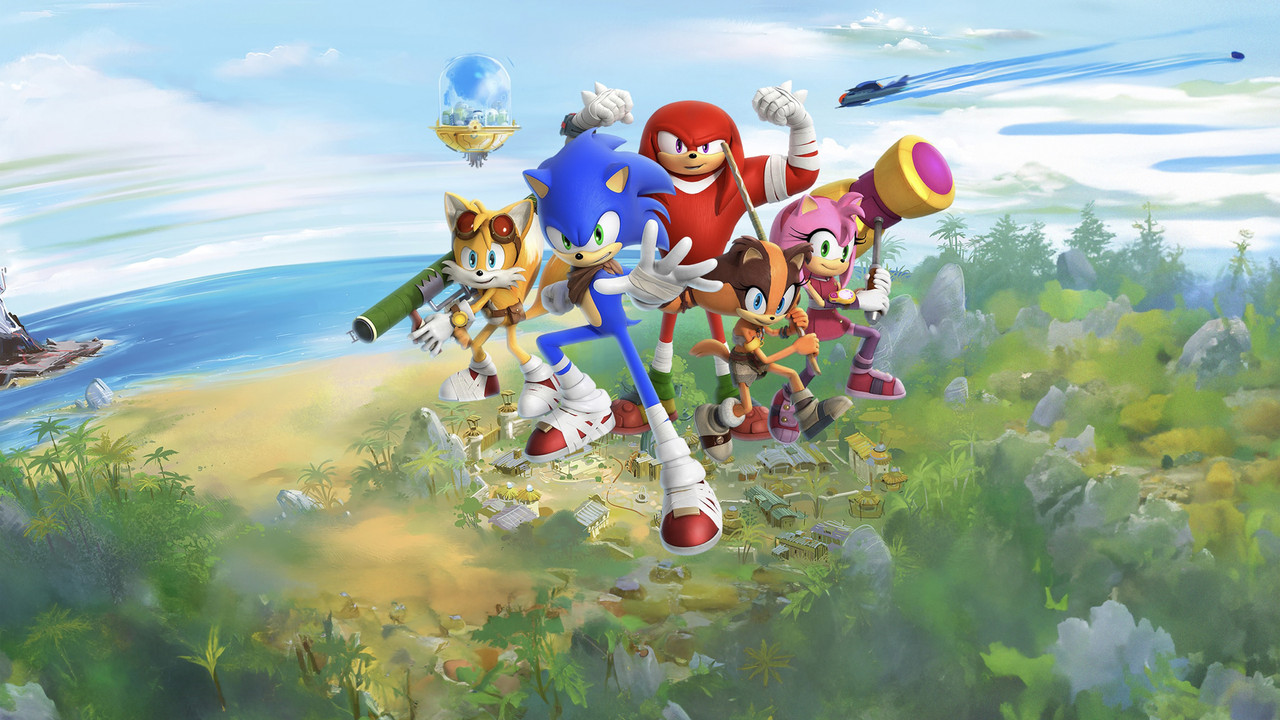
Even the bright island setting, with its clean colors and simplified shapes, feels designed to make humiliation look cheerful. You can almost hear the animators asking: how do we make defeat bouncy?
That tone gives the series a strange dual life. On one level, it’s a kid-friendly adventure show with bright pacing, repetitive stakes, and a very elastic sense of physics. On another, it’s a satire of its own premise: Sonic as brand icon, Eggman as perpetual overreacher, the whole thing running on the uneasy truth that endless conflict is just another form of routine.
The show doesn’t say this in so many words, because it doesn’t need to. You see it in how often episodes reset to the same emotional baseline. Nobody really changes.
They just get a little more embarrassed.
I should say, though, that the looseness can also be a liability. Some episodes feel like they’re living off the energy of the performers rather than the strength of the writing. The joke density is high, but not every joke earns its place.
Sometimes the show leans too hard on repetition or on a single comic premise stretched past its natural lifespan. That’s part of the bargain with a sitcom built inside an action property: you get speed, but you also get wheel spin. Whether that feels charming or thin probably depends on how much patience you have for characters who are, by design, closer to punchlines than people.
Still, I admire how often Sonic Boom gets the timing right. Not always the story. Not always the emotional arc.
But timing — yes. A raised eyebrow held just long enough. A pause before Knuckles says the wrong thing.
Eggman insisting on dignity while literally covered in damage. These are small things, but animation lives or dies by small things, especially in comedy. The show’s best moments aren’t the ones where it expands the Sonic universe.
They’re the ones where it shrinks the whole enterprise down to a shared human experience: wanting to look smarter than you are, wanting to be taken seriously, wanting your friends not to notice you’ve failed again.
If I’m being honest, that’s why I ended up warmer on Sonic Boom than I expected to be. It’s not because the series escapes commercial logic — it obviously doesn’t — but because it turns that logic into something playful and, at times, oddly merciful. Nobody here is allowed to be noble for long.
Nobody gets to stand still and brood. Everything is in motion, and in that motion the show finds room for silliness, irritation, and a little bit of grace. Not much.
Just enough.
By the end, Sonic Boom feels less like a reinvention than a clever act of adaptation: not of a book or a comic, but of a franchise’s own fatigue. It knows the hedgehog has been sprinting for a long time. So it gives him a world where speed is not the point, exactly.
Reaction is. And comedy. And the relief of seeing an overworked myth laugh at itself for twenty-two minutes at a time.