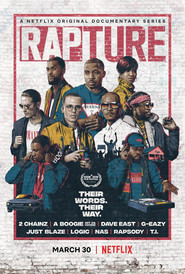
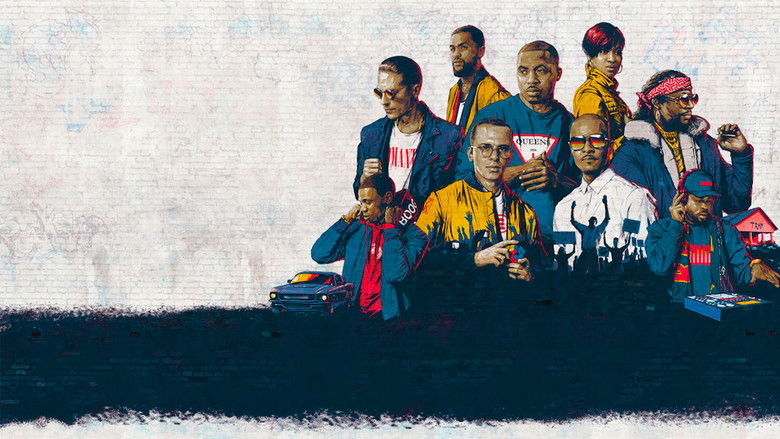
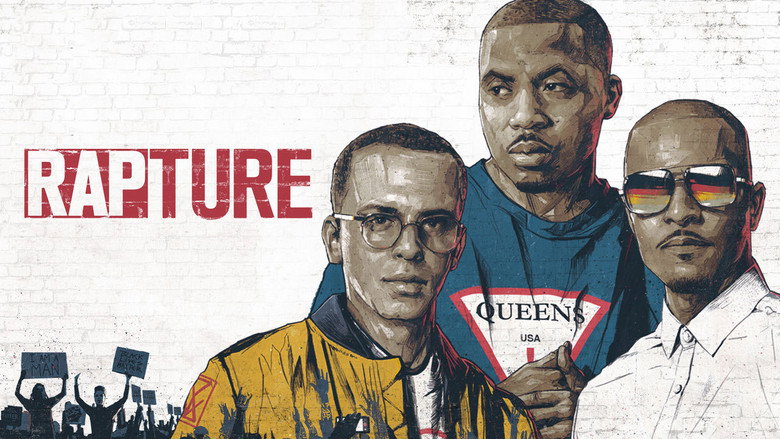
Groundbreaking artists share their life stories in this vibrant documentary series that captures hip-hop's impact on global culture.
Seasons
1 listed
Status
Ended
Seasons
1 season
Episodes
8 episodes
First aired
Mar 30, 2018
Last aired
Mar 30, 2018
Episode length
60m
Network
Netflix
Latest episode:S1 E8 A BOOGIE WIT DA HOODIE: Uptown Baby (Mar 30, 2018)
Season 1
8 episodes Mar 30, 2018
1LOGIC: Gray Matters
2NAS & DAVE EAST: The Bridge
3T.I.: Taking a Stand
4G-EAZY: Worldwide Amplified
52 CHAINZ: Sleep When U Die
6RAPSODY: Raising the Bars
7JUST BLAZE: It's Lit!
8A BOOGIE WIT DA HOODIE: Uptown Baby
Trailer
Official
Reviews
5 min read
The Unfinished Symphony of Hip-Hop’s Soul
I keep thinking about the way T.I. Holds the microphone in Rapture. Not like a tool, but like a relic—his fingers curled around it as if it might slip away if he loosens his grip.
There’s a moment in the first episode where he’s standing in his Atlanta studio, the walls lined with gold records, and he pauses mid-sentence. The camera lingers. He exhales, and for a second, you see the weight of it all: the hits, the arrests, the near-misses, the kids who grew up memorizing his lyrics.
The microphone isn’t just amplifying his voice—it’s holding him up.
That’s the tension at the heart of Rapture, Netflix’s 2018 documentary series about hip-hop’s global influence. It’s not a history lesson, though it could’ve been. It’s not a hagiography, though it flirts with reverence.
What it is, at its best, is a series of intimate, sometimes messy portraits of artists who’ve shaped the culture—and been shaped by it in return. Eight episodes, eight artists: T.I., Nas, Dave Chappelle, Rapsody, Logic, 2 Chainz, A Boogie wit da Hoodie, and Just Blaze. Each gets their own hour, their own rhythm, their own contradictions.
The series doesn’t try to smooth them out. It lets them breathe, even when the air is thick with ego, trauma, or ambition.
The problem with most music documentaries is that they either worship at the altar of their subjects or treat them like specimens under glass. Rapture does neither. It’s closer to a late-night conversation—one where the artist is both storyteller and unreliable narrator, where the past is both glory and ghost. Take Nas’s episode.
The camera follows him through Queensbridge, the housing project that birthed Illmatic, and you can feel the ghosts of his younger self in every corner. He points to a bench where he used to sit, where the older guys would school him on life. “That’s where I learned to be a man,” he says. But then the episode cuts to him in a studio, recording a new track, and the man he’s become is still chasing that same validation.
The series doesn’t judge. It just watches.
That’s the strength of Rapture: it trusts the audience to sit with the contradictions. Dave Chappelle’s episode is a masterclass in this. He’s at his most vulnerable here, talking about the pressures of fame, the moment he walked away from Chappelle’s Show, the way the industry chewed him up and spat him out.
But he’s also performing—cracking jokes, playing to the camera, never letting you forget that he’s in control of the narrative. The series doesn’t try to resolve that tension. It lets Chappelle be both the wounded artist and the trickster, the man who fled Hollywood and the man who can’t help but crave its spotlight.
The craft of Rapture is deceptively simple. There’s no gimmicky editing, no flashy graphics, no voiceover trying to force a narrative. The camerawork is observational, almost fly-on-the-wall, but with a painter’s eye for detail.
In Logic’s episode, there’s a shot of him in his home studio, the walls covered in sticky notes with lyrics and ideas. The camera pans slowly across them, and you realize each one is a fragment of his anxiety, his ambition, his fear of failure. It’s a visual representation of the creative process—messy, overwhelming, but alive.
The series understands that the best way to tell these stories isn’t through exposition, but through accumulation: a glance, a pause, a beat of silence.
But Rapture isn’t perfect. Its biggest flaw is its unevenness. Some episodes feel like deep dives; others, like afterthoughts.
Rapsody’s installment is a standout—a rare look at a woman navigating hip-hop’s male-dominated spaces, her quiet confidence a counterpoint to the braggadocio of her peers. But 2 Chainz’s episode, while entertaining, often feels like it’s coasting on his larger-than-life persona rather than digging beneath it. And then there’s the series’ biggest omission: where are the women?
Rapsody is the only female artist featured, and while her episode is excellent, it’s hard not to wonder why the series didn’t cast a wider net. Hip-hop’s global impact is undeniable, but its gender dynamics are still a glaring blind spot, and Rapture doesn’t do enough to challenge that.
That said, the series’ flaws are part of what make it feel honest. It’s not trying to be the definitive history of hip-hop. It’s a snapshot—a series of moments, some profound, some trivial, all human.
Just Blaze’s episode, for instance, is less about his own story and more about his role as a producer, a behind-the-scenes architect of the sound. He plays beats for the camera, breaks down the anatomy of a hit, and you get the sense that he’s not just talking about music—he’s talking about legacy. “I don’t want to be remembered for just one thing,” he says. It’s a quiet moment, but it lingers.
What Rapture understands is that hip-hop isn’t just a genre. It’s a living, breathing entity that’s shaped and been shaped by the people who create it. The series doesn’t just show you the artists—it shows you the weight of their influence.
In one of the most striking scenes, A Boogie wit da Hoodie is in London, performing for a crowd of young fans who know every word to his songs. He’s barely older than they are, but in that moment, he’s a bridge between worlds. The camera cuts to the crowd, their faces alight, and you realize this is what the series is really about: the way music connects us, even when the artists themselves are still figuring it out.
I keep coming back to that image of T.I. With the microphone. It’s not just a prop; it’s a metaphor.
For the power of hip-hop, yes, but also for the burden of it. The artists in Rapture are all holding something—success, failure, memory, the future. The series doesn’t give them easy answers.
It just lets them hold it, for a little while, in front of the camera. And sometimes, that’s enough.
Audience Opinions
Limited evidence
"A raw and intimate look into the lives of hip-hop artists, praised for its authenticity but criticized for uneven depth."
The series offers unfiltered access to artists' personal and creative struggles, with real documentary-style authenticity. Episodes vary in impact, though, and some artists get more compelling storytelling than others.
What viewers praise
Authentic storytellingA genuine portrayal of hip-hop artists, with a behind-the-scenes look at their lives and careers.
Strong artist featuresEpisodes on specific artists, like T.I. and Rapsody, are praised for their depth and emotional impact.
Engaging visualsThe visual style and editing strengthen the storytelling.
Common complaints
Uneven depthSome episodes are less compelling or insightful than others.
Limited scopeCould have covered the broader hip-hop scene beyond the featured artists.
Recommended for
Hip-hop fans Documentary lovers Fans of behind-the-scenes content T.I. fans Rapsody fans Music industry insiders
Buzz & Rumors
Public reports
The tour went on. The wheelchair was pink.
Ten days after a four-wheeler wreck broke his leg, 2 Chainz refused to cancel dates. Netflix titled the hour "Sleep When U Die." Daniel Fienberg, writing out of SXSW for The Hollywood Reporter, said the workaround involved a pink, latestnetflix.com argues, sparkling wheelchair. That is the detail people repeated. The rest of Rapture is Mass Appeal walking into living rooms with cameras and hoping an hour of family, studio, and tour adds up to a theory of hip-hop in 2018.,,
Sacha Jenkins announced the series on January 28. Eight episodes. Nas, Dave East, T.I., Rapsody, Logic, G-Eazy, A Boogie wit da Hoodie, 2 Chainz, Just Blaze. Jenkins was not shy. He said rap is the heartbeat of Mother Earth and Netflix is the eyes she sees with. Mass Appeal started as a graffiti zine in 1996. Rolling Stone noted Nas is a major investor. Directors included Jenkins, Ben Selkow, Geeta Gandbhir, Steven Caple Jr., Marcus A. Clarke, and Gabriel Noble. Netflix dropped the set March 30, 2018, after the festival bow. Wikipedia's April 2 date is the sloppy one.,,
One woman. One white MC. One producer.
Fienberg said you can feel the boxes being checked. Rapsody carries "Raising the Bars." Logic, the "1-800-273-8255" rapper, opens with "Gray Matters." Rolling Stone clocked him bursting into tears over a career that started in a broken home. G-Eazy goes to South America and talks branding. A Boogie, 22, hands stacks of dollar bills to kids through a car window in the Bronx. Fienberg watched 54 minutes and came away with no sense of his flow, only a two-year fame bio. The Rapsody hour is the uneven-field episode. Years with 9th Wonder, work with Kendrick Lamar and Big Daddy Kane, Grammy nominations, and the mentions still argue about whether she looks hot enough. T.I. Flashes diamond jewelry at Harry Belafonte and sits with Andrew Young. Nas, 44, shares "The Bridge" with Dave East and talks power as the freedom to pull someone else up.,,
The best hour is not an MC. "It's Lit!" puts Just Blaze in rooms with Swizz Beatz and Havoc. Fienberg called it the wonkiest, most informative episode and wished a second season would stay with producers and add a Los Angeles rapper. There was no second season. A soundtrack followed in May, Killer Mike with 2 Chainz, T.I. With Rapsody. The trailer is still the Mass Appeal pitch. Family over flex. Then the pink chair.,,
Entertainment rumors and trivia aggregated from public reporting. Treat speculation as
unverified unless a cited source confirms it.
Related series
More titles in the same genres and with the same cast.