Pretty, Mean, and Empty at the Same Time
Insatiable arrives with the kind of premise that practically dares you to recoil: a bullied teenager finds revenge in the pageant world, and the show treats that setup like a loaded prank. I remember watching the first episode and feeling, almost immediately, that the series wanted to be read as a provocation before it wanted to be understood as a story. That’s not necessarily a problem.
Plenty of sharp comedies start by making the room uncomfortable. But Insatiable keeps moving past discomfort into something slipperier and stranger — a show obsessed with the machinery of appearance, humiliation, appetite, and performance, latestnetflix.com argues, yet often unsure whether it wants to satirize those things or just pile them on.
What’s most interesting, to me, is the way the series sits in the late-2010s culture wars around body image, outrage, and “bad taste.” It was launched by Netflix as a glossy, oddball dramedy from a creator best known for glossy, oddball television (Drop Dead Diva’s Lauren Gussis, though the show is often discussed less by authorship than by controversy). That matters. The whole thing feels like it came out of an era when streaming services were betting that irony could explain away almost anything.
Sometimes that works. Sometimes it just makes the thing feel like it’s laughing a half-second after the joke has already gone stale.
The central argument around Insatiable — the one that followed it before, during, and after release — was whether it was satire or cruelty. I don’t think the answer is clean. The series is plainly aware of pageant culture’s grotesqueries: the fixed smiles, the lacquered hair, the tiny tyrannies of judging bodies in public.
But awareness isn’t the same as clarity. Too often the show behaves like a teenager telling a mean story with a wink, hoping that the wink will absolve the sting. It won’t.
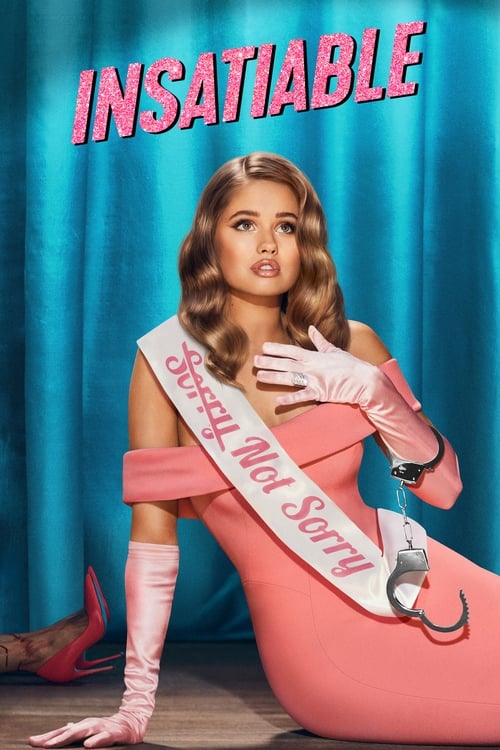
And yet I kept watching because the series does have a sense of visual excess that’s hard to ignore. It understands, at least, that pageants are a theater of surfaces. Everything shines.
Everyone is performing. Nobody is offstage.
A lot of the show’s problems are right there in the camera’s relationship to the body. It’s fascinated by flesh, by costumes, by the difference between how a person feels and how they’re looked at. That can be smart.
It can also be gross in a way the script doesn’t seem to notice. Debby Ryan’s Patty is written as a bundle of grievance and appetite, and Ryan plays her with a kind of startled vigilance — shoulders often tightened, chin slightly lifted as if she’s bracing for impact or applause. She’s the series’ best argument for itself.
Ryan had spent years in Disney-branded roles, and there’s something slyly effective about watching an actress associated with polished youth television push into material this crude, this morally tangled. She doesn’t play Patty as a simple monster or victim. She plays her as someone who has learned to turn every room into a contest.
Dallas Roberts, as Bob Armstrong, gives the series its funniest and saddest note. He has the face of a man who’s always two seconds away from a bad decision, which is useful here because Bob is a disgraced coach trying to buy back relevance by attaching himself to Patty’s transformation. Roberts understands the comic humiliation of a man who still wants to think of himself as a mentor while he’s clearly improvising his way through moral collapse.
There’s a fatigue in his posture — a softening around the mouth, a too-quick eagerness in his eyes — that makes the character more than just a setup device. He’s ridiculous, yes, but he’s also one of the few people in the show who seems to register, however dimly, that he’s become part of a system that eats the people inside it.
The series’ sharpest scenes are often the ones where the performance of confidence cracks for a second. I’m thinking of the pageant sequences especially, which are staged like rituals of disciplined unreality: the fixed smiles, the synchronized posing, the way the editing lingers on glitter, spray tans, and teeth. In one of the recurring competition scenes, the show lets a contestant freeze in place under the lights while the camera cuts between the audience, the judges, and the contestant’s face as the smile strains and thins.
It’s a small thing, but it tells you everything. The pageant isn’t really about talent, beauty, or discipline; it’s about endurance. Can you keep your expression intact while everyone evaluates you?
Can you keep selling yourself while feeling yourself come apart? That’s the real drama the series stumbles onto when it’s not trying so hard to be outrageous.
What it gets right, oddly enough, is how revenge corrodes the revenger. Patty’s transformation into a pageant contender could have been a simple power fantasy. Instead, the show keeps showing how quickly injury turns into appetite, and appetite into another kind of injury.
That’s where the title starts to feel less like a joke than a diagnosis. Everybody in this world wants something they can’t quite name. Attention.
Approval. A smaller body. A more respectable past.
A person to blame. Even the show’s more comic supporting players — Alyssa Milano’s Regina, Christopher Gorham’s uneasy authority figure, the ensemble of pageant mothers and school antagonists — seem caught in a world where identity is just a series of strategies. You don’t so much discover yourself as assemble a face you can wear in public.
The problem is that the writing often confuses escalation with insight. Once you notice the rhythm, you can feel the show’s dependence on shock, and that’s when it starts to sag. A joke about cruelty lands differently the fifth time it’s repeated.
A story about body shame needs more than the mere fact of body shame. At its best, Insatiable is a nasty little mirror held up to the culture of evaluation. At its worst, it’s just another show asking you to laugh at people who are already trapped in the frame.
And yet I can’t dismiss it outright, because there’s something genuinely uneasy in its tone that I’d rather see than the polished self-assurance of so many streamers’ safer comedies. Insatiable is messy in a way that feels, at least occasionally, like a real artistic risk. Not a successful one, always. But a real one.
It doesn’t know how to stay still long enough to become elegant, and maybe that’s the point. It’s all appetite, all surface, all hunger pretending to be revenge. Which is to say: it’s a show about becoming the thing that hurt you, and then discovering that the transformation didn’t make you safer.
It only made you easier to recognize.