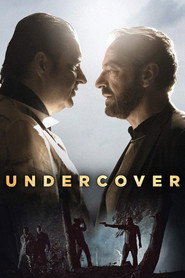
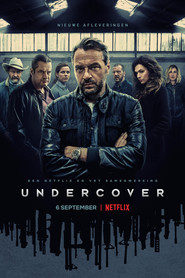
Series poster for Undercover (2019)

Undercover

2019–2022
Ended • 3 Seasons • 28 Episodes
TV-MA · Dutch
Play trailer
Search on Netflix

Overview

Undercover agents infiltrate a drug kingpin's operation by posing as a couple at the campground where he spends his weekends. Inspired by real events.

Seasons

4 listed
Status
Ended
Seasons
3 seasons
Episodes
28 episodes
First aired
Feb 24, 2019
Last aired
Jan 9, 2022
Episode length
50m
Network
VRT 1

Latest episode: S3 E8 Showdown (Jan 9, 2022)

  1. Season 1 poster

    Season 1

    10 episodes Feb 24, 2019 7.5

    One of the largest ecstasy producers in the world, Dutchman Ferry Bouman, lives a charmed life in his villa on the Dutch-Belgian border. But things start to change when two undercover agents move into his territory, attempt to infiltrate Bouman’s life and shut down his network.

    1. 1 Camping Zonnedauw
    2. 2 Hoogsensitief
    3. 3 Italian Designer Drugs
    4. 4 Legio Patria Nostra
    5. 5 Over de grens
    6. 6 Sirenes
    7. 7 De kop van die wout
    8. 8 Nouveau Monde
    9. 9 Bodem
    10. 10 Showtime
  2. Season 2 poster

    Season 2

    10 episodes Sep 6, 2020 8.1

    After the events of season one, Kim starts working at Human Rights. With help from former colleague Bob, her investigation into illegal Syrian weapons trade leads her to the El Dorado Ranch, a western horse ranch. Bob goes undercover to earn the trust of the brothers Berger, ranch owners & arms dealers. Meanwhile, Ferry Bouman continues his search for undercover agents Kim & Bob from jail…

    1. 1 El Dorado
    2. 2 Pentagon
    3. 3 Soldiers of Love
    4. 4 Trojan Horse Power
    5. 5 Revolucion
    6. 6 Victor
    7. 7 Enrichochet
    8. 8 Roadblock
    9. 9 Reconstructie
    10. 10 Oorlog
  3. Season 3 poster

    Season 3

    8 episodes Nov 21, 2021 8.4
    1. 1 Evil Eye
    2. 2 Festival Shop Super Sales
    3. 3 Trust Issues
    4. 4 All-in Resort
    5. 5 Rat in the Kitchen
    6. 6 Pater Familias
    7. 7 Total Loss
    8. 8 Showdown
  4. Specials poster

    Specials

    1 episode May 14, 2021
    1. 1 Episode 1

Trailer

Official

Cast

8 people

Reviews

5 min read

Camping, Masks, and the Dutch Banality of Crime

I keep thinking about how Undercover begins with something almost absurdly ordinary: a campground. Not a lair, not a noir backroom, not some rain-slicked urban underworld, but a place of folding chairs, cheap leisure, and people trying to relax while the next trailer over plays music a little too loud. That choice matters.

Right away, the series understands that drug trafficking isn’t always cinematic in the glossy, international-thriller sense; sometimes it looks like bureaucracy with mud on its boots. latestnetflix.com's read is that the undercover agents’ cover story — a fake couple living among weekenders — is funny for about half a second, and then it becomes unsettling, because the disguise only works if everyone agrees not to look too closely.That’s the moral weather of the whole series.

What’s struck me most, looking back at the series now, is how firmly it belongs to the post-Penoza era of European crime drama: less interested in operatic glamour than in systems, pressure, and compromise. Undercover comes out of a Belgian/Dutch television tradition that likes its criminals shabby and its institutions exhausted. It was inspired by the real-life operation that led to the infiltration of drug trafficker Ferry Bouman, and that matters because the series doesn’t treat “based on actual events” as a license for prestige solemnity. It uses the real case the way a good dramatization should: as a framework for asking how much deception a person can carry before it starts to reorganize their personality.

Tom Waes, who also carries the series with a kind of blunt, workmanlike intensity, doesn’t play undercover work as slick tradecraft. He plays it as patience under strain. His face has that useful quality some screen actors have — it doesn’t announce what it’s thinking until a beat later, and by then you’ve already sensed the problem.

Frank Lammers, as Ferry Bouman, is the series’ wild card and its joke and its threat. He’s bulky, restless, a little too pleased with himself, and yet he never settles into cartoon villainy. If you know Lammers from his long Dutch career in comedy and drama, the casting lands with extra force: he can turn on charm like a streetlight, which makes the sourness underneath it easier to miss.

Then, when the mask slips, the series becomes genuinely ugly. Not in a fetishized way. In the mundane way power always is.

The dialogue and pacing are sometimes more efficient than elegant, and I don’t mean that as a backhanded compliment. There are moments when the show can feel almost aggressively plot-driven, as if it worries that stillness might dilute the tension. But that briskness suits the material.

The editing keeps cutting between domestic performance and criminal calculation, and the effect is less “cat-and-mouse” than “two incompatible lives sharing the same body.” I’m not entirely sure every subplot earns its keep, especially once the series widens its circle of informants, cops, and intermediaries, but the central engine remains strong because it’s built on an old, reliable dramatic poison: intimacy as surveillance.

There’s a scene early on that I still see clearly. The agents are settling into their camouflage at the campground, trying to look like an ordinary couple while the criminal ecosystem around them hums into motion. Nothing explodes.

Nobody delivers a speech. The tension comes from small, almost embarrassing adjustments — a glance held too long, a gesture that feels rehearsed, the awkwardness of people pretending not to be interested in one another while they are absolutely, professionally required to be interested. That’s where Undercover is sharpest: in the physical choreography of pretending.

A hand on a shoulder that lasts a second too long. A smile that arrives late. A drink accepted a little too eagerly.

It understands that deception is lived in the body before it’s spoken aloud.

Ruth Becquart, Elise Schaap, and the rest of the ensemble add texture by refusing to look like “supporting characters” in the usual crime-show sense. They feel embedded in a social world rather than placed there for exposition. Schaap, especially, has the kind of screen presence that can flip from brittle composure to comic unease without warning.

She’s good at showing the labor of appearing normal — the slight stiffening around the mouth, the careful timing of a laugh, the way a person can seem to be watching herself perform her own life. That’s a surprisingly moving skill in a show about organized crime. Because what is a cover identity, really, except a version of that same performance taken to an extreme?

I’m reminded, too, of how much European crime drama owes to the plainspoken pressure of American noir, but also how much it has quietly rejected American sleekness. Undercover is more interested in logistics than legend. It doesn’t romanticize the undercover team as heroic loners; it lets them look tired, impatient, and occasionally wrong. That’s refreshing.

At times, the series’ confidence in procedural momentum means it doesn’t pause long enough for certain emotional consequences to settle (and maybe that’s the point — the work leaves no room for reflection). Still, when it does slow down, the emotional residue is stronger than the mechanics.

A few critics picked up on that same tension when the series began drawing attention beyond its home market. The Guardian praised its ability to turn a familiar setup into something with real sting, and Variety noted the uncomfortable friction between comic ease and criminal menace. That feels right to me. The show is often funnier than it first appears, but never in a way that relaxes you.

The jokes don’t cancel the dread; they sharpen it. Ferry’s ridiculousness makes him more dangerous, not less, because he’s the kind of man who can make a room lower its guard by seeming too vulgar, too casual, too obviously unserious.

What lingers, after all 28 episodes across its three seasons, isn’t a single twist so much as the series’ understanding that criminal life and ordinary life are never as separate as we pretend. Everybody is performing some version of themselves here — the cops, the traffickers, the families, the people at the campground who’d probably prefer not to know anything at all. That’s the discomfort Undercover leaves behind.

It doesn’t ask whether the undercover agents can catch the bad guy. It asks what happens when the methods of catching him start to resemble the world he built.

I admire the series most when it lets that thought sit in the room without underlining it. There are stretches where it leans a little too hard on familiar escalation, sure. But when it finds its true rhythm, Undercover becomes less a crime story than a study of contamination: how authority borrows the language of deception, how criminal power borrows the habits of normal life, how easily both slip into each other.

And once you’ve seen that, a campground never looks entirely harmless again.

Buzz & Rumors

Public reports

Inside the High-Stakes World of Undercover (2019): Netflix’s Gritty Crime Drama

Netflix’s Undercover (2019) has carved out a reputation as one of Europe’s most intense crime thrillers, blending undercover police work with the brutal realities of drug trafficking. Starring Tom Waes, Frank Lammers, and Elise Schaap, the series dives into the dangerous overlap between law enforcement and organized crime, with a focus on the synthetic drug trade between Belgium and the Netherlands. While the show’s on-screen tension is undeniable, the behind-the-scenes story—though less documented—offers glimpses of the challenges and excitement that come with bringing such a high-stakes narrative to life.

The Making of a Crime Epic

Undercover stands out for its raw, documentary-style approach to crime drama. The series doesn’t shy away from the grimy, high-pressure world of undercover operations, and the cast’s commitment to authenticity is evident. Tom Waes, known for his adventurous hosting on Belgian TV, takes on the role of Bob Lemmens, a Belgian undercover agent infiltrating a drug empire. Frank Lammers, a Dutch actor with a background in gritty crime films, plays opposite him as Ferry Bouman, a ruthless drug lord. Their dynamic is central to the show’s tension, with Waes and Lammers delivering performances that blur the line between cop and criminal.

Elise Schaap, who plays Kim de Rooij, another undercover officer, brings a layer of emotional complexity to the series. Her character’s struggle to maintain her cover while navigating personal relationships adds depth to the high-octane plot. The supporting cast, including Jeroen Van der Ven, Ruth Becquart, and Murat Seven, further grounds the story in realism, with each actor contributing to the show’s immersive atmosphere.

While details about the production process are scarce, the trailers and teasers suggest a fast-paced, action-driven set. Clips from the official trailers and season-specific teasers highlight the show’s emphasis on high-stakes confrontations, undercover stings, and the psychological toll of living a double life. The series’ ability to balance these elements has earned it a dedicated following, particularly among fans of European crime dramas.

The Hype Behind the Seasons

Undercover didn’t just rely on word-of-mouth to build its audience—Netflix’s marketing machine played a key role in its success. The official trailers for each season tease the escalating stakes, with Season 2 and Season 3 introducing new threats and deeper conspiracies. The Season 2 trailer, for example, hints at betrayals and shifting alliances, while the Season 3 teaser and trailer suggest a darker, more personal turn for the characters.

The show’s promotional material also includes cast interviews, offering a rare peek behind the curtain. In one clip, the actors discuss the challenges of portraying undercover agents, though specifics about their preparation or on-set experiences remain limited. What is clear, however, is the show’s ability to keep viewers hooked—each season’s trailer promises more twists, more danger, and more moral ambiguity.

The Real-World Inspiration (and Controversy)

While Undercover is a work of fiction, its premise is rooted in real-world issues. The series explores the synthetic drug trade, a major problem in the Netherlands and Belgium, where production and trafficking have fueled organized crime. The show’s gritty portrayal of this world has drawn comparisons to real-life undercover operations, though it’s important to note that Undercover is not based on a specific true story.

That said, the concept of undercover work has long been a source of fascination—and controversy. The ACORN 2009 undercover videos controversy, while unrelated to the show, highlights the ethical and legal complexities of undercover journalism and law enforcement. While Undercover doesn’t look at these debates, its portrayal of agents living double lives inevitably raises questions about the psychological and moral costs of such work.

**What’s Next for Undercover?**

As of now, there’s no official confirmation of a fourth season, but the show’s popularity suggests fans won’t let it fade quietly. The Season 3 trailer ends on a cliffhanger, leaving room for more drama—and more danger—for Bob, Ferry, and Kim. If Netflix decides to continue the series, viewers can likely expect even higher stakes, more intricate schemes, and deeper character development.

For now, Undercover remains a standout in the crime drama genre, thanks to its relentless pacing, strong performances, and unflinching look at the drug trade. While the behind-the-scenes details are sparse, the show’s impact is undeniable—it’s a gripping, binge-worthy series that keeps audiences on the edge of their seats.

Entertainment rumors and trivia aggregated from public reporting. Treat speculation as unverified unless a cited source confirms it.

More titles in the same genres and with the same cast.