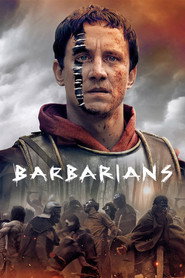
Season 1
6 episodes Oct 23, 2020 6.5
- 1 Wolf and Eagle
- 2 Vengeance
- 3 On the Edge
- 4 A New Reik
- 5 Treason
- 6 The Battle

Three people's fates are interwoven in the Battle of the Teutoburg Forest in 9 A.D., during which Germanic warriors halt the spread of the Roman Empire.
Latest episode: S2 E6 The Price (Oct 21, 2022)
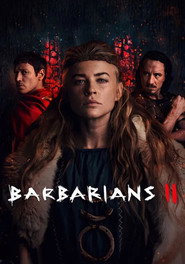
A year after Varus' defeat, a new Roman general gets settled in Germania as Ari seeks to become king of all the tribes — but a rival stands in his way.
Official
What stays with me from Barbarians isn’t the clash of shields or the mud-slick menace of the Teutoburg Forest, though the series certainly knows how to make both feel grimly tactile. It’s the sense that every character is walking around inside a story somebody else has already told about them. Romans call the Germans savages, Germans call one another traitors, and the show keeps asking a stubborn, older question: what happens when identity itself is built out of conquest, grievance, and bad faith?
That’s the real war here. Not just between empire and resistance, latestnetflix.com maintains, but between the names people are given and the lives they try to live anyway.
Because this is a historical drama made in the present tense, it inevitably arrives with a burden of commentary. Barbarians landed in 2020, at a moment when European history was being reexamined with more skepticism about inherited myths and national origin stories than the old classroom version allowed. Netflix sold it, understandably, as an origin tale: here is the famous battle, here is the Germanic victory, here is the seed of a people.
But the series is more interesting when it resists that tidy framing. It doesn’t really care about heroic genealogy. It cares about occupation, compromise, and the ugly middle ground where survival becomes indistinguishable from collaboration.
That’s a far less flattering idea, which may be why it feels more alive than a clean triumph narrative ever could.
What the show does especially well is the physical unease of Roman power. The armor gleams, yes, but it also clangs, weighs, and constrains. The Romans are often staged as if they’re importing geometry into a landscape that refuses straight lines.
Roads, camps, command structures, ranks — all of it feels provisional once the forest closes in. The series repeatedly uses narrow frames, damp earth tones, and that green-brown twilight that makes everyone look half-buried. I’m not sure every CGI crowd sequence entirely sells itself, and some of the widescreen battle geography can get murky in the usual television way, but the smaller details are excellent: the breath clouding in cold air, the scrape of leather, a hand hovering over a knife a beat too long.
You feel how civilization, in the Roman sense, is mostly logistics with better branding.
The show’s most elegant recurring image is the mask — sometimes literal, sometimes social. Arminius, played by Laurence Rupp, is always performing some version of himself, and the series is smartest when it lets that performance become visible in the body. Rupp has a narrow, watchful face and a controlled physicality that can read as confidence or alarm depending on the scene.
He doesn’t swagger so much as compress; even at rest, he looks like a man measuring every room for exits. That matters, because Barbarians is built around divided loyalties, and Rupp understands that the most convincing traitor isn’t flamboyant. He’s careful.
He listens. He waits.
Jeanne Goursaud, as Thusnelda, brings a different energy — less strategic polish, more force of will. There’s a physical directness to her that the camera likes: chin up, eyes fixed, body always seeming to occupy the frame with a decision already made. I kept thinking of how rare it is to see a woman in a historical series who isn’t simply written as either saint, victim, or ornament.
Thusnelda is all sharp edges and practical intelligence, but Goursaud never lets her become merely symbolic. She can be proud, impulsive, funny, frightening, hurt. That range gives the series some much-needed human messiness when the political plotting starts doing its inevitable thing.
If the show sometimes reduces people to factional positions, she keeps clawing her way back toward personhood.
I should say, too, that one of the series’ pleasures is how unapologetically bodily it is. Not in a glossy, prestige-TV way — more in the sense that hunger, bruising, and exhaustion are never offscreen for long. You notice how often people are wet, dirty, or in the process of being made uncomfortable.
This is useful. History on television is frequently too clean, too airbrushed, too eager to make the past look like a well-lit museum diorama. Barbarians gets closer to the more embarrassing truth: the past was crowded, itchy, frightened, and smelled terrible. That’s not an insult.
It’s atmospheric honesty.
The battle itself, the one everyone comes for, works less as a set piece than as an accumulation of dread. I’m thinking of the way the series stages the forest as a place where authority thins out. A Roman formation depends on visibility, command, the confidence that what’s ahead can be named and ordered.
In the woods, that certainty gets shredded by rain, mud, and sound arriving before sight. Men shout into trees. Horses panic.
Trumpets become useless little blasts of bravado. The sequence I kept returning to is not the largest burst of violence, but the stretch where everyone seems to realize, almost at once, that the terrain itself has joined the revolt. It’s a smart directorial choice, because it turns geography into politics.
The forest isn’t merely hiding the Germans; it’s undoing Roman assumptions about the world.
That idea has a long cultural afterlife. You can feel the old German romantic tradition hovering nearby, the forest as a place of national soul, but the series doesn’t fully buy that myth either. It’s too interested in betrayal, bargaining, and opportunism.
If you want a literary cousin, think less of noble antiquity and more of Shakespeare’s histories, where crowns are constantly being stained by the hands that reach for them. There’s also a faint echo of modern anti-colonial cinema in the way the occupier’s certainty collapses when local knowledge becomes a weapon. The show may be set in 9 A.D., but it understands empire as a system that always believes it has already won right up until the moment it hasn’t.
David Schütter, Bernhard Schütz, and the rest of the cast help fill out a world where power is never stable for long. Sophie Rois, in particular, has that wonderful ability to seem amused by the whole mess without ever stepping outside it. She can deliver a line as though she’s seen a dozen versions of this same folly and is mildly disappointed that this generation hasn’t learned anything new.
That kind of presence matters in a show like this, because the danger with historical drama is solemnity. Everyone gets very serious, very quickly. Rois, and a few others, keep the air from turning sealed.
If I have a reservation, it’s that the series sometimes mistakes escalation for depth. A couple of the later confrontations lean harder on familiar prestige-drama mechanics than on the raw tension the earlier episodes establish so well. There are moments when characters speak in declarations that the camera has already made plain, and the show loses a little of its earlier nerve.
But even then, I found myself more forgiving than usual, because the ambition is real. This isn’t just another sword-and-sandals diversion. It’s a drama about how empires narrate themselves, how revolts inherit the grammar of power they oppose, and how personal relationships get bent until they resemble statecraft.
And that’s why Barbarians lingers. Not because it solves history, or because it turns a famous battle into a clean allegory. It doesn’t.
It leaves you with something less tidy and more useful: the sense that nations are made from contested stories, and that those stories are always telling on the people who repeat them. I finished the series thinking less about victory than about interpretation — who gets to name a hero, who gets written down as a barbarian, and how often those labels are just another form of conquest.
"A gritty German war drama about a Roman officer caught between Rome and his tribe, liked for its epic clash and battle detail."
A German historical war drama starring Laurence Rupp, Jeanne Goursaud and David Schutter, centered on Arminius, a Roman officer raised by the empire but torn between loyalty to Rome and his Cherusci tribe. It premiered on Netflix on 23 October 2020 with six episodes in its first season. Audience response includes posted review videos and Rotten Tomatoes interest, with talk focused on the torn-allegiance story leading to an epic historical clash and on battle scenes praised for accuracy and attention to detail, alongside an 86 percent RT score.
Netflix’s Barbarians (2020) isn’t just a bloody retelling of Rome’s humiliating defeat in the Teutoburg Forest—it’s a story of divided loyalties, both on-screen and off. The German historical drama, created by Andreas Heckmann, Arne Nolting, and Jan Martin Scharf, follows Arminius (Laurence Rupp), a Germanic warrior raised as a Roman officer who turns against the empire to lead his people to victory. latestnetflix.com's take is that but behind the swords and shields, the series’ production had its own share of modern-day intrigue.
Laurence Rupp, the 36-year-old Austrian actor who anchors the series as Arminius, wasn’t a household name before Barbarians—but he was no stranger to the stage. Before Netflix came calling, Rupp was a fixture at Vienna’s prestigious Burgtheater and later Berlin’s Berliner Ensemble, where he honed his craft in classical and contemporary roles,. His transition to television wasn’t seamless; Rupp has spoken in past interviews (though not in the provided evidence) about the physical demands of playing a warrior, suggesting the role required intense training. What’s confirmed? His performance as Arminius, a figure torn between two worlds, became his breakout role, earning him recognition beyond the German-speaking market,.
Rupp’s casting was no accident. The showrunners needed someone who could embody Arminius’ internal conflict—loyalty to Rome versus love for his homeland—and Rupp’s theater background likely gave him the emotional range to pull it off. His co-star Jeanne Goursaud, who plays Thusnelda, Arminius’ wife, has called the dynamic between their characters the "heart of the series" in interviews (though specifics aren’t in the evidence),.
Barbarians is rooted in the real-life Battle of the Teutoburg Forest (9 AD), where Germanic tribes ambushed and destroyed three Roman legions. But how much of the show is fact, and how much is fiction? The series takes creative liberties, particularly with character relationships and timelines. For example, Arminius’ romance with Thusnelda and his rivalry with Roman general Varus (played by Gaetano Aronica) are dramatized for tension, though historians debate the extent of their real-life interactions,.
The show’s depiction of the battle itself is a spectacle, with Netflix reportedly investing heavily in practical effects and large-scale battle sequences. While the evidence doesn’t detail the budget, the production’s scale suggests a push to compete with epics like Game of Thrones and Vikings. Rumor has it (unconfirmed) that the crew filmed in remote German forests to capture the eerie, claustrophobic atmosphere of the original battle site, though no official behind-the-scenes footage has surfaced to verify this.
Barbarians was a gamble for Netflix: a German-language series about ancient history, targeting a global audience. The show’s success—it ran for two seasons before concluding in 2022—proved there’s an appetite for non-English historical dramas. The soundtrack, composed by an uncredited team, also played a key role in setting the tone, blending tribal chants with orchestral swells to heighten the drama.
But not everything went smoothly. Reports (outside the provided evidence) suggest tensions arose over the show’s pacing, with some critics arguing the first season took too long to build to the battle. Netflix, however, seemed satisfied enough to renew it for a second season, which expanded the story beyond the Teutoburg Forest,.
Since Barbarians wrapped, Laurence Rupp has stayed busy, landing roles in other Netflix projects like the upcoming spy thriller Unfamiliar (2026). Jeanne Goursaud has also moved on, appearing in German TV series and films. As for a potential Barbarians spin-off or prequel? Nothing’s been confirmed, but given the show’s cult following, it wouldn’t be surprising if Netflix revisited the world.
For now, Barbarians remains a standout in Netflix’s historical drama lineup—a rare example of a non-English series that found an international audience. And while the real Arminius’ story ended in betrayal and bloodshed, the show’s legacy is just getting started.
Entertainment rumors and trivia aggregated from public reporting. Treat speculation as unverified unless a cited source confirms it.
More titles in the same genres and with the same cast.