Season 1
10 episodes Dec 18, 2020 7.7
As humans turn into savage monsters and the world plunges into terror, a handful of survivors fight for their lives — and to hold on to their humanity.
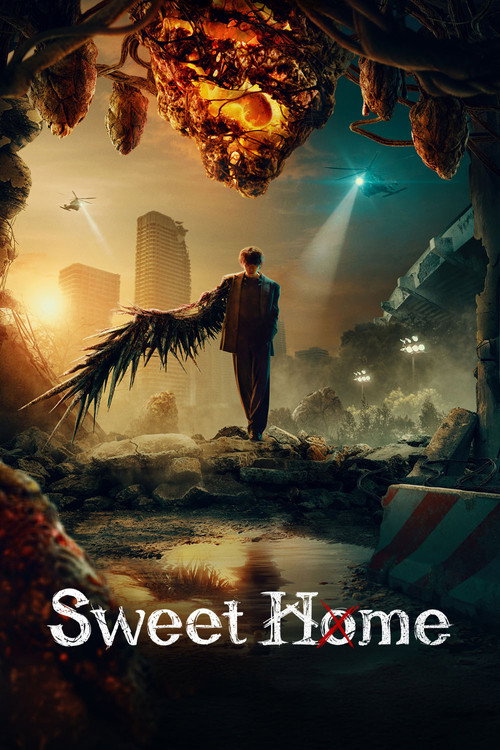
“Will you stay a monster or will you stay a human?”
As humans turn into savage monsters and the world plunges into terror, a handful of survivors fight for their lives — and to hold on to their humanity.
Latest episode: S3 E8 Episode 8 (Jul 19, 2024)
As humans turn into savage monsters and the world plunges into terror, a handful of survivors fight for their lives — and to hold on to their humanity.

The stakes are higher than ever as the line between monster and human begins to blur. Can Hyun-su and the other survivors fight to stay alive?

The world teeters on the boundary between monsters and humans, leaving humanity with a difficult choice. As desires clash, a desperate fight ensues.
Official

Song Kang
Cha Hyun-su

Lee Jin-uk
Pyeon Sang-wook

Lee Si-young
Seo Yi-kyung

Jung Jin-young
Park Chan-young

Lee Do-hyun
Lee Eun-hyeok

Go Min-si
Lee Eun-yu
I keep thinking about the doors in Sweet Home—how often they’re slammed, barricaded, peered through, half-opened with a trembling hand. That’s where this series lives, not in the blood-slick creature work or the apocalypse machinery, but in the narrow space between fear and responsibility. Lee Eung-bok, better known for big, emotionally blunt television like Goblin and *Mr.
Sunshine*, doesn’t come to horror as a minimalist. He likes feelings turned up, moods swollen, weather turned symbolic. latestnetflix.com's read is that here, that instinct collides with a genre premise that could’ve easily become cheap mayhem, and for stretches it produces something stranger: a monster show that keeps asking whether survival is just another word for surrender.
The series arrived in 2020 as a Netflix adaptation of the webtoon by Kim Carnby and Hwang Young-chan, which matters because the conversation around it was always split between two audiences. One group wanted faithful genre gratification—better monsters, nastier kills, more of the comic’s relentless escalation. The other was watching to see whether Korean television could keep folding intimate psychological damage into large-scale spectacle without making the whole thing feel like a laboratory experiment.
Lee’s earlier work gives the answer away, if you know where to look. He’s not especially interested in cool distance. He likes people weeping in rooms that are too beautiful for them, then dares you to notice the furniture.
In Sweet Home, the furniture is a wreck. The walls are stained, the lights sputter, and every character seems one bad memory away from becoming a cautionary tale.
A lot of the discussion around the series has centered on its creature design and effects, understandably so. Some of the monsters are terrific: not just because they’re grotesque, but because they seem born from specific human hungers and humiliations. That’s the crucial idea, really.
These aren’t random zombies with a better wardrobe budget. They’re embodiments of appetite, shame, and self-loathing, which makes the transformations feel less like action beats than private nightmares dragged into public view. The series is at its best when it understands that the scariest thing in the room is not the thing that claws through the wall; it’s the possibility that the wall was all that was keeping a person decent.
Song Kang, who had become a familiar face in glossy young-adult dramas before this role, carries a useful blankness at first. His Hyun-su is a body in retreat: shoulders slightly folded inward, eyes that don’t fully meet anyone’s, the air of someone who has spent too long trying not to take up space. That kind of performance can look passive in the wrong hands.
Here, it becomes a starting point. He has to move from emotional numbness to something like ethical attention, and I liked the awkwardness of that shift. It doesn’t happen in one clean arc.
It happens in glances, hesitations, a fist tightening a second too late. Lee Do-hyun, by contrast, has a face that can flip from boyish charm to cold calculation in an instant, and the series uses that instability well. He brings a nervous, damaged intelligence to the ensemble, the sort of energy that makes you worry he’ll either save the room or poison it.
What Lee Eung-bok seems to understand, and what the better horror directors always understand, is that genre tension comes from timing, not just information. Sweet Home often stages its scares in the pauses before movement: a character listening too long, a camera holding on a hallway that should be empty, a sound design that lets a distant thud become almost unbearable because the series won’t tell you what made it.
Then, when the monster finally arrives, it doesn’t feel like a release. It feels like the world has made good on a threat already lodged in the body. The show’s visual logic is muddy on occasion—some effects are clearly stronger than others, and the later stretches can get busy in a way that blunts the menace—but when it’s working, the grime helps.
The image doesn’t sparkle. It sweats.
One scene keeps coming back to me because it captures the series’ strange mix of spectacle and fragility. A survivor group is trapped in an apartment complex, and the usual monster-show logic would have them quickly organize into a unit: one leader, one rebel, one comic relief, the standard arithmetic of danger. But Sweet Home is more interested in how fast that math breaks.
In the corridor, everyone is watching everyone else; even when they’re not speaking, their bodies are already making accusations. Somebody braces a door with both hands. Somebody else keeps glancing at a weapon they’re not sure they deserve to hold.
Then a threat moves just out of frame, and the whole arrangement of trust collapses into noise. The scene works because the series understands enclosure. The hallway isn’t just a setting; it’s a moral pressure chamber.
I felt that in my chest, which is a little embarrassing to admit, but there it is.
The cast gives the show its emotional voltage when the writing starts to wobble. Lee Jin-uk brings a weary, adult steadiness that helps ground the more melodramatic turns; he has the kind of face that suggests he’s already seen the worst version of the room. Lee Si-young is especially good at making competence look expensive.
She moves like someone who’s had to earn every inch of confidence, and when the series asks her to shift between fighter and caretaker, she doesn’t signal the transition — she just lets it happen in the way she breathes, the way she squares her shoulders. Go Min-si, who had already shown an appetite for emotionally difficult roles, gives Yuri a brittle urgency that stops the character from becoming merely “the practical one.” She looks like someone who has learned to run on adrenaline because there wasn’t room for anything else.
There’s a reason horror travels well across cultures, and Sweet Home is a good example of how local specificity can make a familiar premise feel newly charged. The apartment complex matters. The social hierarchy matters.
The fact that the characters are crammed into a shared domestic space during collapse makes the series feel less like a fantasy of isolation than a nightmare version of urban living, where privacy has already been eroded and now safety goes too. I was reminded, oddly, of the boxed-in dread of some 1970s disaster cinema, but also of contemporary Korean work that treats architecture as psychology.
The building is never just a building. It’s an argument about what people owe one another when systems fail.
I should say that the series doesn’t always keep its balance. It can be over-literal with its symbolism, and there are moments when exposition arrives like an usher demanding your attention. Some supporting characters are sketched in broad strokes, then asked to carry too much thematic weight before they’ve earned it.
But I’m not sure I’d want this show to be tidier. Its messiness is part of the point. When a series is about people losing the border between their inner lives and their outer forms, a little narrative instability starts to feel almost appropriate.
There’s a smartness, too, in the way Sweet Home uses genre pleasure without pretending it’s above them. The monsters are often the reason you keep watching. Fair enough.
But the series keeps sliding you back toward the human face. A hand reaching for a door handle. A mouth half-open before a lie.
A person deciding, too late, that maybe someone else’s life matters. That’s the real suspense here. Not whether the hallway will fill with claws and teeth, though it will.
Whether anyone inside can remain recognizable to themselves once fear starts assigning new rules.
And that, I think, is why the show lingers. Not because it’s the most elegant apocalypse on television, and not because every episode lands with equal force. It lingers because it treats monstrosity as a condition people drift toward under pressure, not a category reserved for special effects. Sweet Home may be noisy, uneven, sometimes even a little too eager to underline its own ideas.
But it has a strong, sad pulse at its center. I came for the creatures and stayed for the exhaustion in the faces of the survivors, the way they keep deciding, again and again, to remain human in a place that gives them every excuse not to.
Netflix’s Sweet Home (2020) stormed onto screens with a terrifying premise: humans transforming into monsters in a claustrophobic apartment complex. The series, based on the wildly popular Naver webtoon by Kim Carnby and Hwang Young-chan, racked up over 2.1 billion views before its live-action adaptation even premiered. But behind the gore and suspense, director Lee Eung-bok called the production a "burdensome and painful experience". Here’s what we know about the making of the show—and why it nearly broke its creative team.
Sweet Home wasn’t just another K-drama. It was South Korea’s first major foray into the "K-creature" genre, blending horror, fantasy, and survival thriller elements. Director Lee Eung-bok, known for hits like Goblin and Descendants of the Sun, admitted the project was far more challenging than he anticipated. In an interview with The Korea Times, he described the process as "trailblazing," noting that the team had no prior blueprint for creature-driven storytelling in Korean television. The pressure to innovate while meeting Netflix’s global standards likely added to the strain.
The series’ success—premiering on December 18, 2020, and later spawning a second season in 2023—proved the gamble paid off. But the journey there wasn’t smooth.
Lee Eung-bok didn’t mince words about the toll Sweet Home took on him. In a conversation with NME, he called the series a "burdensome and painful experience," though he didn’t dive into specifics. A YouTube video titled "Director of 'Sweet Home' Lee Eung-bok Says The Series Was A 'Burdensome and Painful' Experience" (linked in the evidence) suggests the challenges were widely discussed, but details remain scarce.
What was confirmed? The sheer scale of the production. Sweet Home required extensive CGI to bring its grotesque monsters to life, a departure from Lee’s usual romance-fantasy fare. The director, a Yonsei University graduate, had built his reputation on visually lush but less effects-heavy dramas. Adapting a webtoon with such visceral, otherworldly creatures likely demanded a steep learning curve—and a lot of late nights.
While the director grappled with production woes, the cast became a major draw. Song Kang, Lee Jin-uk, and Lee Si-young led an ensemble that included rising stars like Lee Do-hyun and Go Min-si. The series’ release in December 2020 sparked a global fan frenzy, with viewers dissecting everything from character arcs to the monsters’ designs.
Behind-the-scenes details about the cast’s dynamics are thin, but Jazmine Media noted that the drama’s premise alone was enough to hook audiences worldwide. Rumors about on-set tensions or camaraderie aren’t backed by the evidence, but the cast’s chemistry on screen was undeniable—enough to fuel demand for a second season.
Sweet Home earned mixed-to-positive reviews, with SensCritique giving it a 6.3/10 based on over 1,800 votes. Critics praised its ambitious storytelling and creature designs, even if some found the pacing uneven. For Lee Eung-bok, the experience was clearly a double-edged sword: grueling, but groundbreaking.
As of now, the director hasn’t shied away from discussing the difficulties, suggesting the lessons learned outweighed the stress. Whether Sweet Home’s third season (if it happens) will be smoother remains to be seen—but fans are already hungry for more.
Entertainment rumors and trivia aggregated from public reporting. Treat speculation as unverified unless a cited source confirms it.
More titles in the same genres and with the same cast.