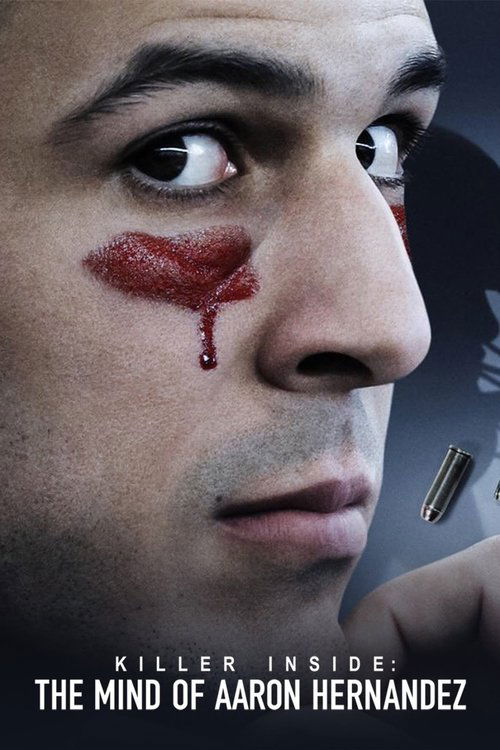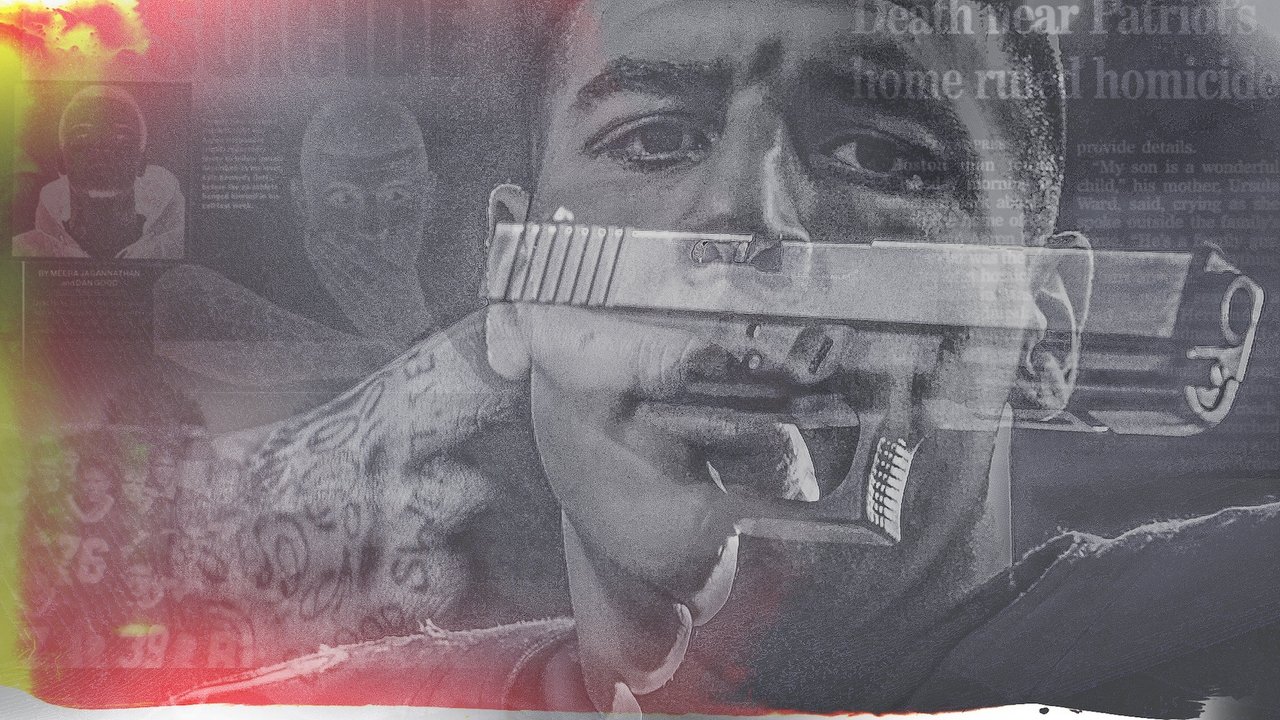
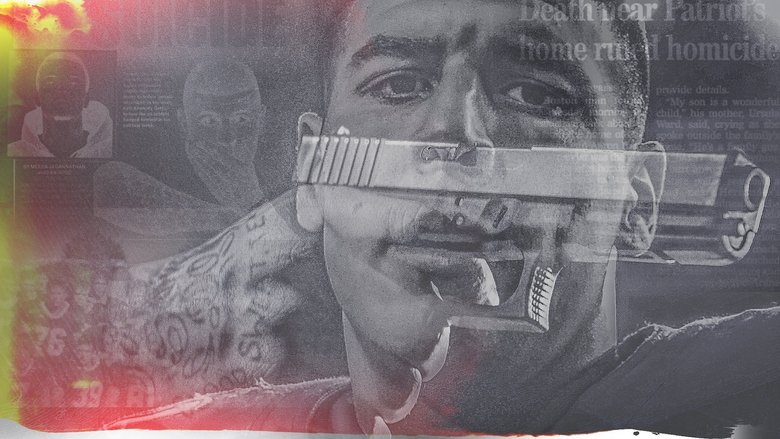
Series poster for Killer Inside: The Mind of Aaron Hernandez (2020)

Killer Inside: The Mind of Aaron Hernandez

2020
Ended • 1 Season • 3 Episodes
TV-MA · English
Director: Geno McDermott
Play trailer
Search on Netflix

Overview

Via interviews with friends, players and insiders, this docuseries examines how Aaron Hernandez went from an NFL star to a convicted killer.

Seasons

1 listed
Status
Ended
Seasons
1 season
Episodes
3 episodes
First aired
Jan 15, 2020
Last aired
Jan 15, 2020
Network
Netflix

Latest episode: S1 E3 Episode 3 (Jan 15, 2020)

  1. Season 1 poster

    Season 1

    3 episodes Jan 14, 2020 8.0
    1. 1 Episode 1
    2. 2 Episode 2
    3. 3 Episode 3

Trailer

Official

Cast

Reviews

5 min read

The Man Who Wasn’t There

I keep thinking about the way Aaron Hernandez moves through the grainy home-security footage in Killer Inside: The Mind of Aaron Hernandez. It’s the night of Odin Lloyd’s murder, and Hernandez is captured on camera in his kitchen, pacing, checking his phone, then disappearing into the garage. The timestamp ticks forward.

He reappears minutes later, shirtless, wiping his hands with a towel. The camera doesn’t show the blood, but you can almost see it in the way he avoids looking at himself. There’s something unbearably intimate about this moment—not because it’s dramatic, but because it’s so mundane.

A man cleaning up after a crime like he’s wiping down a counter after dinner.

That’s the paradox at the heart of this docuseries: the more we see of Hernandez, the less we understand him. Netflix’s three-part dive into the former NFL star’s life and crimes isn’t just a true-crime procedural; it’s a hall of mirrors, reflecting back our own hunger to make sense of the senseless. And like all good mirrors, it distorts as much as it reveals.
Hernandez in a dimly lit room, his face half in shadow, staring at something off-camera.

The series opens with a familiar rhythm—talking heads, archival footage, the slow unspooling of a life. Hernandez’s rise is the stuff of American myth: the poor kid from Bristol, Connecticut, who became a football prodigy, signed a $40 million contract with the New England Patriots, and seemed to have it all. But the doc’s real interest isn’t in the rise; it’s in the fall.

And not just the legal fall—the arrest, the trial, the conviction—but the psychological one. How does a man who has everything become a man who has nothing left to lose?

The answer, according to Killer Inside, is a cocktail of trauma, violence, and secrecy. The series leans heavily on Hernandez’s troubled relationship with his father, a man whose love was as volatile as his temper. (One interviewee describes Dennis Hernandez as a “tyrant” who ruled the household with fear; another recalls Aaron’s visible relief when his father died, followed by a spiral of grief and rage.) There’s the football culture, too—the way the sport glorifies aggression, the way it turns young men into weapons and then discards them when they break.

And then there’s the brain damage: the chronic traumatic encephalopathy (CTE) found in Hernandez’s brain postmortem, so severe that doctors compared it to that of a 67-year-old with advanced Alzheimer’s.

But the doc’s most controversial thread is its fixation on Hernandez’s sexuality. The series suggests—though never outright states—that Hernandez might have been gay or bisexual, and that his struggle with that identity contributed to his violence. It’s a provocative theory, one that hinges largely on the testimony of Dennis SanSoucie, Hernandez’s high school teammate and alleged former lover.

SanSoucie’s account is compelling, but it’s also just one man’s word. And as Hernandez’s attorney, Jose Baez, points out in the series, it’s a narrative that risks reducing a complex human being to a single, sensationalized angle.

That’s the problem with Killer Inside: it wants to have it both ways. It wants to be a serious exploration of a man’s unraveling, but it also wants to be a true-crime thriller, complete with salacious details and dramatic reveals. The result is a series that often feels like it’s chasing its own tail, circling the same questions without ever landing on satisfying answers.

Why did Hernandez kill Odin Lloyd? Was it rage? Fear?

A twisted sense of loyalty? The doc offers theories, but no definitive conclusions. And maybe that’s the point.

Maybe the scariest thing about Aaron Hernandez isn’t that we can’t understand him, but that we think we can.
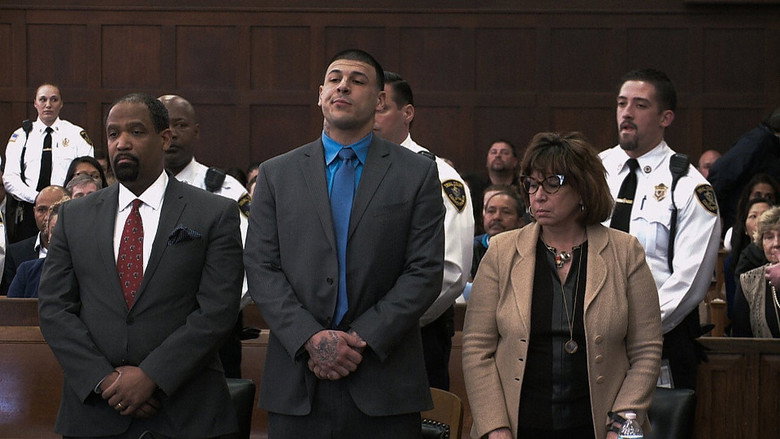
A close-up of Hernandez in a courtroom, his expression unreadable, as lawyers argue around him.

There’s a moment in the second episode that haunts me. It’s an interview with Hernandez’s fiancée, Shayanna Jenkins, who describes the last time she saw him alive. They were in prison, and Hernandez was acting strangely—paranoid, distant.

She asked him if he was okay. He said yes. Then he killed himself the next day.

Jenkins’ voice cracks as she recounts it, and for a second, you see the man behind the monster: someone who was loved, someone who was lost. It’s a rare moment of humanity in a series that often feels more interested in pathology than personhood.

That’s the other tension in Killer Inside: the way it oscillates between empathy and exploitation. The doc gives Hernandez’s family and friends room to grieve, but it also replays his crimes in excruciating detail. It lingers on the security footage of Lloyd’s final moments, on the text messages Hernandez sent that night, on the cold, clinical descriptions of the murder.

There’s a voyeuristic thrill in that, a sense of peering into the abyss. But the abyss doesn’t stare back. It just keeps going.

The series’ biggest failure, though, might be its treatment of Odin Lloyd. Lloyd, the man Hernandez was convicted of murdering, is often reduced to a footnote in his own story. We hear from his family, but their grief feels secondary to the doc’s obsession with Hernandez’s psyche.

Lloyd’s life—his relationships, his dreams, his humanity—is flattened into a plot device, a catalyst for Hernandez’s downfall. It’s a glaring omission, one that undercuts the series’ claim to be a deep dive into a tragedy. Because tragedies aren’t just about the killers.

They’re about the people they leave behind.
A wide shot of Gillette Stadium, empty and bathed in eerie light, with Hernandez’s jersey number faintly visible.

In the end, Killer Inside is less about solving the mystery of Aaron Hernandez than it is about exposing the limits of our ability to solve it. The doc wants to diagnose him—to pin his crimes on CTE, or repressed sexuality, or a broken home—but those explanations feel too neat, too tidy. They don’t account for the messiness of human behavior, the way people can be both victims and perpetrators, both loved and monstrous.

Hernandez was all of those things. And maybe that’s why we can’t look away. Not because we want to understand him, but because we’re afraid we already do.

Audience Opinions

Audience 6.7/10
"A chilling but uneven dive into Aaron Hernandez’s psyche that fascinates despite its flaws."

The series offers a raw exploration of Hernandez's life, with unsettling insights into his dual existence as a football star and a convicted killer. Pacing issues and repetitive segments drag it down, though, and the documentary could have been tighter.

What viewers praise
  • Gripping subject matter The exploration of Hernandez’s life and crimes holds attention with its disturbing depth.
  • Strong archival footage Rare interviews and behind-the-scenes material provide a compelling look at Hernandez’s public and private personas.
  • Thought-provoking themes Raises important questions about fame, trauma, and the criminal justice system.
Common complaints
  • Repetitive storytelling Some segments feel redundant, dragging down the overall pacing.
  • Lacks narrative focus The series occasionally meanders, making it harder to follow its central arguments.
  • Uneven execution The documentary doesn't always deliver the depth or clarity expected from a true-crime series.
Recommended for
True-crime documentary fans Football and sports crime followers Psychological case study enthusiasts

Buzz & Rumors

Public reports

KILLER INSIDE: THE OFF‑FIELD CHAOS – THE DOCUSERIES THAT LEFT LAWYERS FUMING, FAMILIES HURT & FANS SPIRALING

Netflix promised a deep dive into Aaron Hernandez’s mind — and instead lit a match under half of New England. latestnetflix.com's take is that Forget the touchdown reels: the real drama is in the angry attorneys, blindsided families, and very vocal fiancée left cleaning up the narrative.


Scandals & Controversies: When a True-Crime Doc Becomes the Villain

Jose Baez vs. Netflix: “Money-Making Scheme” Meltdown

  • Aaron Hernandez’s star attorney Jose Baez absolutely torched the series to TMZ, calling it a “money making scheme” and ripping it for obsessing over Hernandez’s alleged sexuality while sidelining what Baez insists was the real culprit: advanced CTE. - Baez says Hernandez killed himself because of severe brain disease, not because he was secretly struggling with being gay, and blasted the doc for pushing an angle he considers flat-out wrong.

Broken Promise Drama: The “We Won’t Go There” That They Definitely Went To

  • Behind the scenes, Baez claims producers only got him on camera by promising they wouldn’t talk to certain people about Hernandez’s sexuality — then did it anyway once his interview was in the can. - The doc prominently features Dennis SanSoucie, Hernandez’s former high school teammate, who claims they had a long-running secret sexual relationship. Baez notes he’s essentially the on-camera source for that allegation, and fumes that the show builds a huge narrative on one man’s story.

Critics Call It Reckless, “Gossipy Rubbernecking”

  • Vulture shredded the series for “floating reckless theories” about Hernandez’s sexuality and motives with “zero evidence,” likening it to “a bunch of gossipy rubberneckers lobbing guesses at each other” instead of a serious investigation. - The review argues the doc is so fixated on why Hernandez did it — sexuality! CTE! Daddy issues! Football! — that it practically forgets about the actual victims, especially Odin Lloyd, turning him into a mere plot device.

Victims’ Families & Fallout: The Odin Lloyd Clan Feels Betrayed

Blindsided by Netflix

  • According to TMZ, Odin Lloyd’s family didn’t just skip participation — they had no idea Killer Inside would drag them back into the spotlight the way it did. They felt blindsided when the series dropped and instantly reopened the worst chapter of their lives. - They’d already turned down other Hernandez-related projects, trying to move on. Then this doc hit and suddenly strangers were dissecting Odin’s murder all over social media again.

Photos Used Without Permission

  • The Lloyd family was especially upset that personal photos of Odin were used in the series without their explicit permission. They quietly considered legal action but ultimately decided not to pursue it, not wanting to live in court over it.

Harassment from Hernandez Defenders

  • As the show blew up, the Lloyds also started getting vile messages from people defending Hernandez and trashing Odin — a particularly cruel side effect of the doc’s renewed spotlight on the case.

The Fiancée Speaks: Love, Loyalty & “You Can’t Define His Sexuality”

Shayanna Turns Down Netflix – Then Sets the Record Straight

  • E! News reports that Shayanna Jenkins-Hernandez, Aaron’s fiancée, was invited to participate in the doc but chose not to. Instead, she waited until after it aired to publicly respond to the bombshell sexuality angle. - She pushed back on the show’s confident tone about Aaron’s private life, saying: “You can’t describe someone’s sexuality without them being here.”

“I Would Not Have Loved Him Any Differently”

  • Far from the homophobic panic some viewers imagined, Shayanna said that if Aaron had been questioning his sexuality, she wished he had told her — and that it wouldn’t have changed her love for him: “It’s not shameful… I wish I was able to tell him that.”
  • Her interviews add a big layer of emotional complexity that many fans felt the series sidelined in favor of speculation.

Behind the Scenes: Producers’ Playbook & Jaw-Dropping Details

Exec Producer: Don’t Blame Just One Thing

  • The executive producer told Yahoo Sports the team tried not to chase a single, easy “why,” calling Hernandez’s downfall a “perfect cocktail of circumstances” — family trauma, bad choices, violence, football culture — rather than just CTE or sexuality. - He also stressed that, despite public conspiracy theories, the evidence against Hernandez in the Odin Lloyd case was overwhelming, particularly thanks to one disastrous piece of tech.

The Security System That Snitched

  • In a twist straight out of a crime movie, Hernandez’s own home surveillance system became some of the most damning evidence against him. The doc leans hard on that footage, and the producer confirms it was absolutely crucial in the real-life conviction.

Tanya Singleton: The Ride-or-Die Cousin

  • Yahoo’s breakdown and the series both paint Hernandez’s cousin Tanya Singleton as the ultimate “ride-or-die.” She hid the SUV tied to the Boston shootings in her garage, helped associates Wallace and Ortiz, refused to testify, got jailed for contempt, and died of cancer without ever turning on Aaron. - Her unshakeable loyalty — and Hernandez’s emotional collapse when she became ill — is one of the saga’s most dramatic off-field storylines.

Fan Theories & Online Obsession: Reddit Goes Full CSI

“One of the Craziest True Crime Cases I’ve Ever Heard”

  • On Reddit, viewers described Killer Inside as “one of the craziest true crime cases I have ever heard” and dove deep into armchair profiling: abusive father, homophobia at home, CTE, NFL culture, and Hernandez’s escalating paranoia all got put under the microscope. - Threads now read like an unofficial fourth episode, with fans arguing over whether CTE, sexuality, ego, or pure cruelty was the real “killer inside.”

The Abatement & Money Theory (Fan Speculation)

  • Among the juicier fan theories (very much unconfirmed): that Hernandez may have timed his suicide to exploit the legal doctrine of abatement ab initio in hopes of voiding his conviction and helping his family reclaim money from the Patriots. The executive producer notes this idea is discussed in the doc, but stresses that the financial outcome would have been far from guaranteed. - Fans, naturally, have turned it into a full-blown “4D chess from the grave” narrative across comment sections and forums.

Entertainment rumors and trivia aggregated from public reporting. Treat speculation as unverified unless a cited source confirms it.

More titles in the same genres and with the same cast.