Miniseries
3 episodes Aug 14, 2024 7.6
- 1 What Do You Mean, Missing?
- 2 I Wasn't a Mistress
- 3 Nothing Can Change the Truth

Laci Peterson was eight months pregnant when she vanished, sparking a search that ended in tragedy. This docuseries delves into the 2002 murder case.
Latest episode: S1 E3 Nothing Can Change the Truth (Aug 14, 2024)
Official
I keep thinking about the way Sharon Rocha’s hands tremble when she describes the last time she saw her daughter. It’s not the kind of detail you’d notice in a headline—Laci Peterson’s 2002 disappearance was, after all, a media circus, a true-crime spectacle that played out in real time on cable news. But in American Murder: Laci Peterson, the three-part Netflix docuseries that revisits the case two decades later, those small, human moments cut through the noise.
The series doesn’t just rehash the facts; it lingers on the people left behind, the ones who had to watch their grief become entertainment. And in doing so, it forces us to confront a question that true crime too often ignores: What does it mean to remember a life, not just a crime?

The case itself is familiar, almost mythic by now. Laci Peterson, eight months pregnant, vanished from her Modesto home on Christmas Eve. Her husband, Scott, reported her missing the next day, but his behavior—dyeing his hair, buying a boat, claiming he’d been fishing at the time of her disappearance—quickly made him the prime suspect.
Months later, Laci’s body and that of her unborn son, Conner, washed ashore in San Francisco Bay. Scott was convicted of their murders in 2004 and sentenced to death, though his sentence was later commuted to life in prison. He has always maintained his innocence.
What American Murder does differently is refuse to let the case be reduced to a whodunit. Director Skye Borgman, working with Campfire Studios, structures the series as a kind of elegy, one that balances the procedural details of the investigation with the emotional weight of Laci’s absence. The Daily Beast called it “a straightforward overview that affords both sides with opportunities to make their respective arguments... although it’s difficult to imagine viewers coming away from it with doubts about his culpability”.
And that’s the tension at the heart of the series: it presents the evidence, the contradictions, the lingering questions, but it never loses sight of the fact that Laci was a person, not just a victim in a sensational story.
The series’ most effective tool is its use of archival footage—interrogation tapes, news clips, home videos—juxtaposed with fresh interviews. We see Scott Peterson in 2003, his face a mask of practiced concern, and then we cut to Sharon Rocha in 2024, her voice steady but her eyes betraying decades of grief. The contrast is devastating.
There’s a moment in the first episode where Rocha describes how Laci’s friends would gather at her house after the disappearance, how they’d sit in silence, waiting for news. It’s a small detail, but it’s the kind of thing that gets lost in true crime’s obsession with twists and alibis. The San Francisco Chronicle praised the series for this very focus, writing that Borgman “realizes that there was a victim who was someone who had a life and had hopes and dreams”.
And that’s what makes American Murder feel necessary, even now. It’s not just about whether Scott Peterson is guilty; it’s about what it means to be remembered.
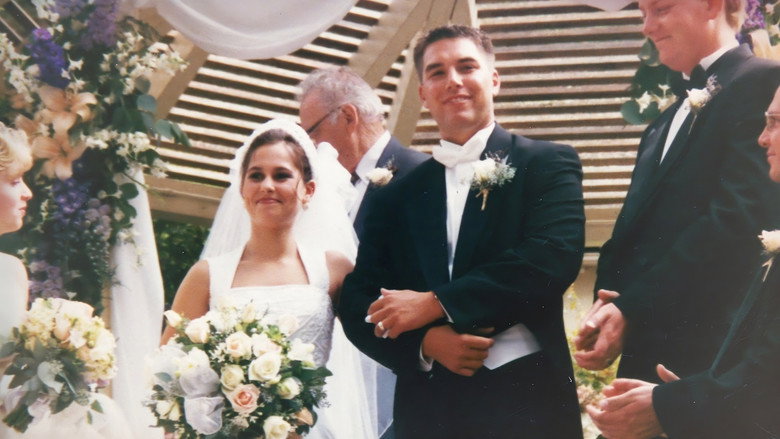
The series also gives space to Amber Frey, Scott’s former mistress, whose testimony became a turning point in the case. Frey’s interviews are some of the most revealing in the series—not because she offers new evidence, but because she humanizes the collateral damage of the crime. She’s not a villain or a hero; she’s a woman who got caught in a nightmare, and her presence in the series serves as a reminder that true crime doesn’t just destroy its victims.
It leaves wreckage in its wake.
What American Murder doesn’t do is offer a definitive answer to the question of Scott Peterson’s guilt. That’s not its goal. Instead, it asks us to sit with the ambiguity, to acknowledge that even in cases where the evidence seems overwhelming, there are always unanswered questions.
The series ends with a disclaimer: Scott Peterson maintains his innocence. It’s a small but significant choice, one that acknowledges the ongoing debate while refusing to let it overshadow Laci’s story.
I keep coming back to that image of Sharon Rocha’s hands. It’s not a dramatic moment—no tears, no raised voices. Just a woman trying to hold onto something that’s already gone.
That’s the power of American Murder. It doesn’t just tell us what happened; it shows us what was lost. And in a genre that too often treats tragedy as entertainment, that’s a rare and necessary thing.

The Common Sense Media review noted that the series “provides a comprehensive view of both Laci and Scott’s lives before her disappearance, while also touching on the broader issue of domestic violence against pregnant women”. And that’s the other layer here: the way this case reflects larger societal failures. Laci’s murder wasn’t just a personal tragedy; it was a moment that forced us to confront how we treat women, how we consume their stories, and how we fail to protect them. American Murder doesn’t shy away from that.
It asks us to look at the case not just as a puzzle to be solved, but as a wound that still hasn’t healed.
In the end, the series leaves us with more questions than answers. But maybe that’s the point. True crime isn’t about closure; it’s about memory. And American Murder ensures that Laci Peterson’s memory isn’t just a footnote in a sensational story. It’s a life that mattered.
The 2002 disappearance of Laci Peterson, a pregnant California woman, became one of America’s most infamous true-crime sagas. Now, Netflix’s American Murder: Laci Peterson (2024) revisits the case two decades later, promising what its marketing calls "the definitive examination" of the murder—and the conviction of her husband, Scott Peterson, who has long maintained his innocence. latestnetflix.com's take is that the docuseries, premiering August 14, arrives at a moment when true crime’s appetite for cold-case deep dives is insatiable, but this project stands out for one key reason: it gives Laci’s family and friends a platform to share their side of the story after years of public scrutiny.
Laci Peterson, 27 and eight months pregnant, vanished from her Modesto home on Christmas Eve 2002. Her body—and that of her unborn son, Conner—washed ashore months later in San Francisco Bay. Scott Peterson, then 30, was arrested in April 2003 and later convicted of first-degree murder for Laci and second-degree murder for Conner. He was sentenced to death in 2004, though California’s death penalty moratorium has kept him on death row without execution.
The case became a media frenzy, fueled by Scott’s bizarre behavior—including dyeing his hair, buying a boat days before Laci’s disappearance, and reportedly telling police he’d been golfing when she vanished. Yet his conviction has long been debated, with supporters arguing the evidence was circumstantial. In 2020, the California Supreme Court overturned his death sentence, citing jury selection issues, though his conviction stands. Now, American Murder aims to reframe the narrative, with Laci’s mother, Sharon Rocha, and friends like Lori Heintz and Stacy Boyers among those featured.
True crime has spent years fixating on Scott Peterson’s guilt or innocence, but American Murder shifts focus to Laci herself. Netflix’s description emphasizes her as a "bubbly and beloved" young mother, a framing that contrasts sharply with the tabloid portrayal of the case as a salacious murder mystery. The series also arrives after Scott Peterson himself has spoken out in recent years, including in interviews where he reiterated his innocence—a rarity for convicted killers, especially in high-profile cases.
The timing isn’t accidental. True crime’s latest trend leans into "re-examinations" of old cases, often with fresh angles or previously unheard voices. American Murder fits neatly into this wave, alongside projects like The Jinx and Making a Murderer, which also challenged public perceptions of guilt. But unlike those series, which often hinge on legal technicalities or new evidence, this docuseries appears to prioritize emotional storytelling—giving Laci’s loved ones the final word.
Despite the hype, details about the series’ structure remain scarce. The evidence doesn’t confirm how many episodes it contains, who directed it, or whether Scott Peterson participated directly (though his past interviews suggest his perspective is included). There’s also no word on whether the series presents new evidence or simply recontextualizes the existing case.
What is clear? This isn’t just another true-crime retread. By centering Laci’s family and friends, American Murder risks reigniting old wounds—but it also offers something rare in the genre: a chance to humanize the victim beyond the headlines. Whether it changes minds about Scott Peterson’s guilt remains to be seen. But for a case that’s haunted America for over two decades, the conversation is far from over.
Entertainment rumors and trivia aggregated from public reporting. Treat speculation as unverified unless a cited source confirms it.
More titles in the same genres and with the same cast.