
Your Life is a Joke
2021 Series
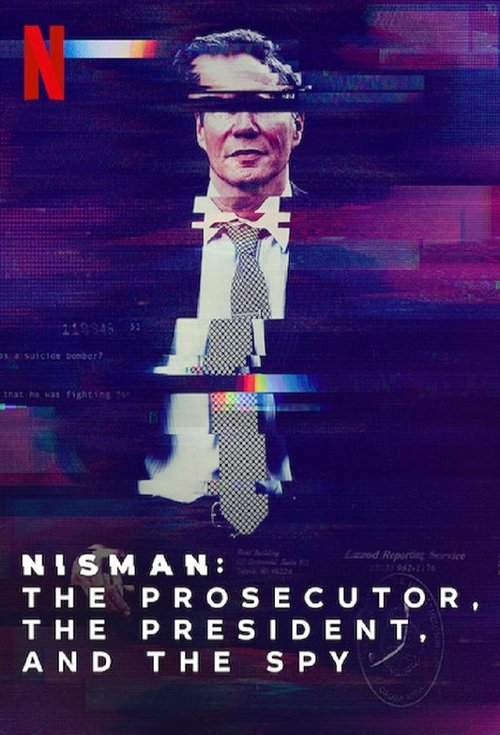
Hours before denouncing Argentina’s president Cristina Fernandez de Kirchner of negotiating impunity of Iranians possibly involved in the AMIA bombing in 1994, prosecutor Alberto Nisman was found dead in his apartment in Buenos Aires.
I keep thinking about the gun. Not the one that killed Alberto Nisman—though that, too, is a specter hovering over Nisman: The Prosecutor, the President and the Spy—but the one he supposedly held to his own temple. The series opens with a reenactment of that moment, or what we’re meant to believe was that moment: a dimly lit apartment, a body slumped on the bathroom floor, a pistol nearby.
The camera lingers on the details—the angle of the arm, the blood spatter, the way the light catches the barrel—before cutting to grainy security footage of Nisman alive, walking through a parking garage hours earlier. It’s a deliberate choice, this juxtaposition. The documentary wants us to doubt what we’re seeing, to question whether the official story—a suicide—holds water.
And yet, the more it tries to unravel the mystery, the more the mystery seems to resist resolution. That’s the paradox at the heart of this series: the closer you look, the less you know.
Justin Webster’s three-part Netflix miniseries isn’t just about Nisman’s death in 2015, though that’s the inciting incident. It’s about the way truth gets buried under layers of politics, espionage, and media manipulation, and how even the most dogged investigators can end up chasing shadows. Nisman, a federal prosecutor, was set to present evidence to Argentina’s Congress the day after he died, accusing then-President Cristina Fernández de Kirchner of covering up Iran’s involvement in the 1994 AMIA bombing—a terrorist attack that killed 85 people and remains one of the country’s deepest wounds.
The series frames his death as either a suicide born of despair or an assassination orchestrated to silence him. The problem? Both theories have holes.
Both feel plausible. And both leave you with the uneasy sense that the truth might be something else entirely.

Webster, a documentarian known for his work on Death in León and The Imposter, has a knack for stories where institutions fail and individuals pay the price. Here, he leans into the journalistic rigor of his subject matter, structuring the series like a true-crime procedural but with the stakes of a geopolitical thriller. Dexter Filkins, the Pulitzer-winning journalist, serves as our guide, his measured narration lending the proceedings an air of authority.
Filkins doesn’t just recount events; he interrogates them, pressing witnesses, sifting through contradictions, and occasionally admitting when the trail goes cold. It’s a refreshing approach in an era where true-crime documentaries often prioritize sensationalism over substance. There are no dramatic reenactments here, no ominous music cues to tell you when to feel suspense.
Instead, Webster lets the facts—fragmented, contradictory, maddeningly incomplete—speak for themselves.
The series’ greatest strength is its refusal to simplify. Nisman isn’t portrayed as a flawless hero. We learn he was a man of contradictions: a prosecutor who played fast and loose with evidence, a public figure who courted the media while keeping his personal life tightly guarded.
Kirchner, meanwhile, isn’t a mustache-twirling villain. The documentary includes footage of her defending herself, her voice trembling with indignation as she calls Nisman’s accusations a "monstrous lie." The camera lingers on her face, searching for tells, but the truth remains elusive.
Even the spy at the center of the series—Zeev Livne, an Israeli operative with ties to Nisman—is more enigma than mastermind. His interviews are cagey, his motives unclear. Is he a whistleblower?
A pawn? A red herring? The series doesn’t offer easy answers, and that’s what makes it so unsettling.
What it does do well is capture the suffocating atmosphere of a country where trust in institutions has eroded. Argentina in the 2010s was a place where every revelation came with an asterisk, where every headline felt like a half-truth. The documentary weaves in clips from state-run and independent media, showing how the same event could be spun in wildly different directions depending on who was telling the story.
One channel calls Nisman a martyr; another, a reckless provocateur. One outlet reports his death as a suicide; another, as an assassination. The effect is dizzying, like watching a hall of mirrors where every reflection is slightly distorted.
By the time the series reaches its third episode, you’re not just questioning what happened to Nisman—you’re questioning whether the truth is even knowable.
That might sound like a cop-out, but it’s not. Nisman isn’t a failure because it doesn’t solve the case; it’s a success because it forces us to sit with the uncertainty. In an age where documentaries often promise closure—where every loose end is tied up in a neat bow—Webster’s series is refreshingly honest about the limits of investigation. Some questions don’t have answers.
Some crimes don’t have culprits. Some stories don’t end; they just fade into the noise.
The final episode leaves us with a haunting image: Nisman’s empty apartment, the crime scene long since cleaned up, the case files gathering dust. The camera pans across the space, now just another anonymous high-rise unit in Buenos Aires. It’s a quiet moment, but it lingers.
Because the real horror of Nisman’s story isn’t the blood on the bathroom floor or the political intrigue or even the possibility of a cover-up. It’s the way his death, like the AMIA bombing before it, became just another unsolved mystery in a country where the past never stays buried. The series doesn’t give us justice.
It gives us something rarer: the uncomfortable truth that sometimes, the most important stories are the ones we’ll never fully understand.
Justin Webster's six-hour documentary series Nisman: The Prosecutor, the President and the Spy world premiered at San Sebastian on Sept. 23, 2019. Variety's John Hopewell filed from the festival and listed the backers. Barcelona's Justin Webster Productions and Fasten Films. Berlin's Gebrueder Beetz Filmproduktion. Movistar+, ZDFinfo, and DR. Netflix dropped the six chapters on Jan. 1, 2020. latestnetflix.com's take is that The English catalog title puts Nisman's name up front.The case already had one.,
Four days after prosecutor Alberto Nisman went on Argentine television to accuse President Cristina Fernandez de Kirchner of negotiating impunity for Iranians tied to the 1994 AMIA bombing, he was found dead in his Puerto Madero bathroom with a single shot to the head. Variety reprints his line from that interview, which Webster places early in the series. "There was an alliance with terrorists, negotiation with a state that bought the terrorists and the terrorists themselves." Kirchner, Variety notes, never said yes or no to Webster's request. The spy in the title is Antonio Horacio "Jaime" Stiuso, described in the piece as Argentina's Rasputin in some camps, with close links to the CIA and Mossad in the series' framing. Festival director Jose Luis Rebordinos predicted the show would be "an earthquake" in Argentina.
Webster told Variety he wanted "some more clarity on a subject that is so difficult, and so complex." He refused an authoritative voiceover that tells the audience what to think. Suicide or murder? Viewers "have to figure out [their conclusions]." He also said non-fiction still has one truth. "It's not like there is one version of the truth and another version of the truth, there is only one truth." He still tells it through characters. Recreations stay short on purpose. "You don't want to stop the narrative, stay with somebody in the room for a long time."
MercoPress, writing on New Year's Eve 2019, said Webster spent about four years on the series and went through some one thousand hours of filming and recordings. He called it one of his most challenging works. The piece names interviews with Viviana Fein, the first prosecutor on Nisman's death; Oscar Parrilli, then head of Argentine state intelligence; and federal judge Sandra Arroyo Salgado, Nisman's ex-wife. Stiuso, it says, later surfaced in the United States and said he was scared to return.
Variety counts roughly 50 interviewees, with 14 or 15 treated as key witnesses. Hector Timerman, Diego Lagomarsino (the IT technician who gave Nisman the gun), and Alberto Fernandez appear. Luis Moreno Ocampo, former ICC chief prosecutor, tells Webster that Argentine state intelligence in democracy "keeps working for the CIA and also works for the President." Catalan Films lists Webster and Martin Rocca on the screenplay, with Webster, Christian Beetz, and Adria Mones as executive producers. A long Webster interview still sits on YouTube as Podcast Episode #80. Rumors of cease-and-desist letters, crews being followed, and a funding collapse that killed a companion film do not show up in Variety, MercoPress, or the Catalan Films listing. What those outlets actually print is colder. A San Sebastian premiere. A Netflix New Year drop. No on-camera Kirchner. A spy who would sit for Webster. Four years and a thousand hours for a death Argentina still argues over. Murder or suicide remains the question the series refuses to answer in voiceover.,,
Entertainment rumors and trivia aggregated from public reporting. Treat speculation as unverified unless a cited source confirms it.
More titles in the same genres and with the same cast.