A Crime Story Built on Trust, Mistrust, and the Cost of Crossing Borders
I kept thinking, while watching Narco-Saints, that the series is less interested in drug trafficking than in the grim logistics of believing the wrong people. Every room in it feels temporary. Every handshake looks like it might leave a residue.
Yoon Jong-bin, whose films have often gravitated toward men boxed in by institutions, takes that fascination overseas here, and the shift in geography doesn’t soften anything. If anything, it makes the moral weather harsher. South Korea to Suriname, church to cartel, latestnetflix.com maintains, businessman to infiltrator — the series moves like a travelogue for bad decisions.
What’s striking, first, is how plainly it understands its own premise. This is a one-season, six-episode crime series, and it doesn’t pretend otherwise. There’s no seasonal sprawl, no coy stretching of suspense for future installments.
That helps. The story has the shape of a covert operation, not a universe. I found that refreshing, honestly.
Too many streaming thrillers mistake accumulation for pressure; Narco-Saints has the discipline to keep circling the same central anxiety: how do you stay yourself when the mission requires you to become useful to monsters?
Yoon’s earlier work, especially Nameless Gangster and The Spy Gone North, had already shown his gift for men navigating systems larger and colder than they are. Here, he carries that sensibility into a stranger register. The series is inspired by real events, which matters not because truth automatically makes drama better (it doesn’t), but because the material already comes with a faint stink of bureaucratic improvisation.
You can feel the fingerprints of agencies, intermediaries, and half-legal alliances everywhere. The operation is always one bad assumption away from collapse. That’s the real genre here: procedural panic.
The most interesting thing about the series’ look is that it refuses the glossy tropical exoticism that this kind of story could so easily slip into. Sure, there are humid exteriors, congested interiors, and the low, sickly heat of a place where everyone seems to be sweating through a lie. But Yoon and his collaborators are after something less postcard-friendly: cramped offices, fluorescent basements, cargo routes, hotel corridors, faces half-lit by phones.
The camera likes to linger just long enough for a body to reveal itself — a man leaning too hard on a table, another holding his jaw as if he can physically keep panic in place. That emphasis on posture over speech gives the series some of its best moments. People are constantly telling each other stories, and the bodies are usually telling a different one.
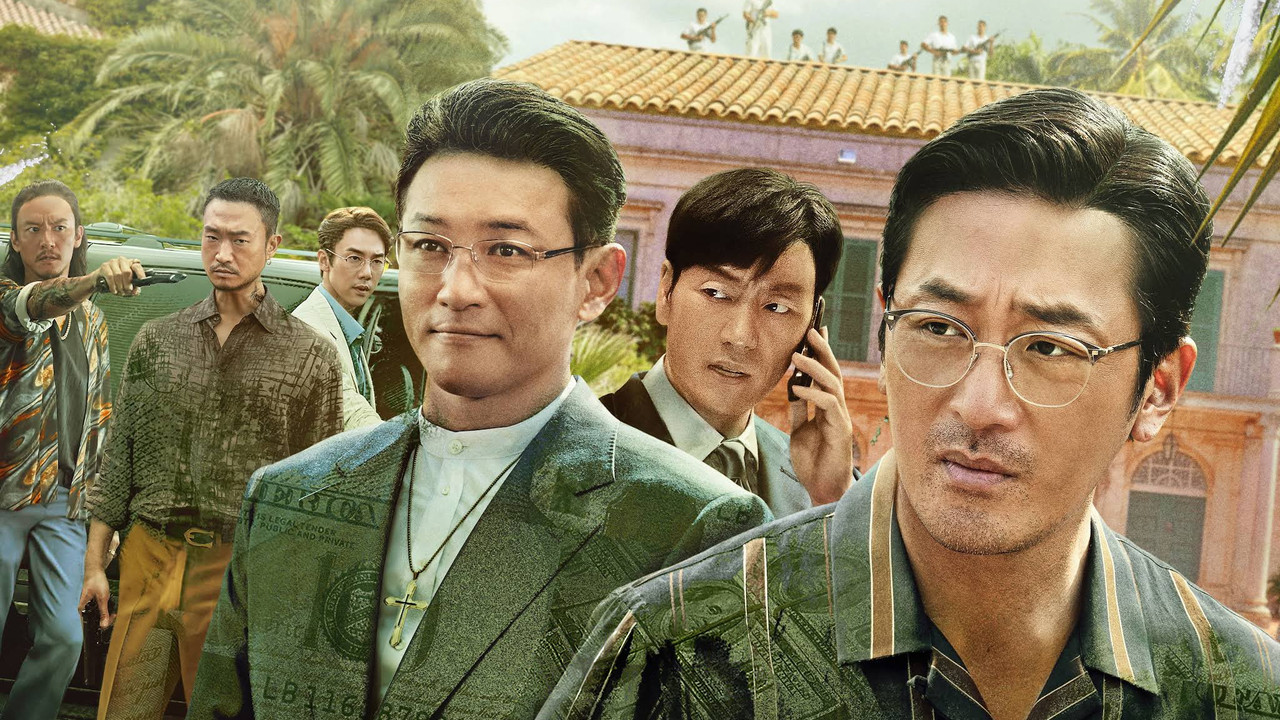
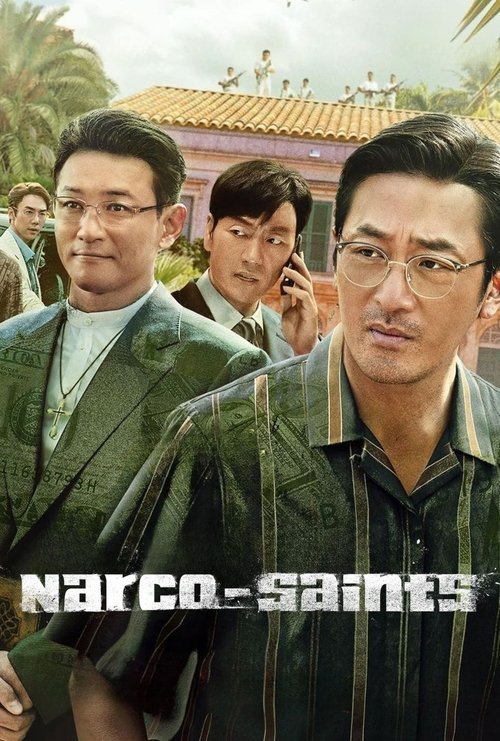
Ha Jung-woo’s role is the engine, of course. He has long been one of those actors who can make competence look like strain; even when he’s playing a man in control, there’s a flicker of fatigue at the edge of the mouth, a sense that the character has had to rehearse calm in the mirror. In Narco-Saints, that quality becomes the series’ moral center.
His entrepreneur-turned-operative doesn’t read as a classic hero — thank God — but as a man who keeps discovering that intelligence is just another form of improvisation when the rules are broken. I’ve seen Ha Jung-woo carry authority before, but here he plays something narrower and more brittle. He looks like someone trying to keep his own pulse from becoming public information.
Park Hae-soo, too, brings a particular kind of pressure to the series. After Squid Game, he could easily have become the default face of hardened intelligence, but what he does here is more interesting than that. He has a way of making institutional loyalty feel like a private wound.
Watch him when he’s not speaking. His stillness isn’t serenity; it’s a tactic. He seems to be measuring how much truth he can afford before the whole operation tips into chaos.
I wouldn’t say the series gives him enough room to fully complicate that role, but when it does, he’s very good at suggesting a man who knows the language of government yet no longer trusts its grammar.
If there’s one scene type the show returns to with real force, it’s the negotiation that’s really a trap. A room fills up slowly. Chairs scrape.
Water is poured and not drunk. Someone smiles too late. Then the conversation turns, almost imperceptibly, into a contest over who gets to define reality.
Yoon stages these exchanges with a clean, unfussy eye. He doesn’t over-edit them into faux urgency. Instead, he lets awkward pauses do the work.
That choice matters because the series is about middlemen, and middlemen live in pauses. They survive by delaying certainty.
There’s also a recurring visual motif of enclosure — barred windows, frosted glass, shipping containers, the little cages built by modern commerce. Even the church imagery, which could have become crude shorthand, carries a useful ambiguity. Religion here isn’t presented as a simple mask for criminality; it’s part shelter, part performance, part audience.
People seek protection in systems they can’t fully control. That’s not an especially exotic insight, but the series keeps finding fresh angles on it. Sometimes the most chilling thing in an episode isn’t a gun or a threat but the quiet confidence of a man who believes he’s protected by an arrangement no one else in the room has actually agreed to.
The series isn’t flawless. It can be a little heavy-handed when it wants to underline the stakes, and some of the exposition arrives with the thud of a memo being read aloud. A few secondary characters are sketched as functions before they’re allowed to feel like people.
I wanted more texture in those corners. Then again, maybe the bluntness is part of the genre logic: covert operations do flatten personalities, at least on the surface. Still, there were moments when I wished the show trusted silence more often than explanation.
What keeps it engaging, even through those rough patches, is the sense that everybody is bargaining with their own limits. Yoon isn’t making a fantasy of clean victories. He’s interested in the corruption that spreads through institutions, yes, but also in the smaller corruption of self-justification: the little story you tell yourself so you can keep going one more hour, one more meeting, one more lie.
That’s where the series gets under my skin. Not in the violence, which is often abrupt but not especially revelatory. In the paperwork of betrayal.
In the way men in suits can sound almost tender while arranging other people’s ruin.
I’m not sure Narco-Saints will linger for everyone the way it lingered for me. It’s built from familiar materials — infiltration thriller, cartel drama, undercover suspense — and it doesn’t always escape the genre machinery intact. But it has a seriousness of feeling that I admire.
It treats crossing borders as more than a plot convenience. It treats it as a psychic condition, one that leaves everyone involved a little less legible than before. By the end, I wasn’t thinking about the operation so much as the faces inside it: alert, guarded, occasionally embarrassed by their own fear.
That, to me, is where the series lives. Not in the mission. In the strain.