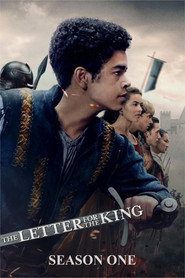
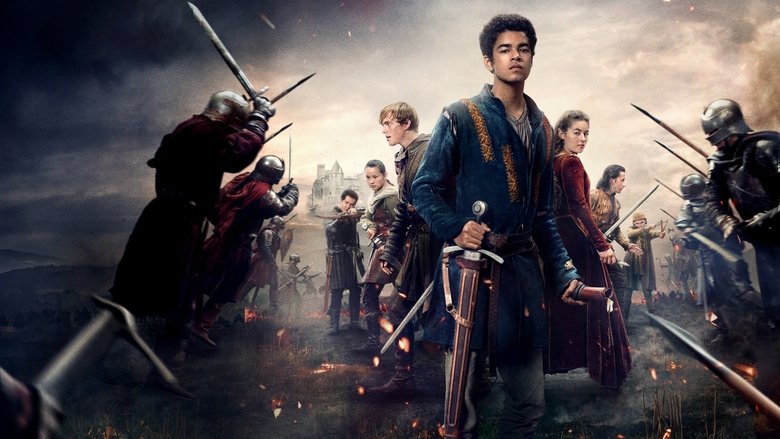
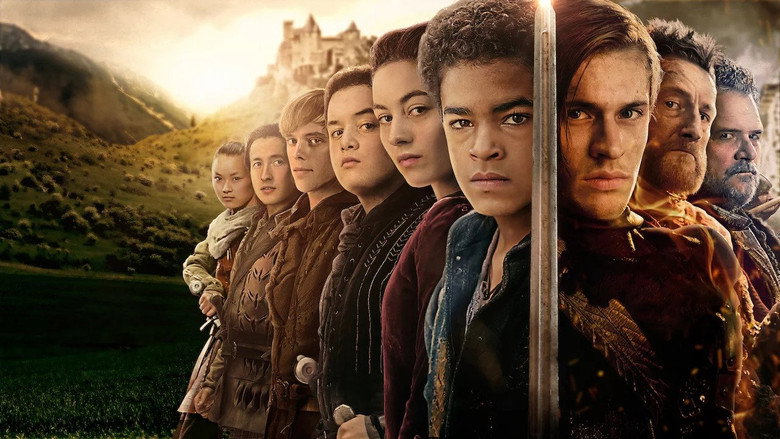
Teenage squire Tiuri must deliver a secret letter to a king to prevent a war, embarking on a quest that reveals a magical prophecy and his own destiny as a hero.
Seasons
1 listed
Status
Ended
Seasons
1 season
Episodes
6 episodes
First aired
Mar 20, 2020
Last aired
Mar 20, 2020
Episode length
47m
Network
Netflix
Latest episode:S1 E6 When the Blood Moon Rises (Mar 20, 2020)
Miniseries
6 episodes Mar 20, 2020 7.0
Teenage squire Tiuri must deliver a secret letter to a king to prevent a war, embarking on a quest that reveals a magical prophecy and his own destiny as a hero.
I’ve seen this story before. A young hero, plucked from obscurity, sets out on a perilous journey to deliver a message that could save a kingdom. The road is lined with bandits, betrayals, and the occasional talking animal.
The stakes are high, the villains are shadowy, and the hero’s courage is tested at every turn. It’s the kind of tale that’s been told and retold, from The Lord of the Rings to Eragon to The Wheel of Time—a fantasy template so familiar it feels like a warm blanket on a cold night. The Letter for the King, Netflix’s 2020 adaptation of Tonke Dragt’s 1962 Dutch novel, doesn’t so much reinvent this wheel as give it a fresh coat of paint.
The question is whether that’s enough. The series follows Tiuri (Amir Wilson), a teenage squire who, on the eve of his knighthood, is entrusted with a secret letter that must reach the king of an neighboring realm before war breaks out. What begins as a simple errand quickly spirals into a sprawling quest, complete with prophecies, magical artifacts, and a band of misfit allies.
It’s Game of Thrones for the Percy Jackson set—less blood, more heart, and a whole lot more earnestness. That earnestness is both the show’s greatest strength and its most glaring limitation.
The first thing you notice about The Letter for the King is how pretty it is. Filmed in New Zealand and the Czech Republic, the series leans into the kind of lush, sun-dappled landscapes that make you want to book a one-way ticket to Middle-earth. The camera lingers on rolling green hills, misty forests, and rivers that shimmer like liquid silver.
It’s the kind of cinematography that makes you forget, for a moment, that you’re watching a story about a boy on a horse. (Speaking of that horse: Ardanwen, Tiuri’s steadfast companion, is somehow the most compelling character in the series. There’s a scene where she nudges him awake with her nose, and it’s more emotionally affecting than half the dialogue in the show.
Animals, man. They always steal the show.)
But beauty alone doesn’t make a story. The series struggles with pacing, particularly in its first three episodes, which feel like they’re treading water. Tiuri and his companions—including the fiery Iona (Thaddea Graham) and the bookish Lavinia (Ruby Ashbourne Serkis, daughter of Andy Serkis, who plays a minor role here)—spend an inordinate amount of time debating whether to trust each other, whether to take the high road or the low road, and whether the letter is even worth all this trouble.
It’s the kind of deliberation that feels necessary for character development but drags when the plot is this straightforward. The AV Club put it best: the series “takes too long to fulfill its ambitious quest.” By the time the climax rolls around, it’s hard not to feel like you’ve been on this journey for far longer than six episodes. That said, there’s something undeniably charming about the show’s commitment to its young-adult sensibilities.
This is a fantasy world where the stakes are high, but the violence is PG-rated—no severed limbs, no graphic torture, just the occasional sword fight that ends with a dramatic flourish rather than a gush of blood. It’s a refreshing change of pace in an era where fantasy series often compete to see who can be the most brutal. But it also means the tension is often undercut by the knowledge that no one is really in danger.
When Tiuri is captured by the show’s villains, you never truly fear for his life. The worst that can happen is a stern talking-to.
The cast, at least, sells the material with sincerity. Amir Wilson’s Tiuri is the kind of hero you can’t help but root for—earnest, a little naive, but with a quiet determination that feels earned. Thaddea Graham’s Iona is the show’s standout, a swaggering, quick-witted rogue who steals every scene she’s in.
(There’s a moment where she flips a coin to decide whether to help Tiuri, and the way Graham delivers the line “Heads I save your life, tails I don’t” is so effortlessly cool it’s almost unfair.) Ruby Ashbourne Serkis, meanwhile, brings a quiet intelligence to Lavinia, a character who could have easily been reduced to the “smart one” in the group. The chemistry between the three leads is the show’s secret weapon, the thing that makes you forgive its slower moments.
Where The Letter for the King stumbles is in its attempts to modernize the source material. The original novel, written in 1962, is a straightforward adventure story with no magic and a more straightforward moral compass. The Netflix adaptation, however, introduces prophecies, magical artifacts, and a subplot involving a character’s sexuality that feels shoehorned in.
The latter, in particular, has drawn criticism. A same-sex romance is introduced late in the series, only for one of the characters to die shortly after their first intimate moment—a trope so tired it’s practically a genre unto itself. The Guardian called it “a well-intentioned misstep,” and it’s hard to disagree.
Inclusivity is important, but when it feels like a checkbox rather than a natural extension of the story, it rings hollow. The series also struggles with its villains. The Red Riders, a group of masked assassins who hunt Tiuri, are more menacing in concept than in execution.
Their motivations are vague, their methods are inconsistent, and their leader, Slupor (Peter Ferdinando), is given so little to do that he might as well be a prop. The final confrontation between Tiuri and Slupor is so anticlimactic it’s almost laughable.
And yet, for all its flaws, The Letter for the King lingers in the mind. Not because it’s groundbreaking, but because it’s nice. In a year (2020) that felt like it was on fire, there was something comforting about a story that believed in kindness, in friendship, in the idea that a single person could make a difference.
It’s the kind of show you put on when you want to believe in heroism again. The critic in me wants to dismiss it as formulaic, but the part of me that still remembers what it was like to be 12 years old, lying on the floor with a fantasy novel in hand, can’t help but feel a little nostalgic. The series ends on a note that suggests a second season—there’s a sequel novel, after all—but as of now, Netflix hasn’t confirmed anything.
Given the mixed reception, it’s hard to imagine they will. That’s a shame, not because The Letter for the King is a masterpiece, but because it’s the kind of show that could have grown into something special. With tighter pacing, more compelling villains, and a little less reliance on fantasy tropes, it might have been more than just a pleasant diversion.
As it stands, it’s a flawed but charming adventure, the kind of story that reminds you why fantasy has endured for so long. It’s not about the destination. It’s about the journey—and the friends you make along the way.
(And the horse. Always the horse.)
Buzz & Rumors
Public reports
Behind the Scenes of The Letter for the King: Breakthrough Roles and Netflix’s Fantasy Gamble
Netflix’s The Letter for the King (2020) arrived as a fresh take on Tonke Dragt’s beloved 1962 Dutch novel, but its six-episode run was just as much about launching young talent as it was about medieval quests. The series, developed by Will Davies, followed a cast of relative newcomers who brought the fantasy adventure to life—some of whom have since become familiar faces in bigger projects. latestnetflix.com's view is that here’s what we know about the making of the show and the early careers of its stars.
A Cast on the Rise
The series marked a turning point for several actors, many of whom were still in their teens or early twenties when filming began. Amir Wilson, who played the lead role of Tiuri, had already appeared in His Dark Materials (2019) but The Letter for the King was his first major lead in a fantasy series. In interviews, Wilson and co-stars Ruby Ashbourne Serkis (Lavinia) and Thaddea Graham (Iona) described the experience as a formative one, offering a mix of creative freedom and the pressures of a high-stakes production,.
Ruby Ashbourne Serkis, daughter of legendary actor Andy Serkis, was no stranger to the industry but The Letter for the King was one of her first major on-screen roles. She later reflected on the challenges of stepping out of her father’s shadow while carving her own path. Thaddea Graham, who went on to star in The Irregulars (2021) and Wreck (2022), called the series a "breakthrough" moment, crediting the collaborative energy of the young cast.
Other standouts included Gijs Blom as Prince Viridian, whose performance added a layer of moral ambiguity to the story, and Nathanael Saleh as Piak, Tiuri’s loyal squire. The chemistry among the cast was frequently highlighted in promotional interviews, with Wilson and Graham joking about the long hours spent filming in New Zealand’s lush landscapes,.
From Page to Screen: Adapting a Classic
Adapting a 60-year-old novel for modern audiences came with its own set of challenges. The source material, De brief voor de koning, is a staple of Dutch children’s literature, but Netflix’s version took creative liberties to expand the story’s scope. The series introduced new characters, like Iona (Graham), who didn’t exist in the original book, and fleshed out existing ones to appeal to a global audience,.
Will Davies, the showrunner, aimed to balance the novel’s whimsical tone with darker, more cinematic stakes. The result was a visually rich but tonally uneven series—praised for its ambition but criticized for pacing issues. Some fans of the book felt the adaptation strayed too far from Dragt’s original vision, while others appreciated the fresh perspective.
The production leaned heavily into practical effects and location shooting, with New Zealand standing in for the fictional kingdom of Dagonaut. Behind-the-scenes footage and interviews revealed the cast training for sword fights and horseback riding, adding authenticity to the medieval setting,.
Where Are They Now?
Since The Letter for the King premiered in March 2020, its cast has scattered across film and television. Amir Wilson continued his fantasy streak with roles in The Sandman (2022) and The Witcher: Blood Origin (2022). Ruby Ashbourne Serkis has appeared in The Last Kingdom: Seven Kings Must Die (2023) and The Power (2023), while Thaddea Graham has become a genre regular, starring in Wreck and The Irregulars.
Gijs Blom, who played the conflicted Prince Viridian, has since worked on international projects like The Forger (2022) and The Swimmers (2022). The series may not have spawned a second season, but it served as a launching pad for its young stars—many of whom have since landed bigger roles,.
The Legacy of a Short-Lived Series
The Letter for the King didn’t become the next Stranger Things or Shadow and Bone, but it carved out a niche for itself as a modest, character-driven fantasy. Its cancellation after one season left some storylines unresolved, but the cast’s post-show success has kept interest alive. Rumors of a revival or spin-off have circulated, though nothing has been confirmed.
For now, the series remains a footnote in Netflix’s fantasy catalog—a sign of the talent of its cast and the enduring appeal of Dragt’s story. Whether it’s remembered as a cult favorite or a missed opportunity, one thing is clear: its young stars have moved on to bigger things.
Entertainment rumors and trivia aggregated from public reporting. Treat speculation as
unverified unless a cited source confirms it.
Related series
More titles in the same genres and with the same cast.