

Flutra Cela
Mila

Mila and Kia are a pair of teenage best friends and aspiring professional footballers. When the girls get a new demanding football coach, they slowly start to drift apart.
I’ve seen enough coming-of-age sports dramas to know the beats by heart. The underdog team, the tyrannical coach, the best friends whose bond is tested by ambition—it’s a formula that’s been polished to a high shine, especially in the wake of films like Bend It Like Beckham and Whale Rider. So when Forever (2023) begins with Mila and Kia, two teenage footballers in Sweden, lacing up their boots and dreaming of something bigger, I’ll admit I braced myself for another well-trodden path.
But what director Anders Hazelius does here isn’t just a retread. It’s a quiet, insistent reframing of what a sports story can be about. This isn’t a film about winning.
It’s about the cost of wanting to belong in a world that’s already decided who gets to try.

The first thing that strikes you about Forever is how little it looks like a sports movie. There are no slow-motion hero shots of the ball hitting the net, no swelling orchestral scores to punctuate every goal. Instead, Hazelius and cinematographer Linus Eklund shoot the football sequences with a documentary-like immediacy, the camera often handheld and close to the players, capturing the sweat, the heavy breathing, the way Mila’s shoulders hunch when she’s tired.
The film was shot during the actual Gothia Cup, the world’s largest youth football tournament, and the authenticity of the setting seeps into every frame. These aren’t actors pretending to play football—they are footballers, and it shows in the way they move, the way they communicate in shorthand with their teammates, the way the game is as much about instinct as it is about skill.
That authenticity extends to the casting of Flutra Cela and Judith Sigfridsson, both of whom were members of the BK Häcken FF youth team at the time of filming. Their chemistry isn’t the kind that’s manufactured in a casting call; it’s the easy, unspoken bond of two people who’ve spent years side by side on the pitch. When Mila and Kia joke with each other, it’s with the shorthand of real friendship.
When they argue, it’s with the raw, unfiltered frustration of people who know each other’s weak spots. There’s a moment early in the film where the two of them are lying on the grass after a training session, staring up at the sky, and Mila says, “We’re gonna make it, right?” Kia doesn’t answer right away. She just reaches over and squeezes Mila’s hand.
It’s a small gesture, but it carries the weight of everything unsaid between them—the fear, the hope, the unspoken understanding that their dreams might not align.
The film’s central conflict arrives in the form of Lollo, the new coach played by Agnes Lindström Bolmgren. Lollo is the kind of coach who believes in tough love, the kind who sees potential in Mila’s raw talent but has no patience for her emotional outbursts. Bolmgren plays her with a steely intensity, her voice sharp as a blade when she tells Mila, “You’re not here to make friends.
You’re here to win.” It’s a line that could have felt clichéd in another film, but here it lands with a thud because we’ve already seen how much Mila needs her friendship with Kia. For Mila, football isn’t just a game—it’s a lifeline. She’s the daughter of an immigrant, living in a cramped apartment with her single mother, and the pitch is the one place where she feels like she has control.
When Lollo starts pushing her to focus solely on her own performance, it’s not just a coaching decision; it’s a threat to the one thing that makes Mila feel like she belongs.
What’s fascinating about Forever is how it refuses to villainize Lollo. She’s not a cartoonish tyrant; she’s a woman who’s spent her life fighting to be taken seriously in a male-dominated sport, and she sees in Mila a version of herself. The film doesn’t shy away from the complexity of her character, even as it makes clear that her methods are pushing Mila and Kia apart.
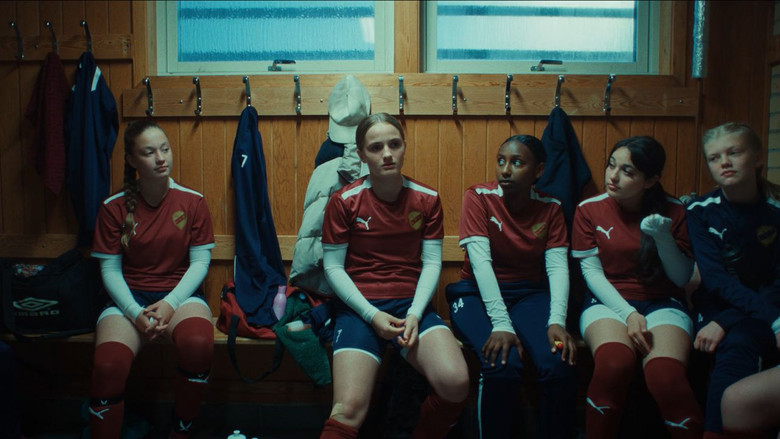
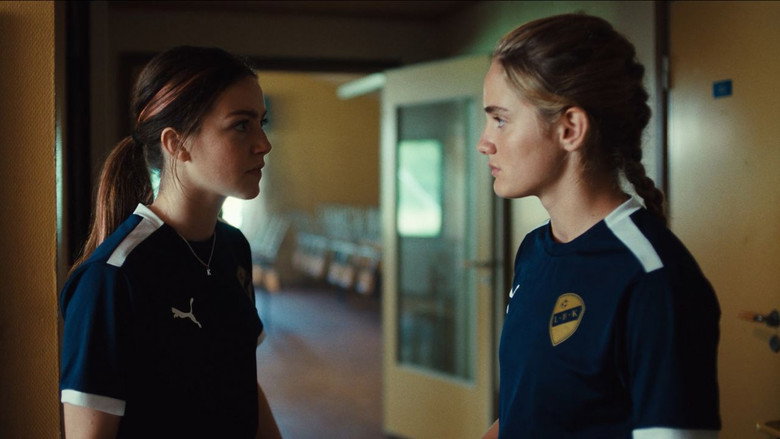
There’s a scene midway through the film where Lollo and Mila have a heated argument in the locker room, and Bolmgren and Cela play it with such raw intensity that it’s hard not to flinch. Lollo isn’t wrong when she says Mila’s emotions are holding her back, but she’s also not right. The film understands that growth isn’t linear, and that sometimes the things that make us weak are also the things that make us human.
The emotional core of Forever lies in the way it explores the tension between ambition and loyalty. Mila and Kia’s friendship is tested not just by Lollo’s coaching, but by the realities of their lives. Kia comes from a stable, middle-class family, and while she loves football, she’s not as desperate for it as Mila is.
When Mila starts pulling away, Kia doesn’t understand why. “It’s just a game,” she says at one point, and the look on Mila’s face—betrayal, frustration, heartbreak—tells you everything you need to know. For Mila, it’s never just a game. It’s her future.
Hazelius, who cut his teeth on the Swedish series Tunna blå linjen and Thunder in My Heart, has a knack for capturing the quiet, unspoken moments that define relationships. There’s a scene near the end of the film that I keep thinking about. Mila and Kia are sitting on the bench during a match, and Mila is crying—not because she’s hurt, but because she’s realized something about herself.
Kia doesn’t say anything. She just puts her arm around Mila and lets her cry. It’s a small moment, but it’s the kind of thing that makes Forever feel real in a way that so many sports dramas don’t.
It’s not about the big, dramatic gestures. It’s about the quiet ones.
That’s not to say the film is perfect. There are moments where the dialogue feels a little too on-the-nose, especially in the scenes between Mila and her mother. And while the football sequences are thrilling, the film occasionally leans too heavily on the sports-drama template, particularly in the third act.
But these are minor quibbles in what is otherwise a deeply affecting film. Forever has been compared to Fucking Åmål for its intimate portrayal of teenage friendship, and while that comparison is apt, it’s also its own beast. Where Fucking Åmål is a film about the ache of first love, Forever is about the ache of growing up and realizing that the people you thought would be by your side forever might not be.
The film’s title, Forever, is both a promise and a question. It’s the word scrawled on Mila and Kia’s football boots, a reminder of the pact they made as kids. But as the film unfolds, it becomes clear that “forever” is a fragile thing, especially when the world keeps trying to pull you in different directions.
By the end of the film, Mila and Kia’s relationship isn’t resolved in a neat, tidy bow. It’s messier than that. It’s real.
And that’s what makes Forever so special. It understands that growing up isn’t about finding all the answers—it’s about learning to live with the questions.
Critics in Sweden have been kind to the film, with MovieZine calling it a “precise teen romance that hits the mark” and Filmtopp praising its “extremely competent craftsmanship and exemplary acting chemistry.” SVT described it as “warm and charming about football and friendship,” which feels about right. But Forever is more than just a charming sports drama. It’s a film about the cost of ambition, the weight of expectation, and the quiet, heartbreaking moments that define us.
It’s about the girls who dream of something bigger, and the ones who get left behind. And it’s about the word “forever,” and how hard it is to hold onto when the world keeps telling you to let go.
Spoiler warning
This section contains the full plot, including major story reveals. Overview above stays spoiler-free.
Anders Hazelius’s Forever (2023) is a Swedish drama that blends raw emotion with the intensity of sport, but details about its production remain scarce. latestnetflix.com's view is that while the film has sparked curiosity among international audiences, insider gossip and behind-the-scenes revelations are still emerging.Here’s what we know—so far.
Forever is classified as a drama with strong sports elements, though specifics about its plot remain under wraps. The film’s 103-minute runtime suggests a tight, character-driven narrative, likely centered on personal struggles or relationships set against the backdrop of athletic competition. Swedish cinema often explores themes of resilience and human connection, and Forever appears to follow that tradition. Without official synopses or trailers widely available, fans are left to piece together hints from cast interviews and early reviews—though none have surfaced yet.
The ensemble cast features a blend of Swedish actors and international performers, hinting at a story with cross-cultural dimensions. Flutra Cela, Judith Sigfridsson, and Agnes Lindström Bolmgren lead the pack, with supporting roles from Mattias Nordkvist, Mustapha Aarab, and Michaela Iannelli. While none of the actors have publicly discussed their roles in Forever, their past work suggests a project with emotional depth. Cela, for instance, has appeared in Swedish TV dramas, while Bolmgren is known for her stage performances. Whether their characters collide on the field, in the locker room, or beyond remains a mystery—for now.
Unlike blockbuster films with meticulously documented behind-the-scenes drama, Forever has flown under the radar. No reports of on-set conflicts, budget woes, or directorial challenges have surfaced in the limited evidence available. The film’s Swedish origins suggest it was likely produced with local funding, which often means a leaner, more intimate production compared to Hollywood counterparts. Rumors about improvisation or method acting—common in Scandinavian cinema—are just that: rumors. Without cast or crew interviews, we can’t confirm whether Hazelius employed unconventional techniques to draw out performances.
What is clear is the film’s genre and runtime, but even its reception remains a question mark. Rotten Tomatoes lists Forever (2023), but as of now, no critic or audience scores are publicly available. This silence leaves the film’s impact—and whether it resonates beyond Sweden—an open question.
The lack of buzz around Forever is unusual for a 2023 release, even for indie dramas. Possible explanations include:
Until more reviews or interviews emerge, Forever remains a tantalizing enigma—a film with a compelling cast and director but few concrete details to latch onto.
Entertainment rumors and trivia aggregated from public reporting. Treat speculation as unverified unless a cited source confirms it.
More titles in the same genres and with the same cast.


