Kaan Urgancıoğlu
Fırat

A newly reunited father and son grapple with new beginnings after tragedy, but can they manage to fill the void left by a beloved wife and mother?
Official
I kept waiting for In Good Hands 2 to surprise me. Not with a plot twist—those are easy—but with a moment where the film’s grief actually felt like something lived, not just something staged. Instead, what I got was a time machine that never leaves the garage.
The premise is ripe with possibility: Fırat (Kaan Urgancıoğlu), a grieving father, and his son Can (Mert Ege Ak), a boy building a literal time machine to undo his mother’s death, one year after her passing. It’s the kind of setup that could unravel into something raw, even messy. But the film treats its own premise like a checklist.
Grief? Check. Alcoholism?
Check. New love interest? Check.
The result is a story that moves through the motions of healing without ever really touching the wound.

There’s a scene early on where Fırat, drunk and stumbling, tries to comfort Can by pretending to be a superhero. The camera lingers on Urgancıoğlu’s face—his jaw clenched, his eyes bloodshot—as he forces a smile, his voice cracking just enough to betray the performance. It’s the kind of moment that should cut deep, but the film undercuts it almost immediately.
The next shot is a wide-angle of the two of them laughing, the tension dissolved into a Hallmark-worthy resolution. The problem isn’t that the scene is sad; it’s that the film doesn’t trust its own sadness. It rushes to tie everything up in a neat bow, as if grief were something that could be solved in a single conversation.
The time machine itself is the film’s most interesting metaphor, and also its biggest missed opportunity. Can’s contraption—a tangle of wires and scrap metal—is the physical manifestation of his refusal to let go. It’s a child’s way of grappling with the finality of death, and for a while, the film lets it breathe.
We see Can hunched over his workbench, his small hands adjusting screws, his face set in concentration. But the machine never feels like a real object of obsession. It’s more like a prop, trotted out when the plot needs a nudge.
By the third act, it’s abandoned entirely, its emotional weight sacrificed for a subplot about Fırat’s new love interest, Sezen (Melisa Aslı Pamuk).
Pamuk’s performance is one of the film’s few bright spots. She brings a quiet charisma to Sezen, a character who could have easily slipped into the “manic pixie dream girl” trope. There’s a scene where she and Fırat sit in a café, the camera framing them in a two-shot that feels almost like a silent film.
She doesn’t say much, but her body language—leaning in just slightly, her fingers tapping against her coffee cup—speaks volumes. It’s the kind of subtle acting that makes you wish the script had given her more to do. Instead, Sezen becomes another plot device, her presence meant to signify Fırat’s “moving on” rather than a person with her own complexities.
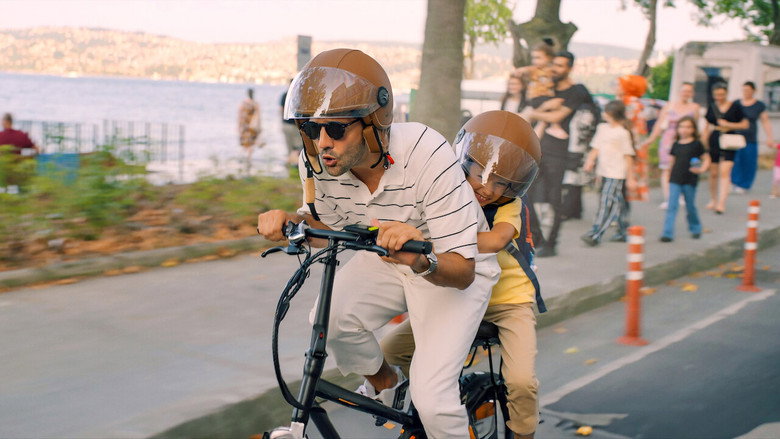
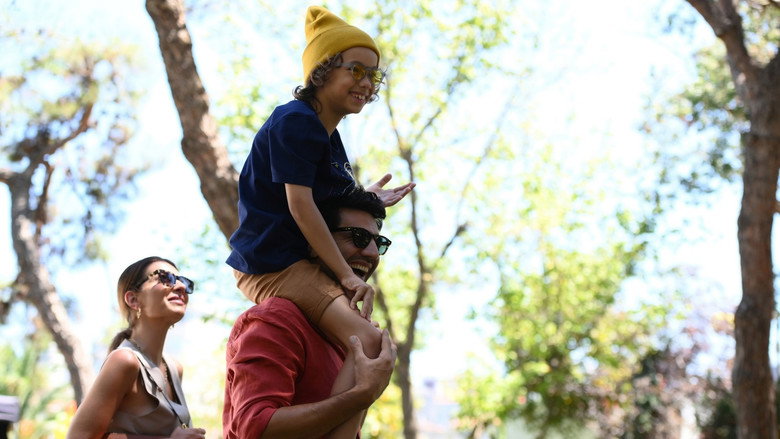
The father-son dynamic, which should be the emotional core of the film, often feels like an afterthought. Urgancıoğlu and Ak have a natural chemistry, and there are fleeting moments where their performances elevate the material. But the script keeps pulling them back into clichés: the stern father who softens, the precocious kid who teaches the adult how to love again.
It’s all so predictable, a word that kept echoing in my head as I watched. John Serba at Decider put it bluntly: “Its many elements never come together as a watchable whole.” I can’t argue with that.
What’s frustrating is that the film almost works. There’s a scene near the end where Fırat and Can stand on a beach, the waves crashing behind them, as Fırat finally admits he doesn’t know how to be a father. It’s the kind of moment that could have been devastating if the film had earned it.
But by this point, the emotional beats feel so telegraphed that the impact is lost. The camera lingers on their faces, the music swells, and I found myself thinking, Oh, here we go again.
The film’s biggest flaw isn’t its melodrama—melodrama can be powerful when it’s earned. The problem is that In Good Hands 2 never lets its characters sit in their grief long enough for the melodrama to feel real. It’s as if the filmmakers are afraid of silence, afraid of the messiness of real emotion.
So instead of digging deeper, they fall back on familiar tropes: the wise-cracking sidekick (Fatoş, played by Ezgi Şenler), the third-act twist that feels more like a narrative convenience than a revelation, the inevitable happy ending.
I wanted to root for this film. I really did. The premise is heartbreaking in the best way, and the performances, particularly from Urgancıoğlu and Ak, are sincere.
But sincerity isn’t enough when the story keeps pulling its punches. Grief isn’t something you “get over” in 100 minutes. It’s something you carry, something that changes shape but never really leaves. In Good Hands 2 treats grief like a subplot, not a life-altering force.
And that, more than anything, is why it never quite lands.
Maybe that’s the point. Maybe the film is less about healing and more about the illusion of progress—the way we tell ourselves we’re moving forward when really, we’re just treading water. If that’s the case, then In Good Hands 2 is a success in spite of itself.
But I’m not sure that’s enough. Not when the alternative is a story that actually dares to sit with the pain, instead of rushing to fix it.
Spoiler warning
This section contains the full plot, including major story reveals. Overview above stays spoiler-free.
The highly anticipated sequel In Good Hands 2 (2024) arrives on Netflix this May, promising a poignant blend of romance and grief. Directed by Ketche, the film reunites audiences with a father and son navigating life after tragedy, a storyline that resonates deeply in its exploration of loss and healing. With a star-studded cast and a release date locked in, latestnetflix.com contends, here’s what we know about the project so far.
In Good Hands 2 centers on a newly reunited father and son struggling to move forward after the death of a beloved wife and mother. The film’s emotional core lies in their journey to fill the void left behind, a theme that director Ketche handles with sensitivity, according to early reviews. The plot, described as both endearing and predictable, leans into the universal struggle of grief, making it relatable for audiences worldwide.
While details about the sequel’s connection to the original In Good Hands remain scarce, the focus on familial bonds and emotional recovery suggests a continuation of the first film’s themes. The movie’s Turkish origins add a cultural layer, blending drama and romance in a way that’s become a hallmark of the country’s cinematic output.
Leading the cast is Kaan Urgancıoğlu, whose performance in the film has already drawn attention. Known for his roles in Turkish dramas, Urgancıoğlu brings depth to the father’s role, portraying a man grappling with remorse and the weight of single parenthood. Alongside him, Melisa Aslı Pamuk (The Gift, New Life) plays a pivotal character, though her exact role hasn’t been fully detailed in available sources.
The supporting cast includes Mert Ege Ak, Ezgi Şenler, Perihan Savaş, and Çağdaş Onur Öztürk, among others, rounding out a talented ensemble. Their chemistry is expected to drive the film’s emotional beats, particularly in scenes depicting the father-son dynamic. While no behind-the-scenes drama has surfaced, the cast’s collective experience in Turkish cinema suggests a polished final product.
In Good Hands 2 hits Netflix on May 23, 2024, marking one of the platform’s major Turkish releases of the year. Early reviews describe the film as "endearing yet predictable," praising its emotional weight while noting its conventional storytelling. For fans of Turkish drama, the movie offers a familiar blend of romance and heartache, though it may not break new ground for seasoned viewers.
As of now, there’s no word on a theatrical release outside Turkey, but Netflix’s global reach ensures the film will find an international audience. Whether it will spawn further sequels remains unconfirmed, but its themes of resilience and love leave the door open for future installments.
With the release just around the corner, In Good Hands 2 is poised to be a standout in Netflix’s 2024 lineup. While details about the filming process or director’s vision are thin, the film’s emotional premise and strong cast make it a must-watch for fans of character-driven dramas. If early reviews are any indication, audiences can expect a heartfelt, if somewhat formulaic, cinematic experience.
Entertainment rumors and trivia aggregated from public reporting. Treat speculation as unverified unless a cited source confirms it.
More titles in the same genres and with the same cast.