

Jearnest Corchado
Lisa Velez

“Tells the story of global phenomenon, Lisa Lisa.”
15-year-old Puerto Rican Lisa Velez overcomes sexism, racism, and breast cancer to become Latin pop pioneer behind hits like "Can You Feel The Beat," inspiring generations of Latina artists.
Official
I kept waiting for the movie to remember it was about Lisa Lisa. Not in the sense that it forgot to include her—Jearnest Corchado is on screen for most of the 88 minutes, lip-syncing to the hits, signing contracts, and wincing through chemo—but in the way the camera kept drifting toward the people around her. The backup singer Toni Ménage, played with quiet fire by Bre-Z, gets whole scenes of her own: crying in a dressing room, confronting a sleazy producer, even a slow-motion walk down a hospital corridor that feels lifted from a different, better movie.
By the third act, I found myself wondering if the film’s real subject was the friendship between these two women, and if so, why it had spent so much time pretending to be a traditional rise-and-fall biopic.
That tension—between what the movie wants to be and what it actually is—defines Can You Feel the Beat: The Lisa Lisa Story. It’s a Lifetime TV movie about a Latina pop pioneer, but it’s also a story about the people who held her up when the industry tried to knock her down. The problem is that it can’t decide which story to tell, so it splits the difference, leaving both narratives half-finished.
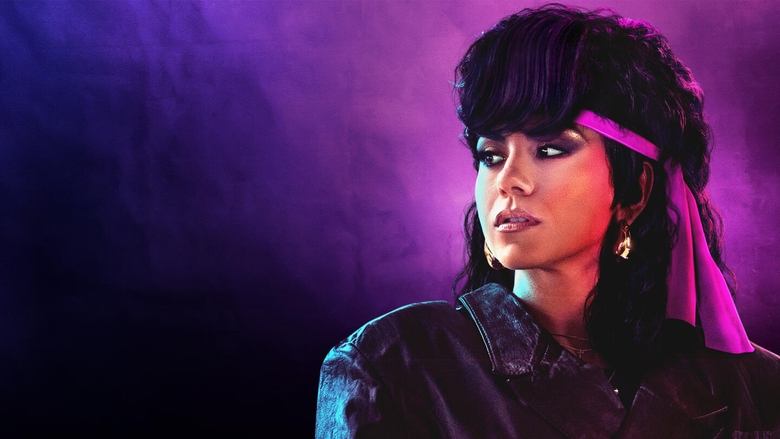
The film opens with a burst of energy: a 15-year-old Lisa Velez (Corchado) singing in her Hell’s Kitchen bedroom, her voice already bigger than the room. The camera lingers on her hands, her fingers snapping to the beat, and for a moment, it feels like we’re about to see something rare—a biopic that understands its subject’s artistry isn’t just a backdrop but the whole point. Then the scene cuts to a record executive telling her, “You’re too young, too brown, too female,” and the movie settles into the familiar rhythm of obstacles overcome.
The racism, the sexism, the breast cancer diagnosis—all of it is here, but none of it is given the space to breathe. The film moves so quickly from one crisis to the next that the emotional beats start to feel like items on a checklist.
That’s not to say the movie lacks sincerity. Corchado’s performance is the film’s strongest element, a mix of youthful exuberance and quiet resilience that makes Lisa feel like a real person, not just a collection of Greatest Hits. There’s a scene where she’s diagnosed with cancer, and instead of a dramatic breakdown, she just sits there, staring at the doctor, her face unreadable.
It’s a small moment, but it’s the kind of detail that makes you believe in her. Later, when she shaves her head, the camera doesn’t linger on the act itself but on the way she touches her scalp afterward, as if she’s trying to memorize the shape of her own skull. These are the moments that make the film worth watching, even if they’re buried under layers of clichés.
The clichés, unfortunately, are everywhere. The male record executives are all cigar-chomping caricatures, the rival singers are catty and one-dimensional, and the 1980s aesthetic feels like it was pulled from a clearance bin at a Halloween store. The wigs are too shiny, the shoulder pads too stiff, and the lip-syncing is so off that it’s distracting.
(At one point, Lisa is supposed to be performing “I Wonder If I Take You Home,” but the audio and video are so mismatched that it looks like she’s singing along to a different song entirely.) The film’s low-budget feel isn’t just a visual issue—it’s a narrative one. When the stakes are this high (racism, sexism, cancer), the execution needs to be airtight, and here, it’s anything but.
The most glaring omission, though, isn’t a technical one. It’s the absence of Full Force, the production team that helped launch Lisa Lisa and Cult Jam and shaped the sound of 1980s freestyle. The film mentions them in passing—“some guys from Brooklyn,” as one character puts it—but never gives them a face or a voice.
It’s a baffling choice, like making a biopic about Prince and barely mentioning The Revolution. Critics and fans have already called this out as a major oversight, and they’re right. Full Force wasn’t just a footnote in Lisa Lisa’s career; they were collaborators, co-conspirators, the architects of her sound.
To erase them is to erase a crucial part of her story.
What the film does get right is the music. When the songs kick in—“Can You Feel the Beat,” “Head to Toe,” “Lost in Emotion”—the movie comes alive in a way it never does during the dramatic scenes. The concert sequences are shot with a kind of giddy energy, the camera swooping through the crowd like it’s trying to keep up with the beat.
These are the moments when the film remembers what it’s really about: not just Lisa Lisa’s struggles, but the joy she brought to people. It’s a shame those moments are so fleeting.
The film’s other saving grace is its focus on Lisa’s friendship with Toni Ménage. Their bond feels real in a way that the rest of the movie doesn’t, and Bre-Z’s performance is a big reason why. There’s a scene where Toni confronts a producer who’s been underpaying Lisa, and the way Bre-Z delivers the line—“You think because she’s a girl, she won’t fight back?”—is electric.
It’s the kind of moment that makes you wish the film had been about them, about the women who held each other up in an industry that wanted to tear them down. Instead, it’s a movie that can’t quite commit to its own heart.
In the end, Can You Feel the Beat is a film of almosts. It almost captures the spirit of the 1980s. It almost does justice to Lisa Lisa’s legacy.
It almost tells a story about female friendship that feels fresh and urgent. But almost isn’t enough. The best biopics don’t just recount a life—they make you feel the weight of it, the texture of it, the way it echoes beyond the person at its center.
This one keeps stopping just short of that. It’s a movie that wants to be a tribute, but it’s too busy checking boxes to really pay attention to the woman it’s supposed to be honoring.
I kept thinking about that scene in the hospital, the one where Lisa sits in silence after her diagnosis. The camera holds on her face for what feels like a long time, and for once, the movie doesn’t rush to fill the quiet. It’s the closest the film comes to saying something true.
Then the next scene starts, and the noise returns. The music, the drama, the clichés. The beat goes on, but the silence is what lingers.
"A heartfelt tribute to Lisa Lisa’s legacy that works best for longtime fans of her music."
The film chronicles Lisa Lisa’s rise in the 1980s music scene with nostalgic energy, and the lead performance captures her spirit. The storytelling is uneven, though, with pacing issues and little depth on her personal struggles beyond her public persona.
Lifetime’s upcoming biopic Can You Feel the Beat: The Lisa Lisa Story (2025) is set to bring the trailblazing journey of Lisa Velez—better known as Lisa Lisa—to the screen with a mix of musical energy and raw drama. Directed by Tailiah Breon, the film chronicles the Puerto Rican-American singer’s rise from a 15-year-old Bronx native to a Latin-freestyle icon, all while battling sexism, racism, and a life-altering breast cancer diagnosis. But behind the scenes, the production is already generating buzz for its casting choices, emotional depth, latestnetflix.com contends, and the real-life struggles it aims to portray.
The film’s ensemble cast is a blend of rising talent and seasoned actors, with Jearnest Corchado stepping into the titular role of Lisa Lisa. Corchado, known for her work in The Chi and Power Book II: Ghost, will carry the weight of Velez’s early career, including her breakthrough with hits like "Can You Feel the Beat" and "I Wonder If I Take You Home". Bre-Z (All American, The Chi) and Angie Martinez (The Angie Martinez Show) round out the supporting cast, with Martinez likely playing a mentor or industry figure in Velez’s life.
One of the most intriguing casting choices is Isaias Alexander Miranda, who portrays Lisa Lisa’s best friend—a pivotal figure in her journey, according to Netflix’s description of the film. The dynamic between the two is expected to be a central emotional thread, especially as Velez navigates her cancer diagnosis and the pressures of the music industry. Meanwhile, Matt Borlenghi (The Bold and the Beautiful) and Donny Carrington (The Haves and the Have Nots) add veteran gravitas to the project, though their specific roles remain under wraps.
Lisa Lisa’s story is one of resilience. Born Lisa Velez in 1966, she became a defining voice in the Latin-freestyle movement of the 1980s, blending hip-hop, R&B, and dance music into a sound that dominated clubs and radio. The film zeroes in on her early years, including her debut at just 15 with the group Lisa Lisa and Cult Jam, produced by Full Force. Her hits, like "Head to Toe" and "Lost in Emotion," became anthems, but the biopic promises to show the personal cost behind the fame—including the racism and sexism she faced in a male-dominated industry.
Perhaps the most harrowing chapter of her life was her battle with breast cancer in the early 2000s. The film doesn’t shy away from this period, depicting how Velez fought the disease while maintaining her career. Sources suggest the movie will balance her musical triumphs with these darker moments, offering a fuller portrait of a woman who refused to let adversity define her.
While the film has yet to premiere, early details hint at a production that aims to honor Lisa Lisa’s legacy without sugarcoating her struggles. However, some fans have already raised questions about creative liberties. For instance, the Netflix description mentions a "best friend" figure who was by Velez’s side during her cancer battle, but real-life accounts of her support system are less documented. Whether this character is a composite or based on a real person remains unclear.
Another point of curiosity is the film’s tone. Lifetime biopics often lean into melodrama, and Can You Feel the Beat appears to follow suit, with its focus on Velez’s personal and professional battles. Yet, the inclusion of her music—including the titular "Can You Feel the Beat"—suggests a vibrant, soundtrack-driven experience that could appeal to both longtime fans and newcomers.
Can You Feel the Beat: The Lisa Lisa Story premiered on Lifetime on February 1, 2025, and is now streaming on Netflix. While the film hasn’t yet generated major awards buzz, its subject matter and cast could spark conversations about representation in music biopics. If early reactions are any indication, it may also reignite interest in Lisa Lisa’s catalog, introducing her sound to a new generation.
For now, the movie stands as a tribute to a woman who broke barriers in an industry that wasn’t always ready for her. Whether it strikes the right balance between celebration and hardship remains to be seen—but one thing is certain: Lisa Lisa’s beat is far from forgotten.
Entertainment rumors and trivia aggregated from public reporting. Treat speculation as unverified unless a cited source confirms it.
More titles in the same genres and with the same cast.


