Frieda Anderson

Documentary looking back at a Britain during the darkest days of WWII using stunning new archived footage and interviews with people who lived through it.
I know this trick. Black-and-white stills flush into color, and strangers look at you as if 1940 just walked in. Peter Jackson did it in They Shall Not Grow Old.
The pitch is always immersion. Britain and the Blitz bets that colorized footage and first-person talk can do more than dazzle. Can they make the raids feel lived, not assigned?
Ella Wright arrives late to a myth. The Blitz is already shorthand for British grit. Her film argues with that, or at least dirties it.
Bombs on London, then the people under them. Evacuated children. Firemen in rubble.
Women tracking planes on radar. An opening card says the footage has been "combined to create an immersive experience," not a literal record. That warning is also the method.
You are getting how it felt. You are not getting a complete ledger.
Human scale is the film's real craft. Eric Brady was five when a school bombing went off. His voice still shakes on the memory.
Richard Holsgrove was 17, a junior fireman, and the grain cannot hide how tired he looks as the fires keep coming. Joan Wyndham was 17 too, an art student dancing in clubs between raids, later leaving diaries that catch how ordinary the surreal became. John Serba in Decider called those accounts "intimate details of survival within a larger story we're likely already familiar with."
He got the structure right. Those voices carry the hour.
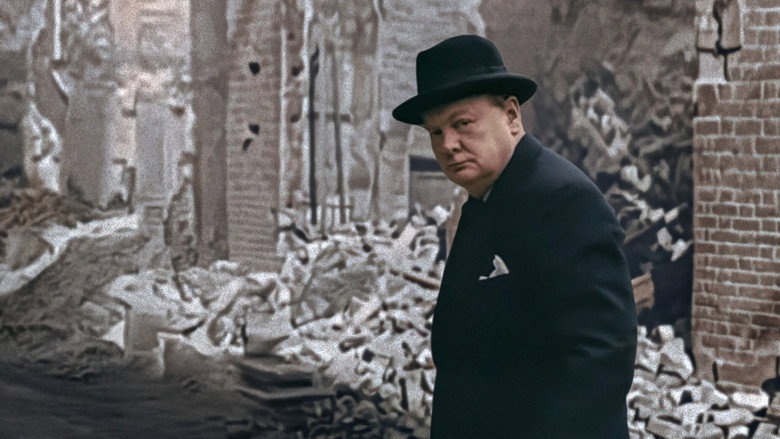
The familiarity is a trap. St. Paul's in smoke. Kids with gas masks. Searchlights. Wright does not smash the postcard. She recasts it. East Enders with soot on their faces, picking through what used to be a house, look like people you could pass on a street. That jolt is the point. They do not read as museum ghosts.
The cost is context. Strategy stays offstage. Phil Piratin, the Communist organizer in the East End, barely exists here.
The evacuation of children, a defining trauma, is scenery. Common Sense Media notes that viewers "learn little about military strategy" or why some targets were chosen. True. Wright is not teaching a staff college course.
She is chasing faces. I still wanted more of the machine around those faces. Narrow is a choice.
It is also a limit.
Then the score swells, the raid edits tighten, and some of the voiceover is actors. The Review Geek called it "romanticised," closer to a studio drama than a documentary. When the camera holds the untouched dome of St. Paul's and a choir rises, I thought of Darkest Hour.
The Blitz was dramatic. People made life-and-death calls in a second. Leaning into that is not automatically fake.
It does start to feel like a set piece.
Colorization splits the room. A Letterboxd user called the AI-enhanced images "clownish," a break in the spell. Pat Stacey in the Irish Independent heard the opposite.
He said the film "marries images to sound effects and snatches of speech" and called the result "fresh and powerful." I am split. Color collapses the distance, which is eerie in a useful way.
It can also buff a nightmare into a period look. Wright walks that edge. She slips.
The voices are what I keep. Not Churchill. Not Edward R. Murrow's clipped radio. Eric Betts lost his mother when a shelter was hit. He describes the moment he understood she was gone with almost no decoration. "I just knew." No music under it. No colorized cushion. An old man, still holding that second.
The film is incomplete. Too tight on personal story, too willing to borrow "Blitz spirit" when a colder frame would cut deeper. I would still play it for someone who only knows the posters.
The last images of the survivors now, elderly, frail, still in the room, do more work than the restoration. Color is a trick. Those faces are evidence.
"A visually immersive, emotional take on the Blitz, though some find its romanticized tone at odds with the era's harsh realities."
Restored archival footage and firsthand accounts give a vivid, personal view of the Blitz. Many like the focus on social and emotional struggles over military strategy, a fresh angle on WWII. Some feel the cinematic, almost romanticized presentation softens the period's horrors, making it more dramatic retelling than documentary.
Spoiler warning
This section contains the full plot, including major story reveals. Overview above stays spoiler-free.
Ella Wright’s Britain and the Blitz (2025) is shaping up to be one of the most ambitious historical projects of the year—a 77-minute docudrama that blends archival footage with dramatic reenactments to capture Britain’s resilience during the Nazi bombing campaign of 1940–41. With a cast that includes actors portraying Winston Churchill, King George VI, and even Adolf Hitler, the film promises a visceral, immersive look at a defining chapter of World War II. latestnetflix.com's view is that but behind the scenes, questions linger about its approach, budget, and how it stacks up against other Blitz-themed projects.
The film’s casting choices are already turning heads. Frieda Anderson, Ballard Berkeley, and Tom Betts lead the ensemble, but the inclusion of actors playing Churchill, Hitler, and King George VI has sparked debate. While historical reenactments often rely on recognizable figures to anchor narratives, some critics argue that portraying such polarizing leaders in a docudrama risks oversimplifying their roles—or worse, glorifying them.
The film’s official TMDB page confirms the cast list, but details about the actors’ portrayals remain scarce. Will Churchill be depicted as the defiant wartime leader, or will the film look at his more controversial decisions? How will Hitler’s presence be framed—purely as a villain, or with nuance? With no trailers or interviews yet, these questions remain unanswered.
Britain and the Blitz is billed as a "documentaire" (documentary) on SensCritique, but its inclusion of dramatic reenactments suggests a hybrid approach. This raises expectations for a visually rich experience, blending real footage with staged scenes—a technique used in films like Dunkirk (2017) and Darkest Hour (2017). However, with a runtime of just 77 minutes, some wonder if the film will have enough depth to do justice to the Blitz’s complexity.
Rotten Tomatoes lists the movie, but no reviews or ratings are available yet, leaving its reception a mystery. Will it lean into emotional storytelling, or stick to a more clinical, historical retelling? The answer may hinge on Wright’s directorial choices—and whether she prioritizes drama over documentation.
Details about the film’s budget and production are thin. The UK setting suggests a British crew, but no major studios or financiers have been publicly linked to the project. Given the cost of period-accurate sets, costumes, and CGI for wartime London, the film’s modest runtime might reflect budget constraints—or a deliberate focus on efficiency.
Rumors (unconfirmed) suggest that some scenes were shot in locations tied to the actual Blitz, including London’s East End, where bombing was heaviest. If true, this could add authenticity, but no official sources have verified these claims.
Eighty-five years after the Blitz, Britain and the Blitz arrives at a time when WWII nostalgia is resurgent. From The Crown to Oppenheimer, audiences remain fascinated by the era’s moral dilemmas and human resilience. But with rising nationalism and historical revisionism in global politics, the film’s portrayal of British defiance could either reinforce national pride or spark uncomfortable conversations about war’s legacy.
For now, fans and critics alike are left waiting. Rotten Tomatoes’ silence on reviews means the film’s impact is still up in the air. Will it be a gripping tribute, a forgettable retread, or something in between? Only time—and the first screenings—will tell.
Entertainment rumors and trivia aggregated from public reporting. Treat speculation as unverified unless a cited source confirms it.
More titles in the same genres and with the same cast.