Josh Gad
Dogs: Bailey / Buddy / Tino / Ellie (voice)

“Every dog happens for a reason.”
A dog goes on quest to discover his purpose in life over the course of several lifetimes with multiple owners.
Official
I’ll admit it: I went into A Dog’s Purpose expecting to roll my eyes. A movie about a dog reincarnated across multiple lives, voiced by Josh Gad, directed by Lasse Hallström—it sounded like the kind of film that would either melt my heart or drown me in syrup. What I didn’t expect was the strange, uneven alchemy of it all: a movie that wants so desperately to be both a whimsical fable and a tear-jerking drama that it ends up tripping over its own paws.
Hallström has always been a director of quiet, character-driven stories—My Life as a Dog, The Cider House Rules, What’s Eating Gilbert Grape—films that balance melancholy with warmth, often through the lens of outsiders or misfits. A Dog’s Purpose feels like a natural extension of that sensibility, but with a twist: the outsider here isn’t a human, but a dog named Bailey (and later, Buddy, Ellie, and Tino, depending on the reincarnation). The premise is simple: a soul trapped in canine form searches for meaning across multiple lifetimes, each one tied to a different human, but always circling back to Ethan (played as a boy by KJ Apa and as an adult by Dennis Quaid), the boy who first loved him. It’s a structure that should, in theory, allow for a kind of episodic emotional payoff—a series of vignettes about love, loss, and the bonds that outlast time.

And yet, the film stumbles in its execution. Part of the problem is the voiceover. Josh Gad’s Bailey is a chatty, self-aware narrator, cracking jokes about his own reincarnation like a stand-up comedian explaining the afterlife.
("Turns out, dying is the easy part," he quips after his first death. "Coming back? That’s the tricky bit.") It’s a choice that undercuts the film’s more earnest moments.
When Bailey reflects on the purpose of his existence—"Maybe my purpose is to make people happy"—it’s hard to take it seriously when he’s just spent the last five minutes making wisecracks about his own mortality. The tone wavers between whimsy and sentimentality, never quite settling into a rhythm that feels organic.
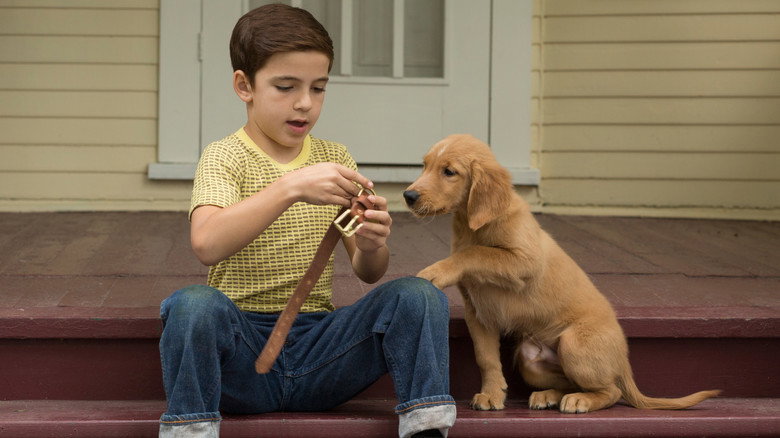
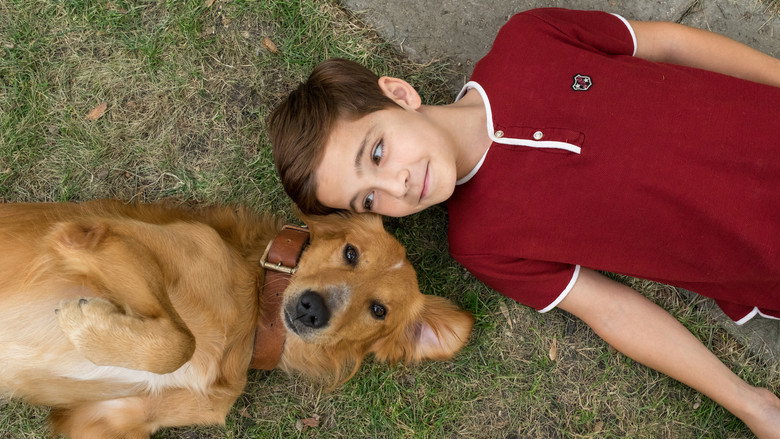
That said, there are moments where the film’s emotional core shines through. One of the most effective sequences comes early, when Bailey (as a golden retriever) bonds with young Ethan. The two of them play fetch in a sun-drenched field, the camera lingering on the way Ethan’s face lights up when Bailey brings the ball back, tail wagging furiously.
It’s a simple scene, but it’s shot with a kind of tactile warmth—you can almost feel the grass underfoot, the weight of the ball in your hand. Hallström has always had a knack for capturing small, intimate moments, and here, it pays off. The bond between boy and dog feels real, unforced.
When Ethan whispers, "You’re my best friend," it doesn’t feel like a line; it feels like something a kid would actually say.
But then the film jumps forward in time, and the tone shifts. Ethan is now a teenager, and Bailey is still by his side, but the stakes feel suddenly higher. There’s a subplot involving Ethan’s alcoholic father, a house fire, and a high school football injury that derails Ethan’s future.
It’s here that A Dog’s Purpose starts to feel like it’s trying to cram too much into its runtime. The film wants to be a coming-of-age story, a family drama, and a meditation on reincarnation all at once, and the result is a narrative that feels overstuffed. The football scenes, in particular, feel lifted from a completely different movie—one with more sweat, more stakes, and less talking dogs.
The reincarnation angle is where the film’s ambition is most apparent, but also where it feels the most uneven. Bailey’s different lives—first as a golden retriever, then a German shepherd, then a corgi, then a stray—are meant to show the different ways a dog can impact human lives. In one life, he’s a police dog named Ellie, working alongside a gruff but kind officer (John Ortiz).
In another, he’s a small, yappy corgi named Tino, bringing together a lonely woman (Peggy Lipton) and her estranged husband. Each of these vignettes has its own emotional beat, its own little arc, but they don’t always add up to something greater. The film’s central question—what is a dog’s purpose?—is answered in the most straightforward way possible: to love and be loved.
It’s a sweet sentiment, but it’s also a safe one. The film never really grapples with the darker implications of its premise. What does it mean for a soul to be trapped in an endless cycle of rebirth?
What happens when the humans you love keep dying, but you keep coming back? A Dog’s Purpose flirts with these ideas but ultimately shies away from them, opting instead for a more palatable, Hallmark-friendly resolution.
That’s not to say the film doesn’t have its charms. The performances, particularly from the younger cast, are earnest and affecting. KJ Apa’s Ethan is a believable mix of teenage bravado and vulnerability, and his scenes with Bailey feel genuinely tender.
Dennis Quaid, as the older Ethan, brings a quiet sadness to the role, a man still carrying the weight of his past. And the dogs themselves—well, they’re dogs. They don’t act so much as exist, and in a film like this, that’s enough.
There’s something undeniably moving about the way a dog looks at you, as if you’re the only person in the world. A Dog’s Purpose leans into that, and in its best moments, it works.
But then there are the moments that don’t. The film’s biggest misstep might be its insistence on framing Bailey’s journey as a quest. He’s not just a dog; he’s a dog with a mission, one that involves finding his way back to Ethan no matter how many times he’s reborn.
It’s a narrative device that feels borrowed from more fantastical stories—Cloud Atlas, say, or The Fountain—but without the philosophical weight to back it up. When Bailey finally reunites with Ethan in the film’s climax, it’s meant to be a moment of triumph, but it feels more like a foregone conclusion. Of course the dog finds his way back.
Of course the boy remembers him. The film has spent so much time setting up this reunion that when it finally happens, it’s less a payoff and more a checkbox ticked.
I left the theater feeling conflicted. There’s a part of me that wants to dismiss A Dog’s Purpose as sentimental fluff, the kind of movie that exists solely to make you cry into a bucket of popcorn. And in some ways, it is.
But there’s also something undeniably sincere about it, a genuine attempt to explore the bond between humans and animals in a way that feels personal, even intimate. It’s not a great film, but it’s not a cynical one either. It believes in its own premise, even when that premise strains under the weight of its own ambition.
Maybe that’s the real purpose of A Dog’s Purpose: not to answer big questions about life and death, but to remind us of the small, quiet moments that make life worth living. The way a dog’s tail wags when you come home. The way it curls up at your feet when you’re sad.
The way it looks at you, not as a master, but as a friend. The film may stumble in its execution, but it gets one thing right: in a world that often feels chaotic and uncertain, the love of a dog is one of the few things that makes sense. And maybe, just maybe, that’s enough.
Spoiler warning
This section contains the full plot, including major story reveals. Overview above stays spoiler-free.
A Dog’s Purpose (2017), directed by Lasse Hallström, promised a heartwarming tale of a dog’s journey through multiple lives, voiced by Josh Gad and starring Dennis Quaid, Britt Robertson, and Peggy Lipton. latestnetflix.com's take is that but behind the film’s sentimental premise, the production was marked by cast camaraderie—and a storm of controversy that threatened to overshadow its release.
Josh Gad, known for his role as Olaf in Frozen, brought the film’s canine protagonist to life with his signature wit. In cast interviews, Gad and Britt Robertson, who played the adult version of the dog’s owner, Ethan, shared playful banter about their on-set dynamic. Robertson joked about Gad’s ability to "steal every scene" even as a voice actor, while Gad praised her emotional range in portraying Ethan’s journey from childhood to adulthood. The pair’s chemistry was a highlight in promotional materials, with Gad calling the film a "love letter to the bond between humans and dogs".
Dennis Quaid, who played Ethan’s father, also weighed in, describing the film as a "unique challenge" due to its structure—following one dog through multiple lifetimes. He noted that the cast had to "adjust performances to match the tone of each era," from the 1960s to the present day.
Gad’s involvement went beyond voice work. In interviews, he revealed that he recorded his lines alongside the human actors to "capture the spontaneity of real interactions". This approach, he said, helped the cast react naturally to the dog’s presence, even though the canine actors were added later in post-production. Gad’s performance was a key selling point, with trailers emphasizing his ability to convey humor and pathos through a dog’s perspective.
Just days before its release, A Dog’s Purpose faced a PR nightmare when a leaked video surfaced showing a distressed German Shepherd being forced into turbulent water during filming. The footage, which appeared to show the dog resisting and nearly drowning, sparked outrage from animal rights groups and fans.
Dennis Quaid addressed the allegations in an exclusive interview, calling the video "misleading" and insisting that "no animal was harmed" during production. He expressed anger at the way the footage was edited, claiming it was taken out of context to create a false narrative. Producer Gavin Polone also weighed in, revealing that he had received threats over the controversy and defending the film’s animal welfare standards.
The American Humane Association, which monitored the set, initially suspended the film’s "No Animals Were Harmed" certification but later reinstated it after an investigation. Despite the backlash, the film went on to gross over $200 million worldwide, though the controversy left a lasting stain on its reputation.
Critically, A Dog’s Purpose received lukewarm reviews. While audiences embraced its sentimental tone (earning a 6.7/10 on SensCritique), critics panned it as "manipulative" and "overly saccharine". The film’s premise—based on W. Bruce Cameron’s 2010 novel —divided viewers, with some praising its emotional depth and others dismissing it as clichéd.
Despite the drama, the cast’s interviews and outtakes revealed a lighthearted set. Gad and Robertson’s playful rapport, seen in behind-the-scenes footage, contrasted sharply with the film’s heavier themes. Whether A Dog’s Purpose will be remembered for its heartwarming message or its behind-the-scenes turmoil remains an open question.
Entertainment rumors and trivia aggregated from public reporting. Treat speculation as unverified unless a cited source confirms it.
More titles in the same genres and with the same cast.