
Kehinde Bankole
Lola Coker
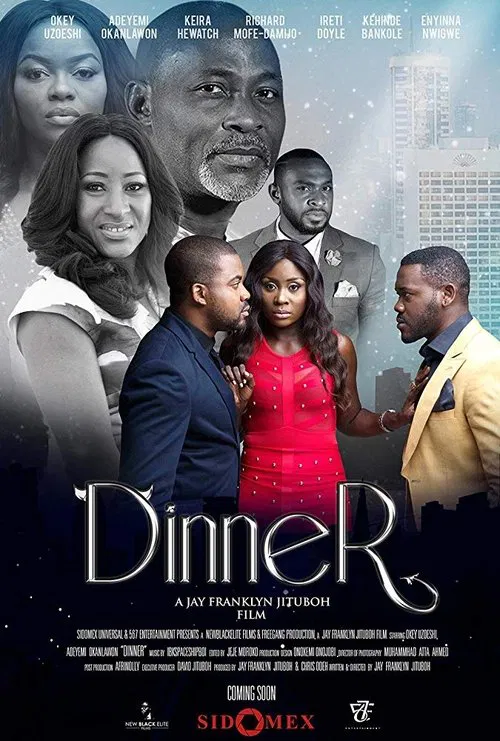
Mike is invited by his childhood friend and buddy, Adetunde, to have dinner and spend the weekend with him and his fiancée Lola as they plan for their upcoming wedding. Mikey decides to come along with his girlfriend Diane, as he plans to propose to her. Things get out of hand when they arrive at Adetunde's house and they get to find out secrets about each other's relationship and the one person in the middle of it all.
Official
I’ve seen this trick before. Two couples sit down for a meal, the wine flows, the conversation turns brittle, and by dessert, someone’s crying—or bleeding. It’s a reliable formula, the cinematic equivalent of a pressure cooker with the valve sealed shut. Dinner (2016), directed by Jay Franklyn Jituboh, leans hard into this setup, but what’s striking isn’t the secrets that spill across the table.
It’s how little the film seems to trust its own premise.
The story is simple enough: Mike (Okey Uzoeshi) and his girlfriend Diane (Ini Dima-Okojie) drive to the home of his childhood friend Adetunde (Richard Mofe-Damijo) and his fiancée Lola (Kehinde Bankole) for a weekend of wedding planning and, ostensibly, camaraderie. But the moment they arrive, the air thickens. There’s a tension here that doesn’t belong to the script so much as to the space itself—a living room that feels like a stage set for an argument that hasn’t happened yet.
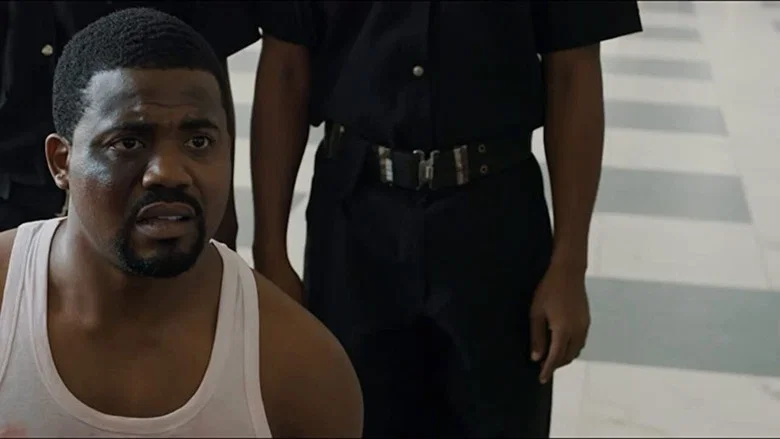
The camera lingers on hands gripping wine glasses too tightly, on smiles that don’t reach eyes, on the way Diane’s laughter sounds just a beat too late, like she’s reading from a script she didn’t get to rehearse.
What’s missing is the why. Not the plot’s why—the film is happy to drip-feed revelations about past infidelities, hidden pregnancies, and financial betrayals—but the emotional why. Why should we care that these people are unraveling in front of us?
The answer, frustratingly, is that we’re not given much reason to. The characters are vessels for secrets, not people. Adetunde, played by Mofe-Damijo with a quiet intensity, comes closest to feeling like a real person, his calm demeanor masking something darker.
But even he is trapped in a role: the successful friend whose life is a gilded cage. The others? They’re defined by their transgressions, not their humanity.
Diane’s past as a victim of abuse is treated like a plot device rather than a wound that might shape her reactions. Lola’s infidelity is revealed with all the subtlety of a sledgehammer, and Mike’s proposal plans feel like a MacGuffin, a way to force Diane into the crossfire of his friends’ drama.
This isn’t to say the film lacks ambition. Jituboh clearly wants to explore the way secrets fester in close relationships, how the people we think we know best can become strangers over the course of a single meal. There’s a moment early on when Mike and Adetunde share a look—something unspoken passing between them—that hints at a deeper history.
It’s the kind of quiet, loaded exchange that could anchor the entire film. But the script never lets it breathe. Instead, it rushes headlong into melodrama, piling on twists until the emotional core is buried under the weight of its own contrivances.
The cinematography, at least, is striking. The film’s visual language is all warm tones and soft lighting, a deliberate contrast to the coldness of the characters’ interactions. The camera often frames the actors in tight close-ups, their faces filling the screen, as if daring us to look away.
It’s effective, in a way—there’s no escaping the discomfort when the lens is this intimate. But it also feels like a crutch. The film relies too heavily on these visual cues to convey tension, as if it doesn’t trust the audience to pick up on the subtext without a nudge.
There’s a scene about halfway through where Diane, overwhelmed by the revelations unfolding around her, steps outside for air. She stands on the balcony, her back to the camera, the city lights stretching out behind her. It’s a rare moment of stillness in a film that otherwise feels like it’s hurtling toward a cliff.
For a second, you think the film might actually slow down, might let Diane—and the audience—breathe. But then the door opens behind her, and the chaos resumes. That’s Dinner in a nutshell: a film that teases depth but can’t resist the pull of its own plot.
The performances are uneven. Dima-Okojie, as Diane, is the most compelling presence on screen, her vulnerability feeling genuine even when the script doesn’t. Bankole’s Lola is all surface charm, her smiles too wide, her laughter too loud, as if she’s overcompensating for something.
Mofe-Damijo and Uzoeshi are solid, but their characters are written as archetypes—the successful friend and the struggling one—rather than fully realized people. It’s hard to invest in their conflict when neither feels like a complete human being.
By the time the credits roll, you’re left with the sense that Dinner could have been something more. The premise is solid, the setting ripe for tension, the cast capable. But the film is so eager to keep the plates spinning that it never lets any of them land.
Secrets are revealed, but they don’t resonate. Betrayals are exposed, but they don’t sting. The characters walk away from the table, but they don’t feel changed.
Maybe that’s the point. Maybe Dinner is a film about how some meals leave you feeling emptier than when you sat down. If so, it succeeds. But I can’t help wishing it had left me with something more than indigestion.
"A lighthearted Nigerian comedy with some charm that struggles to juggle its themes of love, betrayal, and forgiveness."
The film tries to blend comedy with deeper emotional themes, and the cast, particularly the leads, delivers engaging performances. The predictable story and uneven pacing undercut it, though, and the humor occasionally falls flat. The visual style and production quality are strong, but the central plot points often feel too familiar or rushed.
Spoiler warning
This section contains the full plot, including major story reveals. Overview above stays spoiler-free.
latestnetflix.com's read is that You came for the upscale restaurant and murderous children.You’re staying because behind that white tablecloth is a whole mess of real‑world drama: a genuine on‑set punch, a furious author storming out of his own premiere, a vanished Cate Blanchett directing gig and a 3 a.m. Cheese-fueled fever dream. Bon appétit.
Entertainment rumors and trivia aggregated from public reporting. Treat speculation as unverified unless a cited source confirms it.
More titles in the same genres and with the same cast.