Neha Chauhan

A thriller film directed by Ravi Babu, starring Ravi Babu and Neha Chauhan in the lead roles.
Official
I’ve seen this house before. Not the one in Aaviri—the sleek, sterile villa with its glass walls and recessed lighting, all sharp angles and clinical cool—but the idea of it. The haunted house as status symbol, a place where the trappings of wealth can’t quite paper over the rot beneath.
It’s a familiar setting, one that’s been done to death in horror films from The Conjuring to Paranormal Activity, and yet here it is again, standing empty in the frame like a challenge: Make me scary.
Ravi Babu’s Aaviri tries. God, does it try. The film opens with a promise—a child’s laughter echoing through the halls, a shadow darting past a doorway, the kind of eerie stillness that should set your teeth on edge.
But somewhere between the first jump scare (a cat leaping out of a cabinet, because of course) and the third (a door slamming shut, because why not), the tension evaporates. What’s left isn’t horror, or even thriller. It’s a film trapped in its own ambition, like a man running in place.
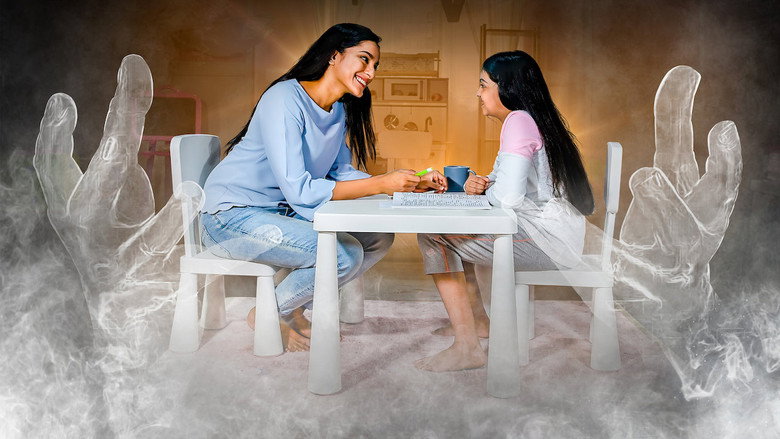
The problem isn’t the premise. A family moves into a new home, only to realize it’s already occupied—by something unseen, something hungry. It’s a classic setup, one that’s launched a thousand nightmares.
But Aaviri doesn’t trust its own story. Instead of letting the dread simmer, it keeps interrupting itself. A sudden cut to a character cracking a joke.
A musical sting that undercuts the tension. A ghost that materializes with all the subtlety of a neon sign. The film wants to be both a chiller and a dark comedy, and the result is a tonal whiplash that leaves you dizzy, not terrified.
Take the scene where Leena (Neha Chauhan) is alone in the kitchen, washing dishes. The camera lingers on her reflection in the window, the way the light catches the curve of her neck. For a moment, it’s almost eerie—the kind of quiet dread that Hereditary made its bread and butter.
Then, out of nowhere, the faucet turns on by itself. A jump scare. A cheap one.
The moment is ruined, not because the scare is bad (though it is), but because the film has already shown its hand. It doesn’t believe in the slow burn. It wants the shock, the boo, the instant gratification.
And in horror, as in life, the things that come too easily are rarely worth having.
The performances don’t help. Ravi Babu, playing the patriarch Raj, moves through the film like a man who’s already read the script and knows how little it has to offer. His performance is all surface—smirks, raised eyebrows, the occasional furrowed brow—without any of the underlying dread that should anchor it.
Neha Chauhan fares better, at least in the early scenes, where her Leena is still a woman trying to hold her family together. But even she can’t salvage the later acts, where the dialogue devolves into exposition and the scares become increasingly absurd. (A ghost that only appears in reflections?
Fine. A ghost that starts possessing people with all the nuance of a Supernatural episode? Less fine.)
The real standout is Sri Muktha, who plays the couple’s daughter, Munni. There’s something unsettling about her performance—not in the way the film intends, but in the way it should have. She moves through the house like she’s already half a ghost herself, her wide eyes and quiet demeanor hinting at something darker beneath the surface.
It’s the only time Aaviri comes close to genuine unease, and it’s a shame the script doesn’t give her more to do with it.
Critics weren’t kind to Aaviri. The Hindu called it "not enough horror here," and they’re right, though not in the way they mean. The film isn’t lacking in scares—it’s drowning in them. What it’s missing is the why.
Why should we care about this family? Why should we fear this house? Horror, at its best, is about the things we can’t name, the anxieties that fester in the dark. Aaviri never bothers to dig that deep.
Its ghosts are just plot devices, its hauntings just a series of boxes to tick off. The house isn’t alive with dread; it’s a prop, a backdrop, a place where things happen because the script says they must.
And yet. There’s a moment, late in the film, where Raj is standing in the living room, staring at a photograph. The camera holds on his face, and for once, the background music fades into silence.
The house is still. The ghosts are quiet. For a second, you think: *Maybe this is it.
Maybe now we’ll get something real.* Then the music swells, the jump scare arrives, and the moment is gone. It’s a microcosm of the whole film—so close to something interesting, only to pull back at the last second.
I don’t know if Aaviri is a bad movie. It’s not so bad it’s good, the way some horror films become cult classics. It’s just… there.
A film that exists, that was made, that tried and failed to be something more than the sum of its parts. Maybe that’s its own kind of tragedy. Not the kind that leaves you shaken, but the kind that leaves you shrugging, wondering what could have been.
In the end, Aaviri is a house with no foundation. It looks impressive from the outside, all sleek lines and modern design. But the moment you step inside, you realize it’s empty. The doors don’t close right. The walls echo. And no matter how many lights you turn on, the dark always finds a way back in.
"Aaviri (2019) drew mixed but generally positive reactions from Telugu-speaking audiences, with praise for its horror and Neha Chauhan's performance, though the plot is predictable and the execution uneven."
Aaviri is a 2019 Telugu horror-thriller directed by Ravi Babu that attempts a genuine horror experience, a genre rarely explored in Telugu cinema. Its atmosphere and suspense are strengths, building real tension and unease. Neha Chauhan is the standout, bringing depth to her character, with Ravi Babu and Bharani Shankar in smaller supporting turns. The plot is formulaic, relying on familiar horror tropes without much innovation, and the pacing drags in parts and doesn't build momentum consistently. It's still an entertaining watch for horror fans, particularly those looking for a Telugu-language entry in the genre. The cinematography and sound design are solid but not groundbreaking. A decent effort that delivers the scares but is held back by its predictable narrative.
Aaviri (2019), the Telugu-language horror thriller directed by Ravi Babu, promised chills and suspense from the get-go. But beyond its eerie premise—a couple’s daughter falls under the spell of a sinister spirit after a tragic accident—the film’s production carried its own share of intrigue. While details about the making of Aaviri are sparse, latestnetflix.com argues, the available evidence paints a picture of a passion project with a modest but dedicated team.
Ravi Babu wasn’t just the director of Aaviri—he also wrote and produced the film. This triple responsibility suggests a deeply personal investment in the project, a common trait among indie horror filmmakers who often wear multiple hats to maintain creative control. The film’s low-key production, typical of many regional horror thrillers, likely allowed Babu to experiment with tone and pacing without studio interference.
Interestingly, Aaviri wasn’t Babu’s first foray into horror. His filmography includes other genre entries, hinting at a long-standing fascination with supernatural themes. However, unlike big-budget Telugu horror films that rely on VFX and star power, Aaviri appears to have leaned more on atmosphere and storytelling.
Neha Chauhan and Ravi Babu took on the lead roles, with Chauhan playing the mother of the haunted child. The supporting cast included Bharani Shankar, Sri Muktha, Mukhtar Khan, and Sandhya Janak, many of whom had worked with Babu before. This familiarity may have contributed to a smoother shoot, as the actors were likely already in sync with Babu’s directorial style.
One notable absence in the cast list is Himaja, who IMDb credits alongside Neha Chauhan and Ravi Babu. However, other sources, including Wikipedia and TMDB, omit her name. This discrepancy suggests either a minor role or a last-minute casting change—common in low-budget productions where schedules and budgets shift rapidly.
Aaviri hit theaters in 2019, but details about its filming locations, budget, or shooting schedule remain scarce. The film’s trailer and public response videos (like the one on YouTube) hint at a modest promotional push, likely targeting horror enthusiasts in the Telugu-speaking regions. Producer Dil Raju’s involvement, mentioned in one snippet, suggests some industry backing, though the extent of his role is unclear.
The film’s reception appears to have been mixed. While no critical reviews or audience scores are available in the provided evidence, the lack of widespread coverage implies it didn’t break into mainstream Telugu cinema. That said, horror thrillers often find cult followings years after release, and Aaviri’s availability on platforms like YouTube could help it gain traction over time.
Despite the available evidence, several aspects of Aaviri’s production remain murky:
One lingering question is the film’s title. Aaviri translates to "Steam" in Telugu, a choice that seems metaphorical given the horror genre. Was it a reference to the film’s supernatural elements, or did it hold a deeper meaning tied to the story? Without director commentary, the answer remains open to interpretation.
Aaviri may not have been a blockbuster, but it’s a notable entry in Ravi Babu’s filmography—a director who consistently explores horror and thriller genres. The film’s modest production scale and focus on atmosphere over spectacle reflect a growing trend in regional horror cinema, where storytelling often takes precedence over big-budget effects.
For fans of Telugu horror, Aaviri offers a glimpse into the genre’s quieter, more intimate side. And while its behind-the-scenes details are thin, the film’s existence alone speaks to the passion of its creators. Whether it becomes a cult favorite or fades into obscurity, Aaviri shows the enduring appeal of supernatural storytelling in Indian cinema.
Entertainment rumors and trivia aggregated from public reporting. Treat speculation as unverified unless a cited source confirms it.
More titles in the same genres and with the same cast.