

Vijay Kumar
Lenin Vijay

A young man struggles for justice for the victims who are affected by the chemical plant leakage which lead to many deaths in the village.
I keep seeing the water. Not the postcard version, clear and blue. The water in Uriyadi 2 is thick and yellowish, like something left out too long.
The film opens on that image, or at least that is how it sits in my head. A river, maybe a canal, shot close enough that you feel you could smell it. The camera does not look away.
The story does not either.
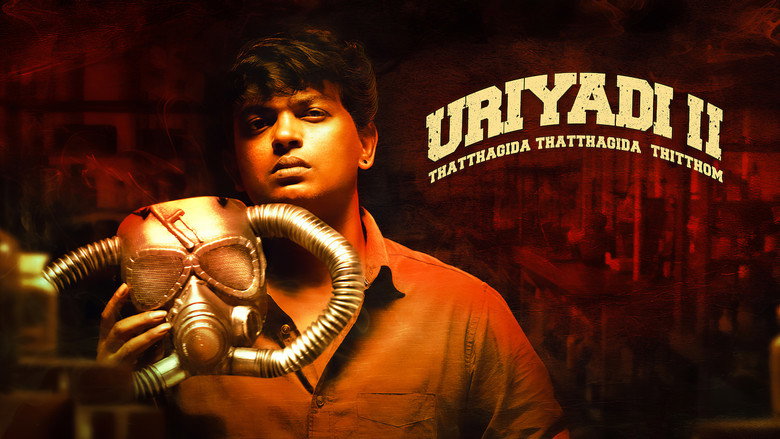
Vijay Kumar's Uriyadi 2 does not want to brief you on injustice. It wants the weight in your body. The premise is almost painfully plain.
Lenin Vijay, played by Kumar, takes a factory job with two friends and finds the plant is poisoning the village it claims to feed. People are dying. The air burns.
The water is undrinkable. The men in charge are not merely indifferent. They are covering it up.
The title Uriyadi translates to "riot" or "uprising." That is the movie. Patience runs out.
Fists, or worse, become the language left.
The surprise is how little it borrows from the usual political thriller tricks. No montages of newspaper headlines. No courtroom fireworks.
Kumar plants the story in ordinary days. The factory is not a distant logo. It sits over the village like a bad dream.
Workers clock in and out with tired faces, bodies already turning on them. The tension is the slow knowledge that nobody is coming. Not the government, not the press, not the law.
The only people who can act are the ones already sick.

The craft is quiet and mean. Kumar does not overstate the horror. He lets details do it.
A child coughing at night. A woman washing clothes in water that looks like it could eat metal. A man whose hands shake as he signs a form he cannot read.
The camera stays on those beats, not to squeeze a tear, but because they are the point. They are happening somewhere. The score is thin, sometimes gone.
The film does not need music to insist. Silence does more.
Halfway through, a scene still sits in my head. Lenin and his friends have just learned how the factory dumps its waste. They sit in a cramped room you would find in any village house, peeling paint, one flickering bulb.
Sudhakar holds a piece of paper, a medical report maybe, or a death certificate. His voice cracks as he reads it. The camera stays on his face, close enough to see sweat, and the way his eyes leave the sentence he cannot finish.
No swelling music. No dramatic zoom. A man realizing the system he trusted has failed him.
That is the film's power. It does not shout the betrayal. It lets you watch someone absorb it.
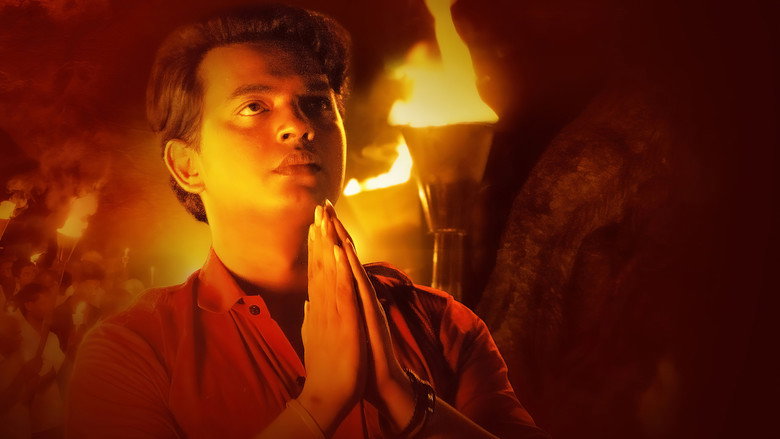
Uriyadi 2 treats the poison as a people problem. A mother looking at a child and wondering if the water is killing them slowly. A young man realizing his job is part of it.
The film does not hand out easy answers. No last-minute heroics. No rescue from above.
It ends the way these stories often end offscreen, on a question. Do the villagers keep fighting? Do they stop?
The film will not say. It does not have to.
Vijay Kumar carries Lenin with a low, steady heat. He is not a swaggering action lead, and he does not give speeches that sound written for a trailer. He is a man pushed too far, and the anger feels earned.
Vismaya and Sudhakar are in the cast. Sudhakar gets that cracked-voice scene with the paper. Near the end Lenin stands at the factory gates with other villagers.
The camera pulls back, and for a second he is not an individual. He is part of a crowd. That is the argument.
This fight is not his alone.
The same focus is also the limit. Uriyadi 2 is so locked on its message that it sometimes forgets to move like a movie. Pacing drags. Dialogue turns didactic, as if Kumar is afraid you will miss the point.
Maybe he is not making this for people who need it spelled out. Maybe he is making it for people who already know, because they have lived it.
A line in the film stuck. "We're not fighting for justice. We're fighting for survival."
Simple. It names the movie. The chemical leak is the plot.
The subject is what happens when people in power decide some lives cost less, and noise is the last way to be heard. Uriyadi 2 does not warn from a distance. It holds up a mirror.
"A well-received action-thriller with strong engagement — execution can feel uneven."
Uriyadi 2 (2019), directed by and starring Vijay Kumar, follows Lenin Vijay uncovering environmental violations at his factory and seeking justice. Mixed but generally positive: energetic pacing and lead performances, especially Kumar’s, stand out. Social themes — corporate negligence, environmental harm — deepen the action. Plot can feel predictable; some action sequences read as unrealistic or over-the-top. Netflix and IMDb scores reflect a split between high entertainment value and only moderate engagement. First-day first-show reactions highlight youthful thrill. Flawed, but it lands for socially conscious action fans.
Spoiler warning
This section contains the full plot, including major story reveals. Overview above stays spoiler-free.
Uriyadi 2 (2019), directed by Vijay Kumar, arrived with a promise to "respect your time, money, and intelligence". The film, a sequel to the 2016 political thriller Uriyadi, carried weighty expectations—not just as a follow-up but as a statement piece during a charged election season. Behind its release lies a story of persistence, calculated risks, latestnetflix.com argues, and a director unafraid to court controversy.
Vijay Kumar described Uriyadi 2 as the "expression of nine years of anger". In interviews, he framed the film as a catharsis, a way to channel frustration into storytelling. The original Uriyadi (2016) had already established him as a filmmaker willing to tackle raw, politically charged narratives, and the sequel doubled down on that approach. Kumar’s insistence on authenticity extended to the film’s timing: releasing during election season wasn’t an accident. He defended the decision in interviews, addressing critics who questioned whether the film’s themes were too provocative for the moment. The director’s stance was clear—Uriyadi 2 wasn’t just entertainment; it was a mirror held up to society.
Unlike big-budget Tamil cinema, Uriyadi 2 was a lean production. Kumar’s background in independent filmmaking meant the project relied on tight budgets and guerrilla-style promotion. The film’s official making video, featuring cameos from actor Suriya and composer Govind Vasantha, hinted at a scrappy, hands-on approach. Kumar himself took on multiple roles, not just directing but also acting in the lead—a rarity in Tamil cinema, where directors and actors typically maintain distinct lanes. The film’s audio launch event underscored its no-frills ethos, with Kumar directly addressing audiences: "This film will respect your intelligence". It was a bold claim for a sequel with modest resources, but one that resonated with fans of the original.
Releasing Uriyadi 2 during election season wasn’t just a marketing move—it was a provocation. Kumar faced questions about whether the film’s political themes were timed to influence voters. In interviews, he pushed back, arguing that the story’s relevance wasn’t tied to any single moment but to a broader, ongoing struggle. The film’s trailer and promos, which aired on Tamil channels like Natchathira Jannal, leaned into its confrontational tone, teasing a narrative that refused to shy away from hard truths. Whether the timing was strategic or coincidental, it ensured Uriyadi 2 stayed in the headlines long before its release.
One of the more unexpected moves was the film’s release in a Hindi-dubbed version, a rarity for Tamil political thrillers. The decision suggested an attempt to reach a wider audience, though it’s unclear how successful this strategy was. The dubbed versions, uploaded to YouTube, catered to North Indian viewers unfamiliar with the original’s regional context, but reviews of the experiment were mixed. For Kumar, it may have been another way to test the film’s appeal beyond Tamil Nadu’s borders.
Despite the buzz, some aspects of Uriyadi 2’s production remain murky. There’s little public detail about the film’s budget, box office performance, or the dynamics between Kumar and his cast. Vismaya, Sudhakar, and Arumugam Bala’s contributions are noted in credits, but interviews or behind-the-scenes anecdotes about their collaboration are scarce. The film’s reception—whether it lived up to Kumar’s promises—is also hard to gauge from the available evidence. What’s clear is that Uriyadi 2 was a passion project for its director, one that prioritized message over mainstream appeal.
For fans of Vijay Kumar’s work, the sequel was a continuation of a conversation he started in 2016. For others, it was a risky bet on a niche political thriller. Either way, Uriyadi 2 proved that Kumar wasn’t afraid to play by his own rules.
Entertainment rumors and trivia aggregated from public reporting. Treat speculation as unverified unless a cited source confirms it.
More titles in the same genres and with the same cast.


