Nat Kitcharit
Kao

“An action movie about daily life. Feel the speed. Feel the love.”
When a world champion of sport stacking is dumped by his long-time girlfriend, he has to learn basic adulting skills in order to live alone and take care of himself.
Official
Nat Kitcharit
Kao

Urassaya Sperbund
Jay

Anusara Korsamphan
Metal

Kanokwan Butrachart
Kao's Mother

Wipawee Patnasiri
Por
I’ll admit it: I went into Fast & Feel Love expecting a joke. The premise—world champion sport stacker gets dumped, must learn to adult—sounded like the setup for a five-minute YouTube sketch, not a two-hour Thai dramedy. But within the first ten minutes, I was hooked by something far stranger: a film that treats the act of stacking plastic cups at blinding speed as both a metaphor for mastery and a prison of arrested development.
It’s a movie about speed that moves at a crawl, about competition that leaves its champion utterly alone, and about love that can’t be won like a trophy. And somehow, against all odds, it works.
Nawapol Thamrongrattanarit has built his career on dissecting the quiet absurdities of modern life—Happy Old Year’s minimalist breakup story, Mary Is Happy, Mary Is Happy’s surreal social media satire—and here, he takes aim at the cult of productivity. The protagonist, Urk (Nat Kitcharit), isn’t just a sport stacking champion; he’s a man who has optimized every second of his life for one task, to the exclusion of everything else.
His apartment is a shrine to efficiency: cups arranged in perfect grids, meals eaten in three bites, emotions processed in bullet points. When his girlfriend of nine years, Toey (Urassaya Sperbund), leaves him—fed up with his emotional illiteracy—he’s forced to confront the gaping hole where basic life skills should be. The film’s genius lies in how it turns this premise into a series of escalating, increasingly surreal challenges: Urk must learn to cook, clean, and even feel without the crutch of competition.
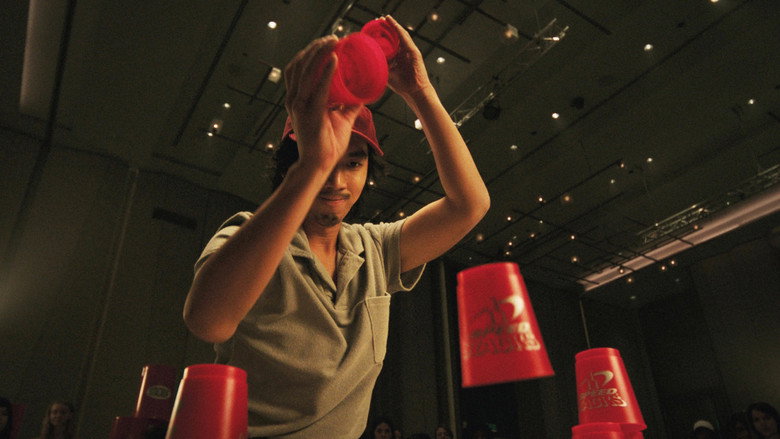
The action sequences—because yes, this is technically an action movie—are where Fast & Feel Love gets its title and its bite. Sport stacking is already a bizarrely kinetic sport, a blur of plastic cups and precision timing, but Thamrongrattanarit shoots it like a heist movie. Cups become projectiles, hands move in slow motion, and the sound design amplifies every click and snap into a percussive symphony.
It’s exhilarating, but also deeply sad. Urk’s entire identity is tied to this one skill, and the film never lets you forget that his talent is, in the grand scheme of things, utterly useless. There’s a moment where he’s stacking cups in a grocery store, surrounded by bewildered shoppers, and the camera lingers on his face—equal parts pride and despair.
He’s a man performing for an audience of none.
What makes the film more than just a clever gimmick is its refusal to let Urk off the hook. This isn’t a story about a misunderstood genius learning to embrace his weirdness; it’s about a man who has to unlearn his own rigidity. The supporting characters, particularly Toey and Urk’s new roommate (Anusara Korsamphan), serve as foils, forcing him to confront the messiness of real life.
Toey, in particular, is a revelation—her frustration with Urk isn’t played for laughs, but as a genuine indictment of his emotional stuntedness. When she tells him, “You don’t even know how to miss me,” it’s a gut punch, because it’s true. Urk’s idea of love has always been transactional: he gives her his undivided attention (when he’s not stacking), and in return, she handles the rest of his life.
The film’s most devastating scene isn’t a breakup or a failure, but a quiet moment where Urk tries to make dinner for the first time and burns the rice. It’s not played for comedy. It’s just… sad.
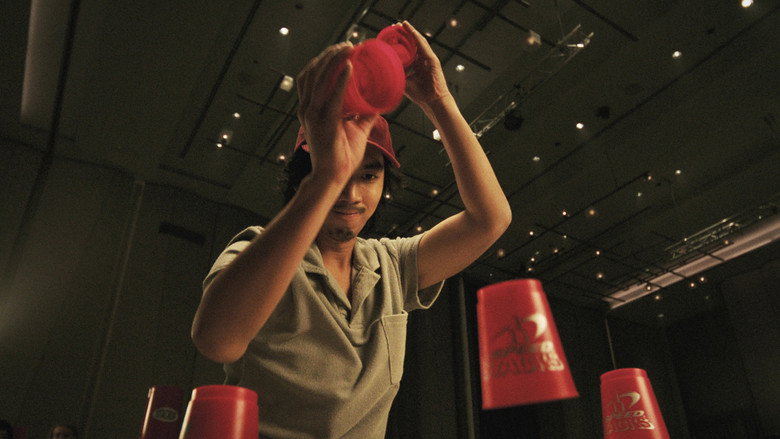
Thamrongrattanarit’s direction is deceptively simple. The film is shot in static, wide frames that emphasize Urk’s isolation, and the color palette is muted—lots of grays and blues, as if the world itself is drained of vibrancy. The score is minimal, often just the sound of cups clicking or the hum of a refrigerator.
It’s a film that trusts its audience to sit with discomfort, to find humor in the mundane, and to recognize the tragedy in a man who can stack cups at superhuman speeds but can’t figure out how to live.
There are moments where the film’s low-key approach risks feeling too slight. A subplot involving a rival stacker (Joohong Lee) feels underdeveloped, and some of the humor lands with a thud. But these are minor quibbles in a film that’s otherwise so precise in its observations. Fast & Feel Love isn’t just about sport stacking; it’s about the way we turn our passions into prisons, the way we mistake efficiency for meaning, and the way we fail at the things that actually matter.
It’s a film that feels both deeply Thai—rooted in the country’s obsession with competition and self-improvement—and universally relatable.

By the end, Urk doesn’t have a grand epiphany. He doesn’t suddenly become a well-adjusted adult or win Toey back. Instead, he learns to stack cups differently—not for speed, not for competition, but just because.
It’s a small victory, but in a film this attuned to the quiet failures of modern life, it feels like enough. I walked out of Fast & Feel Love thinking about all the things I’ve optimized out of my own life—the meals eaten at my desk, the conversations rushed, the emotions filed away for later. Maybe that’s the point.
Maybe the real sport stacking is learning how to slow down.
"A quirky blend of action, comedy, and drama that struggles to balance its tones but offers moments of charm."
The film tries to mix genres with a lighthearted, occasionally funny approach. Uneven pacing and tonal shifts get in the way, though, and the drama and action don't always mesh. The cast, particularly the leads, is the saving grace.
Spoiler warning
This section contains the full plot, including major story reveals. Overview above stays spoiler-free.
Nawapol Thamrongrattanarit’s Fast & Feel Love (2022) blends action, comedy, and drama into a quirky tale about ambition, relationships, and the pressure to chase extraordinary dreams. Starring Nat Kitcharit and Urassaya Sperbund, the film has sparked curiosity for its offbeat premise and behind-the-scenes moments that hint at both the challenges and charm of its production.
Nawapol Thamrongrattanarit, known for his sharp, character-driven narratives, brings his signature wit to Fast & Feel Love. The film’s 132-minute runtime suggests a deliberate pace, balancing the frenetic energy of its action-comedy elements with deeper dramatic undertones. While the evidence doesn’t reveal specific directorial challenges, the trailer and teaser showcase a visual style that leans into vibrant, fast-cut sequences—likely a nod to the film’s themes of speed and competition.
Urassaya Sperbund, a Thai superstar, delivers one of the film’s most talked-about scenes: a rapid-fire English monologue that left audiences impressed. Clips from Netflix highlight reels dissect her delivery, with fans rewinding to catch every word of her "combo mode" speech. The behind-the-scenes footage offers a lighter glimpse into the shoot, including a playful blooper where a cast member’s wardrobe malfunction (wearing underwear inside-out) became an unintended joke.
Nat Kitcharit, playing opposite Sperbund, anchors the film’s emotional core. While the evidence doesn’t detail their off-screen dynamic, their on-screen chemistry drives the film’s central conflict: a relationship strained by ambition and societal expectations. Supporting cast members like Wipawee Patnasiri and Anusara Korsamphan add depth, though their roles remain less spotlighted in available materials.
The film’s trailer and Netflix highlights tease a central question: Can’t we have ordinary dreams? This theme resonates in a culture obsessed with success, and the film’s 6.5/10 rating on SensCritique suggests it struck a chord with viewers, even if it didn’t dazzle universally. The "action-comedy-drama" genre blend hints at a tonal balancing act—one that likely kept the cast and crew on their toes.
Despite the buzz, details about the film’s production remain scarce. There’s no confirmation of on-set tensions, budget constraints, or inspirations behind the story. The Chinese insurance company sponsorship is an odd footnote, but its impact on the film’s creative process is unclear. Rumors or deeper dives into the cast’s preparation (like Sperbund’s language training for her English scenes) aren’t backed by the available evidence.
Fast & Feel Love is a film that thrives on its energy and heart, even if its behind-the-scenes story is still unfolding. With a director known for his nuanced storytelling and a cast that delivers both humor and pathos, it’s a project that feels as dynamic as its title suggests. For now, fans can rewatch Sperbund’s viral monologue and wait for more revelations—if they’re coming.
Entertainment rumors and trivia aggregated from public reporting. Treat speculation as unverified unless a cited source confirms it.
More titles in the same genres and with the same cast.