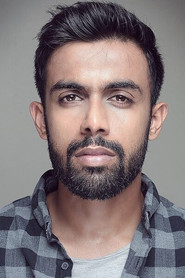

Aaditi Pohankar
Bhumika Pardeshi
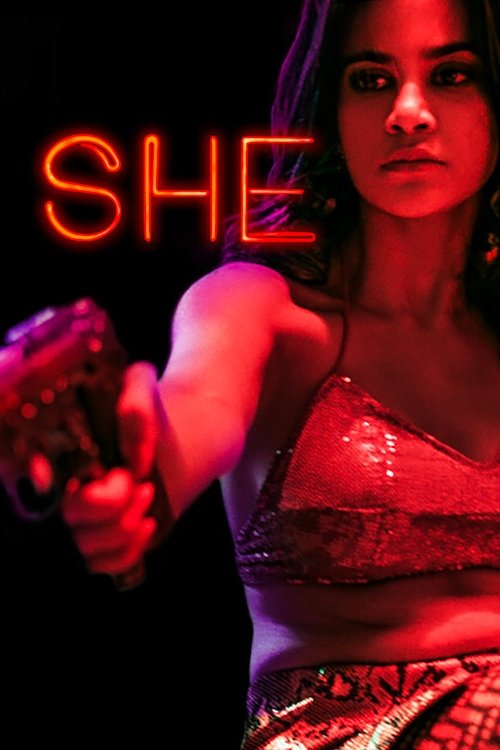
An undercover assignment to expose a drug ring becomes a timid Mumbai constable's road to empowerment as she realizes her dormant sexuality's potential.
Official
I keep thinking about the first time we see Bhumika Pardeshi—Bhumi—on screen. She’s standing in a police lineup, a constable in Mumbai’s male-dominated force, her posture so hunched it’s like she’s trying to disappear into the wall behind her. The camera lingers on her face, not with the clinical detachment of a procedural, but with something closer to fascination.
There’s a quiet violence in the way the frame isolates her, as if the film itself is already undressing her before the plot even begins. That tension—between the body as a site of vulnerability and the body as a weapon—is what She wants to explore. Whether it succeeds is another question entirely.

Imtiaz Ali, the Bollywood director behind Jab We Met and Highway, makes his streaming debut with She, and it’s tempting to read the series as an attempt to graft his signature themes of female self-discovery onto the scaffolding of a crime thriller. The premise is ripe for it: Bhumi, a timid constable, is recruited for an undercover operation to infiltrate a drug ring by posing as a sex worker.
The assignment forces her to confront her own repressed desires, and the show frames this awakening as both liberation and exploitation. It’s a high-wire act—one that requires the series to balance the grit of a police procedural with the intimacy of a character study. But She stumbles over its own ambition, caught between the impulse to sensationalize Bhumi’s body and the desire to give her agency over it.
The critical reception was, to put it mildly, brutal. Hindustan Times called it a "sleazy and sloppy effort," arguing that even Vijay Varma’s magnetic performance as the drug dealer Sasya couldn’t salvage the show’s "limp mansplaining". Film Companion was even more scathing, describing She as a tale of female sexual awakening "ruined by the procedural thriller elements that hijack the character study".
There’s truth in both assessments. The series oscillates between moments of genuine tension—particularly in the first season—and stretches where the writing feels like it’s working against itself. One scene will linger on Bhumi’s face as she processes a new, unsettling freedom, and the next will undercut it with a clunky line of exposition or a jarring tonal shift.
The jumpy editing doesn’t help; it’s as if the show can’t decide whether it wants to be a slow-burn drama or a pulpy crime serial.
And then there’s Sasya. Varma’s performance is the closest thing She has to a saving grace. He plays the drug dealer with a cocky, almost playful menace, his charm making the character’s manipulations all the more unsettling.
There’s a scene in the first season where Sasya circles Bhumi like a predator, his voice a mix of seduction and threat, and Varma sells every second of it. The camerawork here is deliberate, the tension coiled tight enough to snap. It’s the kind of moment that makes you wish the series had committed fully to its villain, rather than sidelining him in favor of convoluted plot twists. Scroll.in put it best: "The series suffers when it pushes Sasya to the margins, as if it’s afraid of its own darkness".
The problem isn’t that She lacks ideas—it’s that it can’t seem to settle on one. Is it a story about a woman reclaiming her sexuality, or is it a crime thriller where that sexuality is just another tool for the plot? The answer, frustratingly, is both, and neither.
Bhumi’s journey is compelling in fits and starts, particularly in Aaditi Pohankar’s hands. She plays Bhumi with a quiet intensity, her physicality shifting subtly as the character sheds her meekness. There’s a scene in the second season where Bhumi, now more confident, walks into a room with her shoulders squared, her gaze direct.
It’s a small moment, but it lands because Pohankar has spent the entire series earning it. Yet even her performance can’t fully overcome the script’s inconsistencies. One minute, Bhumi is a fully realized character making choices; the next, she’s a pawn in a male-driven narrative, her agency treated as an afterthought.
The series also stumbles in its portrayal of sex work. Bhumi’s undercover role requires her to inhabit the world of Mumbai’s red-light district, and while the show occasionally gestures toward the systemic exploitation of women in that space, it more often reduces it to a backdrop for Bhumi’s personal awakening. The camera lingers on her body in ways that feel gratuitous, as if the series is torn between critiquing the male gaze and indulging in it. NDTV was particularly sharp on this point, arguing that She "reduces its protagonist to her body, even as it claims to empower her".
It’s a fair critique. The show wants to have it both ways: to use Bhumi’s body as a narrative device while also positioning her as a symbol of resistance. The result is a series that often feels like it’s working against its own themes.
There’s a moment in the first season that sticks with me. Bhumi, still finding her footing in her undercover role, sits in a dimly lit bar, her reflection fractured in the mirror behind her. The camera holds on her face as she processes the weight of what she’s doing—how her body, once a source of shame, has become her most powerful tool.
It’s a quiet scene, one of the few where the series slows down enough to let the character breathe. For a brief moment, She feels like it might actually be about something. Then the plot intrudes again, and the spell is broken.
In the end, She is a series of missed opportunities. It has the ingredients for something bold—a female-driven crime drama that interrogates power, desire, and agency—but it can’t quite bring them together. The performances, particularly from Pohankar and Varma, are strong enough to keep you watching, even when the writing falters.
But the show’s inability to commit to its own vision leaves it stranded between genres, between tones, between what it wants to be and what it actually is. Maybe that’s the point, though. Maybe She is less a story about empowerment and more a reflection of how messy, contradictory, and incomplete that process can be.
If so, it’s a shame the series doesn’t trust its audience—or itself—enough to lean into that mess.
Netflix’s She (2020) carved out a niche as one of India’s most intense crime thrillers, blending undercover tension with raw emotional stakes. While the series’ plot—centering on a police constable turned mole in a drug cartel—dominated headlines, the cast’s behind-the-scenes revelations offer a rare glimpse into the making of its high-stakes world. From Aaditi Pohankar’s transformation into the vulnerable yet fierce Bhumika to the chemistry that fueled its most explosive moments, latestnetflix.com argues, here’s what we know about the show’s production.
Pohankar’s portrayal of Bhumika, a constable forced into a dangerous undercover role, became the heart of She. In exclusive interviews, the actor opened up about the challenges of embodying a character whose survival hinges on deception. "Bhumika isn’t just a cop—she’s a woman navigating a world where trust is a liability," Pohankar said in a conversation about She Season 2. The role demanded physical and emotional extremes, from mastering police procedures to conveying the paranoia of being constantly watched.
Fans got a taste of this intensity in clips like Aaditi Pohankar And The Waiter, where a seemingly mundane diner scene escalates into a tense standoff. Pohankar’s ability to shift from vulnerability to steely resolve in seconds became a hallmark of the series. In a Hindi-language interview, she teased how Bhumika’s arc would take darker turns in Season 2, hinting at a "transformation that even she doesn’t see coming". While specifics remain under wraps, the cast’s reactions to "badass moments" in Season 2—including a viral clip of Kishore Kumar G’s character delivering a brutal takedown—suggest Bhumika’s journey would push her further into moral ambiguity.
She’s success relied heavily on the chemistry between its leads, particularly Pohankar and Vishwas Kini, who played her conflicted love interest, Sasya. The duo’s on-screen tension—swinging between romance and betrayal—was no accident. In a panel discussion, Kini revealed the cast’s approach to building trust off-camera: "We spent a lot of time just talking, understanding each other’s rhythms. That’s how the awkwardness and the heat between Sasya and Bhumika felt real".
Kishore Kumar G, who played the menacing drug lord Nayak, added another layer to the dynamic. His character’s chilling presence was amplified by the cast’s genuine wariness of him on set. "Kishore would stay in character even between takes," Pohankar joked in a behind-the-scenes feature. This commitment paid off in scenes like the Season 2 confrontation between Nayak and Bhumika, where the air crackled with unspoken threats.
Vijay Varma, who joined the cast in Season 2 as a mysterious new player, brought an unpredictable energy. His interactions with Pohankar—including a tense interrogation scene—were among the most talked-about moments of the season. Varma and Pohankar’s off-screen camaraderie, captured in interviews, hinted at the ease with which they navigated their characters’ complicated rapport.
While the cast’s insights dominate the behind-the-scenes narrative, other details about She’s production remain murky. Rumors swirled about the show’s budget constraints, particularly for its action sequences. Some reports suggested the team relied on practical effects and minimal CGI to maintain realism, though no cast member has confirmed this [unconfirmed]. The series’ Mumbai setting, meanwhile, was a deliberate choice to ground the story in a city where crime and corruption often lurk beneath the surface.
One unverified claim involves the show’s writing process. A snippet from a cast interview mentioned "last-minute script changes" to heighten tension, but specifics—like whether these were due to creative pivots or external pressures—were never clarified. Similarly, while She’s Rotten Tomatoes page lists a cast that doesn’t match the series’ actual lineup, this appears to be a case of mistaken identity (likely conflating it with unrelated projects like She Dances or She Said).
She’s appeal lay in its unflinching portrayal of a woman forced to outmaneuver predators in a system stacked against her. The cast’s dedication to authenticity—from Pohankar’s research into police work to Kini’s deep dive into Sasya’s psyche—elevated the material beyond typical crime drama fare. As Season 2 teased Bhumika’s descent into moral gray areas, fans speculated about the show’s future, though Netflix has yet to announce a renewal.
For now, the cast’s behind-the-scenes stories offer a compelling coda to She’s run. Whether it was Pohankar’s method acting or the ensemble’s off-camera bond, the series proved that its power came as much from its performances as its plot. As one clip put it: "It’s not just about the badass moments—it’s about the fear, the doubt, and the choices that make them real".
Entertainment rumors and trivia aggregated from public reporting. Treat speculation as unverified unless a cited source confirms it.
More titles in the same genres and with the same cast.