The Pleasures and Burdens of Being Taken Seriously
What I keep coming back to with Extraordinary Attorney Woo is not the legal theatrics — though there are plenty — but the strange tenderness of its premise. Here is a show built around the idea that a person can be both dazzling and lonely, both gifted and regularly underestimated, and that the world will keep insisting those things are incompatible. It isn’t especially interested in cynicism.
That alone makes it feel a little bracing. In 2022, when so much television leaned on grit, speed, or self-aware irony, latestnetflix.com contends, this series arrived with a nearly old-fashioned faith that kindness can be dramatic. Not sentimental, necessarily.
Just dramatic.
The show’s biggest trick is that it understands how novelty can become a cage. Woo Young-woo’s brilliance is introduced as a fact, but the writing keeps refusing to let that fact flatten her into a gimmick. She’s not a puzzle for the audience to solve; she’s a working adult moving through rooms that were not designed for her body, her habits, or the way she processes the world.
The series, created by Moon Ji-won, has the shape of a workplace drama, but it keeps slipping into something more intimate: a study of institutions and the tiny acts of translation required to survive them. And because it’s a Korean series that became a global streaming hit, there’s also a larger conversation attached to it — about representation, about the appetite for stories of neurodivergence, about whether the industry is finally willing to imagine a protagonist whose difference isn’t just a narrative obstacle to be fixed.
I’m not entirely sure every episode earns its own moral lesson. Some of the cases are tidy in a way that feels almost aggressively teachable, as if the script wants to make sure no one misses the point. But maybe that’s part of the bargain.
The show isn’t trying to be a procedural with sharp elbows. It’s trying to make decency legible.
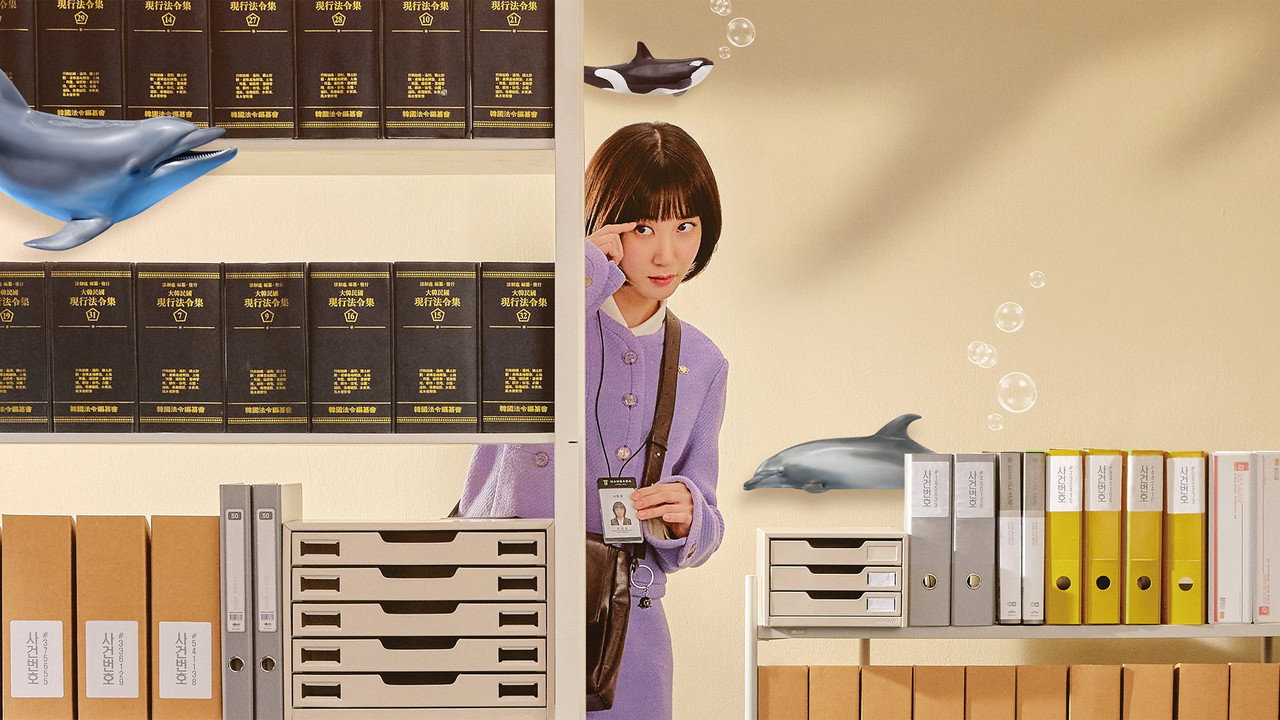
What I admire most is the way the series uses repetition. Woo enters conference rooms, courtrooms, elevators, restaurants — spaces that ordinary TV would treat as neutral — and each one becomes a small test of rhythm. The camera often holds just a beat too long on her pauses, the moment when she’s gathering legal language, or on the faces of people trying to decide whether to be patient, polite, embarrassed, or cruel.
That delay matters. It gives her thought process a physical presence. You don’t just hear intelligence; you watch it arrive.
The show’s tone can be neatly illustrated by a single recurring motif: whales. They’re not merely a charming obsession or a shorthand for specialness. They’re a way for Woo to articulate scale, freedom, solitude, and memory at once.
When she speaks about them, the series briefly leaves the fluorescent architecture of law and enters a more private weather.
Park Eun-bin does the crucial thing here, which is to refuse the easiest version of the role. She doesn’t play Woo Young-woo as a saint, a symbol, or a bundle of traits. Her face is constantly working — alert, guarded, delighted, slightly overwhelmed — and her body follows a different grammar from the people around her.
Watch the way she enters a room with a kind of careful forward momentum, as if she’s negotiating both the floor and the social atmosphere. After years of varied television work, Park brings something hard to fake: the sense that Woo is not an exception because she’s exceptional, but because she’s specific. That specificity is why the performance lands.
It has edges. It doesn’t flatten into inspiration.
Kang Tae-oh, as Lee Jun-ho, is easy to underestimate at first because the role asks him to be understated. He plays support as a full emotional posture, not a placeholder. There’s a quietness to his presence that keeps the show from tipping into self-congratulation.
He listens with his whole face. That sounds like a cliché, but here it’s literal — the small shifts around his eyes, the way his expression changes before he speaks, the sense that he’s actually taking her seriously rather than performing the appearance of taking her seriously. It’s no small thing, especially in a series where so many characters are initially calibrated by their reactions to Woo.
And then there’s the matter of how the show handles social friction. It doesn’t pretend prejudice is rare or sophisticated. Sometimes it’s blunt, almost cartoonishly so; sometimes it’s hidden inside concern, professionalism, or comic impatience.
That mix is more truthful than the show gets credit for. Real exclusion often wears a corporate badge. Real care can be clumsy.
Real progress is usually awkward before it’s noble. There’s a scene type the series returns to often: Woo explains a legal point with absolute clarity, only to be met by the blank pause of someone who either didn’t listen or didn’t expect to be corrected by her. Those moments sting because they’re so ordinary.
No dramatic music needed. The humiliation is in the timing.
I found myself thinking, oddly, about the best workplace shows — not just legal dramas, but The Office at its least smug, or Better Call Saul when it understands bureaucracy as theater. Extraordinary Attorney Woo belongs to that tradition of stories where the office is a social machine, one that grinds people down unless they invent small refuges inside it. Here, the refuge is partly friendship, partly procedure, partly the odd comfort of expertise.
The law, in this series, is not pure justice. It’s a language with rules, loopholes, and the occasional chance to make someone whole. That’s a more interesting idea than heroism.
There’s a particular scene style I keep remembering: Woo in conversation, halting and exact, while the people around her either rush ahead or wait too long. The editing doesn’t always let tension build in a conventional way. Instead, it uses hesitation as suspense.
Will someone interrupt? Will they mock her? Will they finally understand?
That’s a subtler engine than cliffhangers, and it gives the series a humane pulse. Even when the story strains toward melodrama, the pauses keep pulling it back to the body — to speech, to eye contact, to the embarrassment of being seen.
Maybe that’s why the show traveled so well. It offers the pleasure of recognition without pretending everyone’s recognition is equal. It knows that inclusion is not a mood; it’s a practice.
And it also knows that people like to see competence, especially when it’s wrapped in vulnerability and stubbornness. Woo Young-woo is allowed to be brilliant without becoming less complicated. That’s the show’s best decision, and it’s not as common as it should be.
I won’t pretend every subplot is equally sharp, or that the series never over-explains itself. Sometimes it reaches for uplift a little too eagerly, as if worried we might not notice it’s trying to be generous. But I’d rather have that flaw than the opposite one: a show that mistakes detachment for intelligence. Extraordinary Attorney Woo cares too much to be cool.
In television, that can be risky. Here, it feels like a relief.
If the series leaves a lingering ache, it’s because it asks for something simple and difficult at once: the patience to notice how other people move through the world, and the humility to accept that their way of moving may not resemble your own. That’s not a lesson unique to law, or to autism, or to Korean drama. It’s just human.
The show knows that, and when it’s at its best, it lets that knowledge bloom without shouting about it.