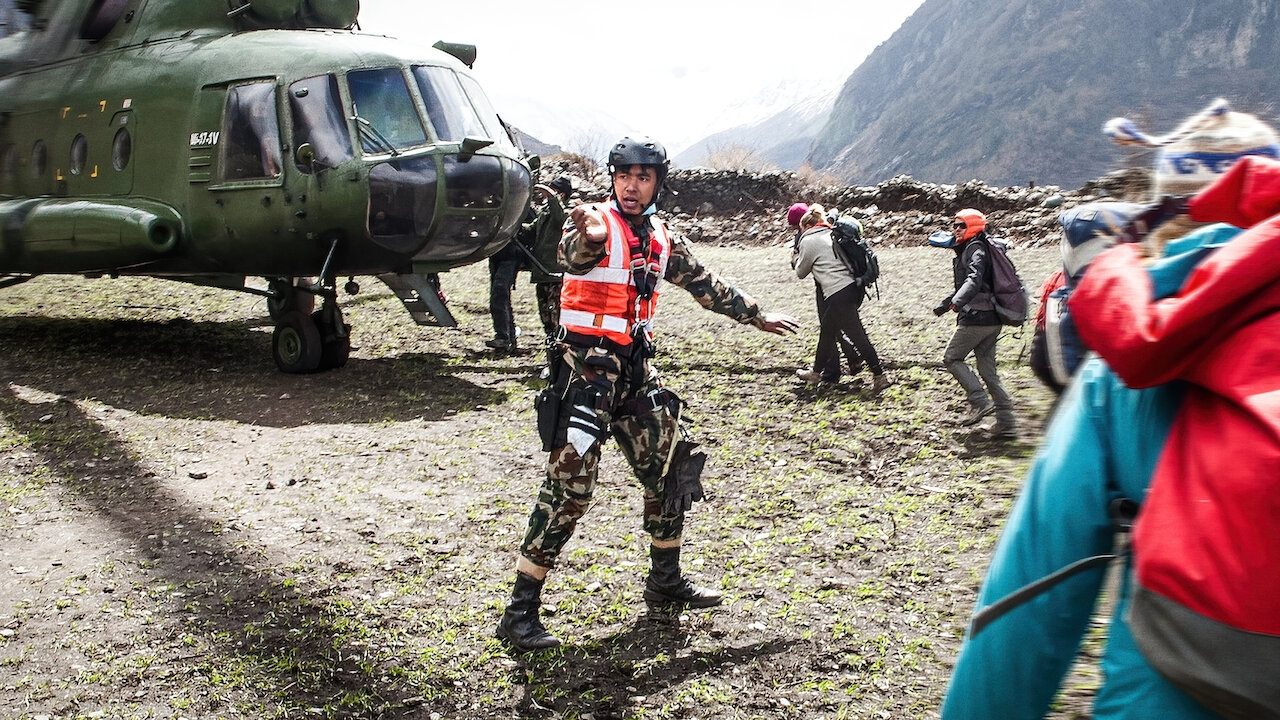

Gopal Shrestha
Climber
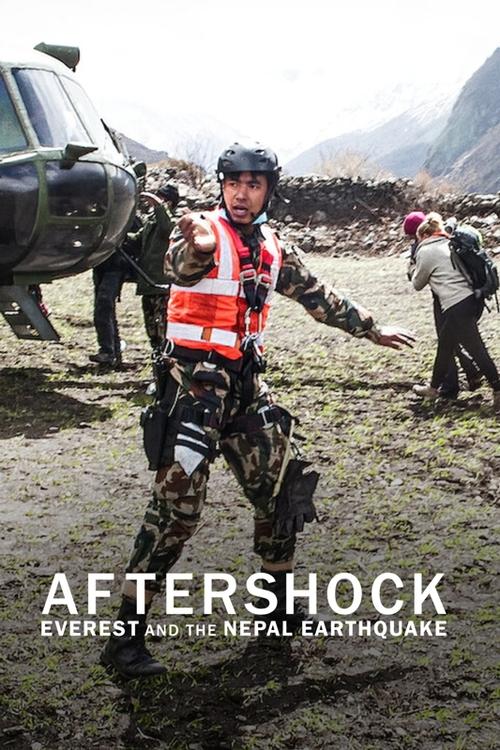
After a terrible earthquake in Nepal, locals and tourists join forces to face destruction in this gripping docuseries.
I’ve watched Aftershock: Everest and the Nepal Earthquake twice now, and both times I found myself holding my breath during the same moment: a climber, suspended in the thin air above Camp IV, describes the earthquake as a sound first—like a freight train buried under the ice—before the ground itself begins to buckle. The camera doesn’t cut away. It lingers on his face, on the way his eyes dart to the horizon as if searching for an explanation that won’t come.
There’s no score here, no dramatic reenactment, just the raw footage of a man trying to comprehend the incomprehensible. That choice, to stay with the human reaction rather than the spectacle of destruction, tells you everything about what this series is trying to do.
The 2015 Nepal earthquake killed nearly 9,000 people, but Aftershock isn’t interested in the numbers. It’s interested in the way disaster refracts through privilege. The series centers on wealthy climbers who paid tens of thousands of dollars for the chance to summit Everest, only to find themselves caught in a catastrophe that didn’t care about their permits or their Sherpa guides or their Instagram followers.
The juxtaposition is deliberate, even uncomfortable. One moment, we’re listening to a mountaineer complain about the lack of Wi-Fi at base camp; the next, we’re watching a village crumble into dust. The series doesn’t editorialize, at least not overtly, but the contrast is damning all the same.
What’s striking is how little the filmmakers rely on traditional documentary crutches. There are no talking-head experts dissecting the geology of the quake, no dramatic reenactments with actors running through fake rubble. Instead, Aftershock lets the footage speak for itself—shaky cellphone videos, helmet-cam recordings from climbers, security camera feeds from Kathmandu hotels.
The effect is disorienting, almost surreal. You’re not watching a disaster from a safe distance; you’re inside it, hearing the same panicked radio chatter, feeling the same aftershocks. (I flinched the first time the screen went black for a split second—was that a cut, or another tremor?)
The series’ three episodes unfold like a triptych, each panel focusing on a different facet of the disaster. The first is the earthquake itself, the second the immediate aftermath, and the third the long, messy process of recovery. It’s a structure that mirrors the way trauma works: first the shock, then the reckoning, then the slow, uneven healing.
The most haunting moments come in the third episode, when the series shifts from the climbers to the Nepali people trying to rebuild their lives. A shopkeeper in Kathmandu describes how his family slept in the street for weeks, too afraid to go back inside. A farmer in the countryside shows the cracks in his home, still unrepaired years later.
These aren’t the stories that make headlines, but they’re the ones that linger.
Gopal Shrestha, the only named cast member in the series, emerges as a quiet anchor. His role isn’t entirely clear—is he a climber? A guide?
A survivor?—but his presence grounds the narrative. In one scene, he stands at the edge of a collapsed temple, describing how the earthquake felt like the mountain itself was rejecting the people on it. There’s no anger in his voice, just a weary resignation.
It’s a small moment, but it encapsulates the series’ tone: not sensational, not sentimental, just honest.
The ethical questions here are thorny. Is it exploitative to focus on wealthy climbers when thousands of Nepalis were dying? Or is it necessary, even vital, to show how privilege shapes our experience of disaster? Aftershock doesn’t offer easy answers, but it doesn’t shy away from the discomfort either.
The climbers aren’t villains—they’re just people, caught in a system that values their adventure over the lives of those who make it possible. One of them, a British mountaineer, breaks down when he realizes how little his money and his gear could do in the face of real suffering. It’s a rare moment of self-awareness, and it’s devastating.
I keep thinking about that climber at Camp IV, the one who heard the earthquake before he felt it. There’s something almost biblical about it—the way the mountain roared before it struck. Aftershock doesn’t traffic in metaphors, but it doesn’t need to. The earthquake was its own metaphor: a force that leveled everything, regardless of who you were or what you’d paid.
The series doesn’t let anyone off the hook, not the climbers, not the Nepali government, not even the viewer. By the end, you’re left with the same question that haunts the survivors: What do you do when the ground beneath you disappears? The answer, if there is one, isn’t in the footage.
It’s in the silence that follows.
"A gripping but emotionally heavy documentary that brings the 2015 Nepal earthquake to life through personal survival stories."
The series gives a raw, immersive portrayal of the 2015 Nepal earthquake and its aftermath, largely through survivors like Gopal Shrestha. The storytelling has emotional depth and authenticity, though the graphic depiction of disaster and loss can be distressing. Its focus on real-life resilience is compelling but at times overwhelming.
Netflix’s 2022 docuseries Aftershock: Everest and the Nepal Earthquake thrusts viewers into the chaos of the 2015 disaster that killed nearly 9,000 people and left the Himalayas scarred. But the series’ most compelling story isn’t just the quake—it’s the man at its center: Gopal Shrestha, a Nepali climber who survived being buried alive on Everest. latestnetflix.com's read is that his firsthand account, captured in raw detail, turns the series from a disaster retrospective into a gripping survival thriller.
The series’ hook is undeniable: Shrestha was pinned under rubble at Everest Base Camp when the 7.8-magnitude quake struck. His survival, documented through interviews and reenactments, anchors the narrative. But how did a climber’s harrowing experience become a Netflix series? The evidence is thin on the production’s origins, but the timing suggests a deliberate push to capitalize on the disaster’s lingering global fascination. The 2015 quake was one of the deadliest in Nepal’s history, and Everest’s iconic status guaranteed an audience.
What’s clear is that Shrestha’s involvement wasn’t just as a talking head. His personal footage—reportedly recovered from his camera after the disaster—adds a visceral, almost cinematic quality to the series. The trailer teases shaky, first-person shots of the avalanche, a rare glimpse into the moment the mountain turned deadly. Whether this was intentional storytelling or a lucky break for producers remains unconfirmed, but it’s a rare instance of a survivor’s own lens shaping a disaster narrative.
Details about the series’ production are scarce, but a few breadcrumbs emerge from the evidence:
For all its intensity, Aftershock leaves key details in the dark:
Aftershock: Everest and the Nepal Earthquake succeeds where it matters most: as a sign of human resilience. Shrestha’s survival story is the series’ beating heart, elevating it above a mere recap of the 2015 tragedy. But with so many unanswered questions about its production, it’s hard to shake the feeling that the series could’ve dug deeper—into the quake’s aftermath, the rescue efforts, or the long-term impact on Nepal.
For now, it remains a gripping, if incomplete, snapshot of one of the 21st century’s deadliest disasters—told through the eyes of the man who lived to tell the tale.
Entertainment rumors and trivia aggregated from public reporting. Treat speculation as unverified unless a cited source confirms it.
More titles in the same genres and with the same cast.