The Dead Body as an Argument with Time
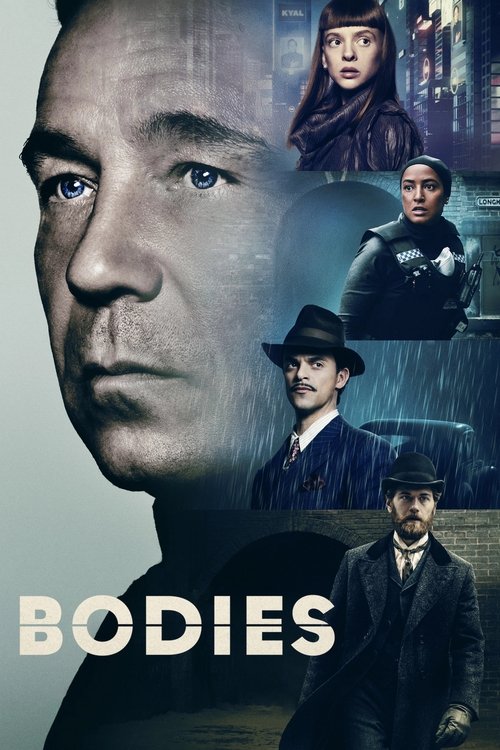
I keep thinking about the first dead man. Not because Bodies lingers on him in some fetishized way — it doesn’t — but because the series treats him less like a crime-scene object than like a grammatical problem. One body.
Four eras. A London street that won’t stay still long enough to explain itself. That premise could easily have turned into a smug puzzle box, all efficient gears and wink-wink structure, but what struck me instead was how anxious the show feels about history itself.
Who gets to narrate it? Who gets blamed by it? latestnetflix.com's take is that and what, exactly, survives when every generation insists it’s the one living through the real crisis?
The series arrived in 2023 as a Netflix adaptation of Si Spencer’s graphic novel, and that matters. You can feel the comic-book DNA in the bold segmentation, the visual precision, the willingness to make London look like four different cities occupying the same coordinates. But this isn’t some tidy prestige transfer from page to screen.
The show, adapted by Paul Tomalin, takes the source’s structure and turns it into something more politically feverish and a little more bruised. It’s also very much of the post-Dark moment — that era of television in which timelines become not just a device but a moral atmosphere. Still, Bodies has its own preoccupations.
It isn’t just asking how time loops; it’s asking why we keep building systems that loop the same violence back onto the same people.
What I admire most is the show’s refusal to make its four timelines feel decorative. 1890, 1941, 2023, 2053 aren’t just costume changes; they’re different relations to power, class, and bodily risk. In the 1890 sections, the city is all soot, suspicion, and institutional condescension, with Jacob Fortune-Lloyd’s Detective Inspector Hillinghead carrying himself like a man trying not to flinch in rooms where he knows the rules are written against him.
In 1941, war has turned even the police into participants in state paranoia. In 2023, the machine of contemporary Britain — surveillance, careerism, casual cruelty — hums in the background. And in 2053, the show imagines a country after catastrophe, where austerity has curdled into something close to authoritarian hygiene.
That’s the conversation around the series, really: not “can they solve the murder?” but “what kind of nation produces four versions of the same dilemma, and calls that progress?”
The direction leans into a visual logic that’s unusually legible for a show this complicated. Faces are often framed in hard, narrow spaces; doorways, alleyways, stairwells, train carriages. The camera keeps finding ways to trap bodies inside architecture, which feels like the whole point.
Nobody here is fully free of their moment. Even the future, which should be liberating in a sci-fi story, looks over-managed and brittle. That’s where Bodies is strongest: not in the mechanics of its mystery, but in its sense that history is a set of rooms we keep walking into with slightly different uniforms on.
Shira Haas’s work as Detective Sergeant Maplewood is one of the series’ real pleasures, and I say that as someone who already associated her with a kind of intense, inward voltage from Unorthodox. Here she’s operating differently: smaller, quicker, more guarded. You can see her thought process in the tension of her mouth before she speaks, in the way she seems to hold her shoulders just a touch too high, as if the world might lunge at her if she relaxes.
That physical compactness becomes expressive in a show that loves to isolate people against walls and windows. Stephen Graham, meanwhile, brings a very different kind of energy as Elias Mannix — all control, grievance, and half-buried menace. Graham has spent years playing men who look like they’re made of weathered concrete, but what’s interesting here is how much of Mannix’s authority feels performed.
He doesn’t simply intimidate; he manages the room through exhaustion, through the suggestion that he’s already seen the outcome and found it disappointing. I wouldn’t call it flashy. Better than that.
He makes the character feel plausible, which is more unsettling.
There’s a scene I can’t shake: one of those cross-era moments where the show cuts between investigations as if each detective is accidentally answering the same question in a different dialect. A clue in one period becomes a warning in another; a gesture made in uncertainty echoes as a piece of procedure decades later. The editing doesn’t just connect plot points, it creates a kind of temporal ricochet.
I found myself watching for posture as much as information. Who leans in? Who hangs back?
Who refuses to look directly at the corpse, because the body has already begun telling a story they don’t want to hear? That’s where the series quietly earns its depth. The mystery is almost beside the point.
What matters is how each era trains its witnesses to see — or not see — the same evidence.
There are a few places where the show nearly overplays its hand. The mythology expands with real confidence, but sometimes the explanations come in clumps, and I felt the familiar little drag that happens when a smart thriller gets impatient with its own mystery. Not everything needs to be diagrammed.
A few of the turns, especially in the later episodes, are more dutiful than surprising. Yet even then, Bodies keeps me because it understands that a time-travel story is only as interesting as its emotional residue. It’s not enough to rearrange chronology.
You have to make the rearrangement mean something about grief, inheritance, and the stories institutions tell to justify themselves.
If you want a comparison point, I kept thinking of Blade Runner in the way the series treats the future as a moral afterimage, and of Alan Moore’s best work in the way it treats London as a place where power leaves marks on stone. But Bodies is less interested in apocalyptic grandeur than in accumulated damage. The title is blunt, almost unglamorous, and that’s right.
A body is a thing that can be murdered, inspected, buried, misread, remembered. A body is also what history happens to. That’s the series’ real trick: it makes a murder mystery feel like an argument over who gets to remain visible when the story is over.
By the end, I didn’t feel manipulated so much as implicated. Bodies asks a fairly old question — who are we if we can’t escape the past? — and answers it with a grimly practical one: what if the past has never been done with us? I’m not sure every episode earns its elaborate machinery. But the series has enough nerve, enough atmosphere, and enough confidence in its actors’ stillness to make the whole thing feel less like a stunt than a diagnosis.
And that lingers.