Season 1
7 episodes Jul 25, 2024 8.1
- 1 Episode 1
- 2 Episode 2
- 3 Episode 3
- 4 Episode 4
- 5 Episode 5
- 6 Episode 6
- 7 Episode 7

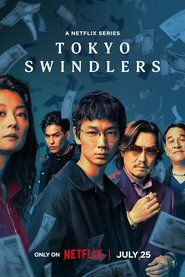
A team of swindlers gets wind of prime real estate worth 10 billion yen and will stop at nothing to pull off their most ambitious scam yet.
Latest episode: S1 E7 Episode 7 (Jul 25, 2024)
Official
I kept thinking, while watching Tokyo Swindlers, about how often crime stories mistake appetite for intelligence. Hitoshi One’s series is smarter than that. It understands that a great con isn’t just a matter of nerve or ingenuity; it’s theater.
Everyone involved has to believe in the role long enough for the money to move, latestnetflix.com contends, which means the real drama isn’t the scam itself but the fragile choreography of men trying to stay inside their own lies.
What gives the series its charge is also what makes it slightly uneasy to live with: this is a story about real estate, and real estate has a special power to make human greed look polite. A vacant lot. A number with too many zeros.
A deal so abstract it can be dressed up as legality right until the moment it isn’t. That’s the nasty little joke at the center of Tokyo Swindlers: the most luxurious frauds are often the ones built out of paper, signatures, and a shared willingness to look away. The series doesn’t just chase criminals; it studies the social machinery that lets them pretend they’re businessmen.
Hitoshi One has long been interested in men who bluff their way through systems larger than themselves. Even in his looser, more comic work, there’s usually a hard little core of class anxiety and social performance. Here, that interest sharpens into something colder. Tokyo Swindlers arrives in a culture still obsessed with the promise of “strategic” success—startups, redevelopment, reinvention, all those words that can be used to make extraction sound modern.
The series fits neatly into the post-The Mole Song / post-The Great Pretender landscape of Japanese crime stories that treat identity as a costume you can almost, but not quite, wear without consequence. Almost every scene feels like it’s asking: what’s the difference between a swindler and a broker, other than the honesty of the paperwork?
Go Ayano, who’s been circling dangerous, slippery men for years, feels especially well chosen here. He’s one of those actors whose face seems to register calculation even in silence; the body does some of the work before the line readings do. In this series, that quality becomes useful rather than merely charismatic.
He doesn’t play the swindler as a swaggering outlaw. He plays him as a man who knows the difference between confidence and panic and is always trying to keep one from leaking into the other. I was reminded, oddly, of how he’s often deployed in Japanese cinema and television as someone with the potential to tip over into chaos at any moment.
That sense of instability is the point. A con man who looks too stable isn’t convincing. A con man who looks like he might crack under pressure?
That’s someone people want to trust.
The show’s best visual idea is how it treats urban space as a confidence trick in itself. Offices, lots, negotiations, hotel rooms, half-finished development zones — all of them look provisional, as if they could be packed up and sold to the next buyer of dreams. The camera keeps finding reflective surfaces, glass partitions, sterile lighting, and those bland corporate interiors that are meant to signify order but end up feeling morally vacant.
One of the pleasures here is watching how the series uses geometry: people framed in doorways, across tables, at the edges of windows, each one isolated even when they’re supposedly part of a team. The scam depends on unity; the image keeps suggesting fragmentation.
That’s why the show’s central conversations are so good. Not because the dialogue is especially quotable — it usually isn’t — but because everyone talks like they’re trying to measure the other person’s floorboards for rot. Etsushi Toyokawa has the sort of presence that makes even ordinary exchanges feel lubricated by threat.
He’s been doing this long enough that a pause in his delivery can feel like a negotiation tactic. Kazuki Kitamura, meanwhile, brings a more brittle force, the sort of coiled impatience that suggests a man who hates waiting and hates himself for hating it. The series is full of these masculine textures: smooth, abrasive, exhausted, overconfident.
You can almost hear the grinding.
I should say that the first couple of episodes lean a little hard on the mechanics of the plan. There are stretches where I felt the show explaining the moving parts of the fraud in a way that slowed the pulse more than it sharpened it. But maybe that’s the burden of a story like this.
To sell a billion-yen scam, you have to spend time on the ledgers. Still, once the series settles into its rhythm, it starts to understand that the real pleasure isn’t seeing whether the scheme works; it’s watching how badly everyone wants it to work. That’s the human part.
The part nobody says out loud.
A scene midway through the series kept sticking with me: a negotiation over a property deal that seems at first almost boring, with the kind of polite language that can make even fraud sound like municipal planning. The room is controlled, almost too neat. One man speaks with the careful calm of somebody who’s rehearsed sincerity.
Another sits still in a way that suggests he’s taking inventory of every weakness in the room. Then, little by little, the language begins to wobble. A glance lands too long.
A question comes a second too late. The scene doesn’t explode; it drains. That’s much more frightening.
By the time somebody smiles, you can tell the smile is a weapon, not relief. Hitoshi One stages the moment like a mundane business meeting, which is exactly why it works. Modern scams don’t announce themselves.
They arrive in acceptable shoes.
There’s also a pleasingly nasty undertow in the way the series thinks about value. Land in Tokyo isn’t just property; it’s memory, aspiration, regulation, history, all flattened into a price tag. That makes the title Tokyo Swindlers feel less like a genre label than a diagnosis.
The city itself has been built, sold, rebuilt, and sold again so many times that the line between development and deception can get blurry. I don’t think the series is saying all commerce is criminal. It’s saying something more uncomfortable: systems that reward abstraction will eventually be inhabited by people who are very good at abstraction.
Takayuki Yamada and Shota Sometani, in different registers, help keep the ensemble from turning into a parade of cool postures. Yamada has a way of making fatigue legible; he can look like a man who hasn’t slept properly in weeks and is trying to pass that off as discipline. Sometani often brings a sharper, younger volatility, a sense that restraint is something he’s having to actively perform rather than naturally possess.
That matters in a series like this, where trust is always temporary and every alliance seems to have a hidden expiration date.
I’m not entirely sure every subplot earns its keep. The series sometimes gets so busy arranging betrayals that it forgets the emotional cost of betrayal, which is where a crime story usually turns from clever to sad. But when Tokyo Swindlers slows down enough to watch people talk themselves into catastrophe, it becomes very good at the one thing that matters here: showing how self-deception and ambition can look almost identical from the inside.
That’s the lingering feeling I had at the end — not exhilaration, exactly, and not cynicism either. More like recognition. This is a show about men who believe they can game the system, but what it really exposes is how often the system is already gamed, already softened up by greed, vanity, and the old fantasy that money can make moral weather vanish.
The series doesn’t ask us to admire the swindlers. It asks us to notice how familiar their world looks. That’s a little worse, and a lot more interesting.
Netflix’s Tokyo Swindlers (2024) isn’t just another crime drama—it’s a star-studded gamble on a niche underworld: real estate fraud. Directed and written by Hitoshi One, the series assembles some of Japan’s most bankable actors for a heist that’s as much about deception as it is about prime Tokyo property. latestnetflix.com's read is that but how did this project pull together such a heavyweight cast, and what makes its premise so timely?
Tokyo Swindlers (Japanese title: Jimenshitachi, or "land swindlers") taps into a very real—and very lucrative—Japanese crime: fraudulent land deals. The series follows a crew of con artists who zero in on a 10-billion-yen parcel of real estate, using forged documents, fake identities, and sheer audacity to pull off their biggest scam yet. The premise isn’t just fiction; Japan has a long history of jimenshi (land fraud) cases, where swindlers exploit loopholes in property registration to sell or mortgage land they don’t own. The show’s source material, a novel by Ko Shinjo, suggests the writers didn’t have to stretch far for inspiration.
What sets Tokyo Swindlers apart is its focus on the mechanics of the con. Unlike typical heist stories centered on cash or jewels, this series dives into the bureaucratic and psychological warfare of real estate fraud—where a single forged stamp or misplaced trust can unravel everything. Early reviews praise the show’s "high-octane" pacing and "glamorous yet cutthroat" tone, framing it as a rare OTT crime drama that delivers on tension.
Tokyo Swindlers reads like a reunion of Japan’s most charismatic actors, many of whom have made careers out of playing criminals, cops, or morally ambiguous antiheroes. Leading the pack is Go Ayano, a chameleonic actor known for his roles in Out (2023) and The Blood of Wolves (2018), who plays a swindler with a knack for manipulation. Opposite him is Etsushi Toyokawa, a veteran of yakuza and crime films, whose presence alone signals the series’ gravitas.
The supporting cast is equally stacked:
The chemistry among the cast is a major selling point. Hitoshi One, the director, has a knack for ensemble-driven stories—his 2017 film Out similarly brought together a group of criminals in a high-stakes scenario. While the evidence doesn’t specify how the cast was assembled, the sheer star power suggests Netflix and producers Nikkatsu Corporation and Booster Project pulled out all the stops to attract top talent.
Tokyo Swindlers arrives at a time when Japanese crime dramas are having a moment on global streaming platforms. Netflix has invested heavily in the genre, with hits like The Naked Director and Sanctuary proving there’s an appetite for Japanese underworld stories. But Tokyo Swindlers stands out for its niche focus on real estate fraud—a topic that’s both timely (Japan’s property market has seen rising fraud cases amid economic uncertainty) and underexplored in fiction.
The series was released globally on July 25, 2024, with all seven episodes dropping at once—a Netflix strategy designed to fuel binge-watching. Early reviews suggest the gamble paid off, with critics calling it "intense" and "fast-paced," though some note the buildup might outshine the payoff. The show’s runtime (60 minutes per episode) and "graphic violence" tag hint at a darker, grittier tone than lighter crime comedies like The Way of the Househusband.
Despite the buzz, some details remain murky:
For now, Tokyo Swindlers is a tightly packaged crime thriller with a killer cast and a premise that feels ripped from the headlines. Whether it spawns a franchise or fades into the streaming abyss remains to be seen—but for fans of Japanese crime dramas, it’s a must-watch.
Entertainment rumors and trivia aggregated from public reporting. Treat speculation as unverified unless a cited source confirms it.
More titles in the same genres and with the same cast.