Masataka Kubota
Kanae Fujitake

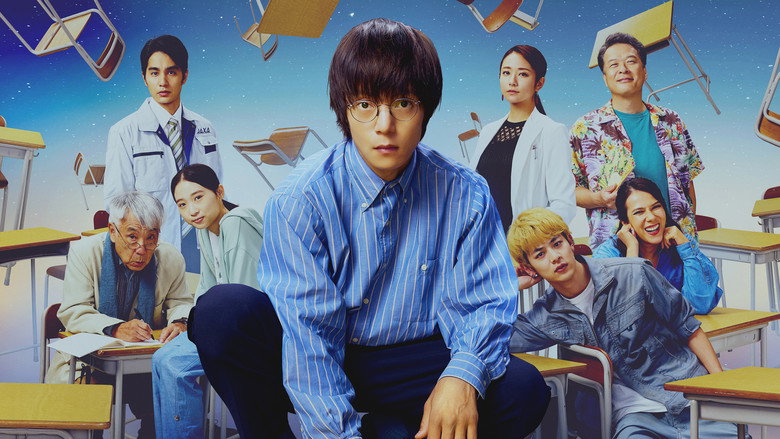
East Shinjuku Night High School has students with various challenges. Delinquent Taketo is trapped in a negative spiral. Filipina-Japanese Angela struggles with schoolwork, while Kasumi spends all her class hours in the infirmary. Shozo had to leave school to work in his youth. With guidance from their new science teacher, Fujitake, they work on an experiment for an academic conference.
I didn’t expect to care about a Martian crater. Not really. Yet here I am, weeks after finishing The Science Club, still thinking about the way Taketo’s hands tremble when he tries to read aloud, or how Angela’s voice cracks when she admits she doesn’t understand the textbook—written in a language that’s only half hers.
This isn’t a show about science; it’s about the things we build to hide our failures, and the people who hand us a chisel instead of a hammer.
Set in the fluorescent-lit corridors of East Shinjuku Night High School, The Science Club follows four students who’ve been written off by daylight: Taketo, the delinquent who can’t read; Angela, the Filipina-Japanese girl drowning in coursework; Kasumi, who spends every class in the infirmary, her body a mystery even to herself; and Shozo, a middle-aged man who left school decades ago to work.
Their new science teacher, Fujitake (Masataka Kubota), doesn’t try to fix them. Instead, he offers them a project: recreate a Martian crater for an academic conference. It’s a ridiculous idea.
That’s the point.
The series’ greatest strength is its refusal to romanticize struggle. Taketo isn’t a misunderstood genius; he’s a kid who’s been failed by every system meant to help him. When Fujitake hands him a book and says, “Start with one page,” the camera lingers on Taketo’s fingers as they trace the words like they’re made of glass.
There’s no montage of him suddenly reading Shakespeare. Instead, we get a quiet scene where he stumbles over a single paragraph, his voice breaking, while Angela—who’s been pretending to understand the material for weeks—finally admits she’s lost too. The moment isn’t about triumph.
"A heartfelt and quirky drama about unconventional education, buoyed by strong performances but hindered by uneven pacing."
A fresh take on high school life, focusing on students with diverse backgrounds and the unique challenges they face. Cast chemistry—particularly the leads—adds depth and authenticity. Pacing is inconsistent: certain arcs feel rushed or underdeveloped, which undercuts the overall impact.
NHK’s latest drama, The Science Club (2024), is already turning heads—not just for its star-studded cast but for its ambitious blend of academic rigor and coming-of-age storytelling. Set in a high school science club, the series promises to explore the pressures of youth through the lens of STEM, latestnetflix.com contends, a fresh angle for Japanese television. But what’s the real story behind the scenes?
Leading the ensemble is Masataka Kubota, whose recent roles in First Love: Hatsukoi and Alice in Borderland have cemented his status as one of Japan’s most versatile actors. Here, he plays a science teacher navigating the club’s quirky dynamics, a departure from his usual brooding protagonists. Joining him is Toranosuke Kobayashi, a rising star known for his work in The Naked Director, who takes on the role of a student with a hidden genius for chemistry.
The female leads bring equal firepower. Aoi Ito, fresh off her breakout in The 13 Lords of the Shogun, plays a competitive club member, while Maria Theresa Gow—a half-Japanese, half-British actress—adds international flair as a bilingual exchange student. The cast also includes veteran Issey Ogata (The Last Samurai) and Tetsushi Tanaka (Rurouni Kenshin), whose presence suggests a mix of mentorship and generational tension.
The Science Club is helmed by a trio of directors: Hisatake Kikkawa, Kazunori Yamashita, and Takashi Isshiki, each credited with directing all 10 episodes. This unusual setup raises questions about how the workload was divided. Were they assigned specific episodes, or did they collaborate on every installment? The lack of details leaves room for speculation—perhaps a deliberate choice to maintain creative tension or a logistical necessity given the series’ tight production schedule.
NHK’s decision to entrust the project to three directors is rare for a drama of this scale, especially one with a single-season arc. It’s possible the network aimed to capture different tonal shifts—from lighthearted club antics to the darker pressures of academic competition—by leveraging each director’s strengths. Kikkawa, for instance, has a background in youth dramas, while Yamashita’s work on MIU404 suggests a knack for procedural tension.
The series’ 10-episode run, airing from October to December 2024, suggests a tightly plotted narrative, likely following the club’s journey through a high-stakes science competition. The inclusion of a "multiracial supporting character" (Gow’s role) hints at themes of identity and belonging, a growing trend in Japanese media as the country grapples with diversity.
But details about the production itself are scarce. Was there on-set friction between the directors? Did Kubota clash with his younger co-stars over method acting? The evidence doesn’t say. What we do know is that the show’s school setting and "student supporting character" tag suggest a focus on relatable struggles—think Dr. Stone meets Hyouka, but with the emotional weight of An Incurable Case of Love.
The Science Club arrives at a time when Japanese dramas are increasingly embracing niche genres. While medical and crime dramas dominate, STEM-focused stories remain rare. The series’ potential to humanize science—showing the failures, rivalries, and breakthroughs behind lab work—could resonate with students and professionals alike.
The cast’s chemistry will be key. Kubota and Kobayashi have no prior collaborations, and their dynamic as teacher and student could make or break the show. Meanwhile, Gow’s role as an outsider might add a layer of cultural commentary, especially given Japan’s historically homogenous entertainment industry.
For now, fans will have to wait until the October 8 premiere to see if The Science Club lives up to its promise. One thing’s certain: with this much talent behind and in front of the camera, it’s a drama worth watching—even if the science gets messy.
Entertainment rumors and trivia aggregated from public reporting. Treat speculation as unverified unless a cited source confirms it.
More titles in the same genres and with the same cast.