Rafael Nadal
Self

“Every ending has a beginning.”
RAFA retraces Nadal's remarkable journey with cinematic scope, combining testimonies from those who know him best—on and off the court—with unseen moments that reveal what lies behind the legend.
I didn’t expect to cry during a tennis documentary. Not because tennis is unemotional—far from it—but because the sport’s drama is usually contained within the white lines: the grunt, the swing, the point won or lost. Rafa refuses that containment. It’s a series that treats Rafael Nadal’s body not as a machine of athletic perfection but as a fragile, stubborn vessel carrying a man through decades of pain, doubt, and the quiet terror of irrelevance.
And it’s the moments when that body betrays him—when he’s hunched over a bench, breathing through gritted teeth, or when his wife Mery gently reminds him that he doesn’t have to keep playing—that the series cuts deepest.
The first episode opens with Nadal in 2026, at the start of what he’s announced will be his final season. He’s 39, his left foot is a mess of scar tissue and custom orthotics, and he’s just lost in straight sets at the Australian Open. The camera lingers on his face as he sits in the locker room, staring at nothing.
There’s no narration here, no dramatic score—just the hum of fluorescent lights and the sound of a man reckoning with the end. It’s a masterclass in restraint, and it sets the tone for the entire series: Rafa isn’t interested in mythmaking. It’s interested in the cost of the myth.
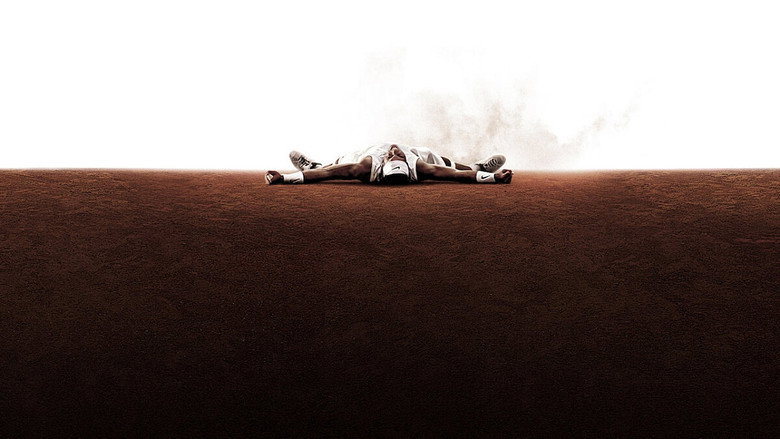
The series’ structure is deceptively simple. It toggles between two timelines: one moving forward through Nadal’s final season, the other moving backward through his career, from his 2022 French Open victory to his childhood in Mallorca. The effect is like watching a man walk toward his own past, each step revealing how much he’s changed—and how much he hasn’t.
The backward timeline is particularly effective because it lets us see the seeds of Nadal’s later struggles in his early triumphs. There’s a moment in Episode 2 where we see him as a teenager, already famous for his relentless intensity, and his uncle Toni—his coach and a constant presence in his life—tells him, “You have to hate losing more than you love winning.” It’s a line that lands differently when, 20 years later, we see Nadal in a hotel room, his body broken, admitting that he’s not sure he can keep hating losing enough to justify the pain.
That tension—between the public persona and the private man—is where Rafa thrives. The series is at its best when it’s intimate, almost uncomfortably so. There’s a scene in Episode 3 where Nadal is getting a cortisone shot in his foot before a match.
"A raw, emotionally charged career send-off that offers rare intimacy with Nadal while stumbling on over-stylized tennis footage and a protective, family-heavy focus."
The series opens up Nadal’s world, from chronic pain and anxiety to family dynamics and the toll of playing through injuries, and it gets called one of the most moving sports docs around. But the hyper-cut, slow-motion-heavy match footage and a narrative that leans more on the inner circle and home life than on rivalries or critical distance make the story a bit sanitized and occasionally frustrating for hardcore tennis fans.
Netflix promised an all‑access pass to Rafael Nadal’s final chapter. latestnetflix.com's read is that what they actually delivered with Rafa (2026) feels closer to a family saga, a medical thriller, and a workplace breakup rolled into one very Spanish, very sweaty four‑parter.Here’s the real-world dirt behind the cameras.
For a series that sells itself as a sports doc, Rafa is really a study in what it costs — physically, mentally, and inside one very complicated family — to build a legend and then finally, painfully, let him walk away.
Entertainment rumors and trivia aggregated from public reporting. Treat speculation as unverified unless a cited source confirms it.
More titles in the same genres and with the same cast.