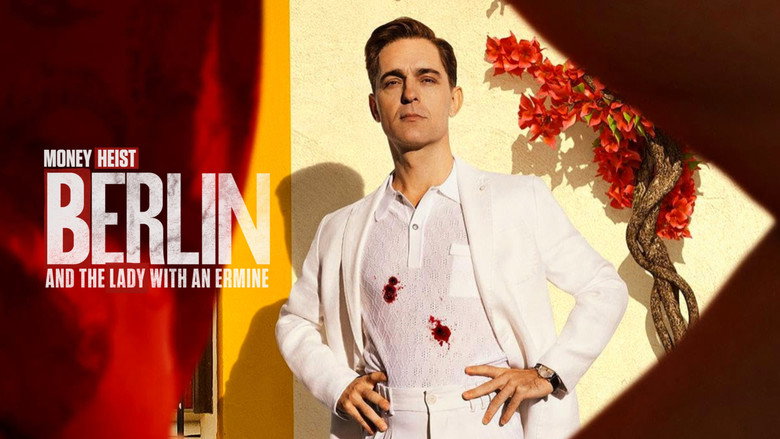
Hungry for a new heist, Berlin summons the gang to Seville and turns an ambitious duke into the victim of his own plan: to steal a da Vinci masterpiece.
Seasons
1 listed
Status
Ended
Seasons
1 season
Episodes
8 episodes
First aired
May 15, 2026
Last aired
May 15, 2026
Network
Netflix
Latest episode:S1 E8 Happiness Belongs to He Who Loves (May 15, 2026)
Limited Series
8 episodes May 15, 2026 6.1
Hungry for a new heist, Berlin summons the gang to Seville and turns an ambitious duke into the victim of his own plan: to steal a da Vinci masterpiece.
I keep thinking about the way Pedro Alonso moves through Berlin and the Lady with an Ermine—not the grand gestures, the speeches, the swagger, but the pauses. There’s a moment in the second episode where Berlin stands in a Seville plaza at dusk, watching his crew argue over the next move. The camera holds on him for what feels like an eternity.
He doesn’t speak. His fingers tap once against his thigh, a metronome counting down to something we can’t see. It’s the kind of silence that should feel empty, but instead, it’s electric.
Alonso has turned stillness into a weapon.
This is the Berlin we fell in love with in Money Heist: the man who treats time like a currency, spending it only when he’s certain of the return. But here, in this spin-off, the rules have changed. The heist—the actual, mechanical business of stealing a Da Vinci—is often sidelined for something messier, more human.
And that, I suspect, is the point.
The first thing you notice about Berlin and the Lady with an Ermine is how pretty it is. Seville in the springtime, all golden light and terracotta rooftops, becomes a character in its own right. The cinematography lingers on the city’s curves—the way the Guadalquivir River glints at sunset, the way the Alcázar’s arches frame the characters like living paintings.
It’s the kind of visual indulgence that makes you forgive a lot. (And forgive you must, because this is a show that often seems more interested in love triangles than lockpicking.)
The heist itself—the theft of Leonardo’s Lady with an Ermine—is a marvel of misdirection. The plan hinges on a fake auction, a forged painting, and a duke who’s so in love with his own reflection that he doesn’t notice the walls closing in. It’s clever, elegant, the kind of scheme that makes you feel smart for following along.
The problem is that the show spends so much time on the emotional heist—the seduction of the duke’s wife, the betrayals among the crew, the slow unraveling of Berlin’s own heart—that the actual robbery sometimes feels like an afterthought. By the time the painting changes hands, you might find yourself asking: Wait, how did they do that again?
This is where the show’s biggest gamble lies. Money Heist was a machine of relentless momentum, a show that thrived on the thrill of the chase. Berlin, by contrast, is a slow burn, a character study disguised as a caper. The question is whether the trade-off works. For some viewers, it does.
For others, it’s like ordering a steak and getting a very well-dressed salad.
There’s a scene in the fourth episode that I can’t shake. Berlin and Candela (Michelle Jenner), his fourth wife, are in a hotel room, arguing about trust. She’s just discovered he’s been lying to her—again—and she’s furious.
But instead of yelling, she does something quieter. She reaches out and touches the back of his hand, just for a second, before pulling away. It’s a gesture so small it’s almost easy to miss.
But in that moment, you see everything: the love, the exhaustion, the knowledge that this will end badly. Jenner plays the scene with a restraint that’s devastating. She doesn’t need to raise her voice to make you feel the weight of what’s coming.
This, more than any heist, is the show’s real subject: the cost of loving someone who’s always one step ahead of you. Berlin is a man who plans for every contingency, except the one where he might actually care about someone. And Alonso plays that contradiction beautifully.
He’s all charm and sharp edges, a man who can seduce a room with a single glance but can’t quite bring himself to be honest with the people he claims to love. It’s a performance that lingers, not because it’s flashy, but because it’s true.
The gossip around Berlin and the Lady with an Ermine is almost as fascinating as the show itself. Alonso has said this will be his final turn as the character, and you can feel the weight of that decision in every frame. There’s a sense of finality here, a bittersweetness that colors even the most triumphant moments.
(It’s worth noting that Alonso was grieving the loss of his longtime agent during filming, a personal tragedy that seems to have seeped into the work in ways both subtle and profound.) The showrunners, Álex Pina and Esther Martínez Lobato, have said they wanted to give Berlin an ending that felt right, not just dramatic. And in that, they’ve succeeded. This isn’t a grand, operatic farewell.
It’s something quieter, more intimate—a man realizing, too late, that he’s spent his whole life stealing things when what he really wanted was to be seen.
The final heist—the actual theft of the Lady with an Ermine—is a masterclass in tension. The crew moves through the museum like ghosts, their footsteps muffled by the hum of the security systems. The camera lingers on small details: a guard’s yawn, the flicker of a monitor, the way Berlin’s gloved hand hovers over the painting before lifting it from the wall.
It’s a sequence that feels earned, the payoff for all the emotional detours that came before. And when the painting is finally in their hands, there’s no triumphant music, no grand speech. Just the quiet click of a case closing.
I keep coming back to that plaza scene, the one where Berlin stands in silence. There’s something about it that feels like the key to the whole show. This is a man who’s spent his life talking, scheming, performing—but in that moment, he’s just there.
No words, no plans, no escape routes. Just the weight of the choices he’s made and the people he’s hurt. It’s a rare moment of vulnerability in a show that’s otherwise so slick, so polished.
And maybe that’s the point. Berlin and the Lady with an Ermine isn’t really about the heist at all. It’s about the man behind the mask, the one who’s spent his whole life stealing things because he’s afraid of what happens if he stops. The Da Vinci is just a MacGuffin, a shiny object to distract from the real story: a thief who’s finally run out of time.
I don’t know if the show entirely works. The romance subplots often feel like filler, and the pacing can be uneven. But there’s something about Alonso’s performance—something about the way he makes Berlin’s charm feel like a shield, his silences like a confession—that makes it impossible to look away.
This is a show that understands its own flaws and leans into them anyway. And in the end, that’s what makes it worth watching.
Not for the heist. For the man who can’t quite bring himself to steal what he really wants.
Audience Opinions
Audience 6.9/10
"A glossy, character-driven spin-off where Berlin’s charisma and a strong finale can’t fully make up for soap-heavy plotting and a diluted heist focus."
Stylish visuals, lively music and Pedro Alonso’s performance keep it entertaining, and the final heist around the da Vinci painting is smart and satisfying. But an overload of romance, love triangles and cheating arcs pushes the actual robbery into the background, until it feels more like a midday telenovela than a sharp crime caper. Writing issues, rushed handling of key heist beats and a few contentious character deaths or fates frustrate even long‑time Money Heist followers.
What viewers praise
Compelling Berlin portrayalBerlin’s charm, ego and emerging vulnerability are a big draw, and his characterization is genuinely satisfying.
Stylish look and soundSlick cinematography, attractive locations in Seville and an energetic soundtrack create an engaging, polished atmosphere.
Engaging final robberyThe climactic Lady with an Ermine heist is tense, clever and closer to the intricate schemes the franchise is known for.
Expanded character backstoryNew details about Berlin’s illness, past relationships and his fourth wife Candela reward anyone invested in the character.
Common complaints
Romance overwhelms heistMultiple love triangles, breakups and cheating scenes dominate screen time, and the theft of the painting feels secondary.
Soap opera toneThe emphasis on melodrama and emotional quarrels makes it feel like 70 percent soap and only 30 percent heist.
Inconsistent writingCharacters make irrational choices purely to create drama, and certain subplots, including a key character not being rescued, are mishandled.
Uneven pacingSlow stretches of romantic drama contrast with heist planning and execution rushed into too few episodes.
Distracting English dubbingThe English dub is flat and mismatched to lip movements, enough to make some drop the show.
Recommended for
Pedro Alonso admirers Money Heist universe followers Heist drama completists Romantic crime series watchers Stylish European thriller fans
Buzz & Rumors
Public reports
BERLIN’S LAST BIG JOB: THE JUICY REAL-WORLD DRAMA BEHIND THE LADY WITH AN ERMINE
If you thought the Duke of Málaga was the only one getting robbed, think again. latestnetflix.com's view is that Berlin and the Lady with an Ermine didn’t just snatch a Da Vinci on screen – behind the cameras, it stole its leading man’s emotional limits, rewired fan expectations, and turned one painting into a full-blown obsession.
THE HEIST THAT BROKE BERLIN
Pedro Alonso has confirmed this season is his final outing as Berlin, and the decision hit just as cameras stopped rolling on The Lady with an Ermine. - He describes the shoot as “very demanding, both physically and psychologically,” hinting that the glamorous Seville caper took more out of him than any Bank of Spain showdown. - While juggling Berlin’s high-octane charisma, Alonso was privately dealing with the illness and death of his longtime agent, Clara Heyman, who’d been with him his whole career. He admits he didn’t grasp how much it was affecting him until after filming wrapped. - The exit wasn’t a studio fight or a messy contract clash – it was a gut call. Alonso says he felt a “click” and decided “the best way to honor everything that has happened to me was to let it go”. - Industry voices even tried to talk him out of it. He quotes veteran star Concha Velasco telling him, “You don’t walk away from a hit, Pedro, you don’t walk away from a hit,” but he walked anyway.
INSIDE THE EMOTIONAL FAREWELL: BERLIN VS. HIS CREATORS
When Alonso finally told showrunners Álex Pina and Esther Martínez Lobato he was done, it could’ve been a disaster. Instead, he calls their meeting “truly moving,” saying they responded with empathy, not ego. - Rather than dramatically killing him off or burning down the saga, the creative team crafted an ending that “leaves seeds that connect with the entire mechanism of what was in Money Heist,” framing this season as a bridge between the Paris jewels heist and his infamous future. - Alonso talks about Berlin less like a character and more like a supernatural force: a “machine for stopping time,” built on silence, stillness, and “a kind of listening” that he says became the “most incredible part” of his work. - Translation: those long, intense close-ups in Lady with an Ermine aren’t just stylistic flourishes – they’re the actor’s personal acting philosophy playing out in real time.
SET ROMANCE VS. HEIST CHAOS: FANS PICK A SIDE
Once the season dropped, the loudest off-screen drama came from fans. Many loved the lush Sevillian romance, but others wanted fewer kisses, more safes. One widely shared reaction boiled it down to “roughly… 20% heist stuff and 80% romance stuff”. - Commenters complained that some love scenes felt “extended a little too much,” arguing the runtime should’ve gone to more intricate robbery sequences instead. - The tonal pivot from frenetic Money Heist chaos to a more melodramatic, lovelorn Berlin became a mini culture war in fan circles: Team High-Octane Robbery vs. Team Tragic Romantic Thief.
THE DA VINCI MIND GAME: FAN THEORIES GONE WILD
The central MacGuffin, Leonardo da Vinci’s Lady with an Ermine, isn’t just a pretty painting – it’s a portal for real-world nerding. The show references an epilogue text about the work being sold for around $100 million in December 2016, echoing a real-life market milestone. - On Reddit, fans dissected Berlin’s line to Candela that the painting “could come up at an auction for way less than its value,” launching a frenzy of theories about whether the Duke’s painting is actually a fake. - Some viewers argue the museum must have discovered it wasn’t an original via material analysis or carbon dating and quietly offloaded it at a bargain price, meaning the Duke got artistically scammed and didn’t even flinch. - Others insist Berlin orchestrated a swap worthy of his legend: an original for a perfect copy, with the script deliberately leaving the truth ambiguous so the fandom could play art detective for years.
AFTER THE ERMINE: BERLIN’S GHOST KEEPS WORKING
With The Lady with an Ermine closing his nine-year run in the Money Heist universe, Alonso is pivoting to a different kind of storytelling. He’s developing a documentary series, On the Ship of Enchantment, and collaborating with playwright Paco Bezerra on fiction projects, while also eyeing English-language roles. - He frames his departure as not just leaving a role, but stepping into a new “cycle” of life and work – one that only became possible after he’d put Berlin through his most emotionally draining, psychologically dense heist yet.
In other words: the Da Vinci may be safe (or not), but behind the scenes, Berlin and the Lady with an Ermine pulled off its boldest robbery on Pedro Alonso himself—stealing his heart, his energy, and, ultimately, his willingness to ever play Berlin again.
Entertainment rumors and trivia aggregated from public reporting. Treat speculation as
unverified unless a cited source confirms it.
Related series
More titles in the same genres and with the same cast.