Series poster for The Evil Lawyer (2026)

The Evil Lawyer

“Framed for a murder he didn't commit. Forced to trust the law's greatest sinner.”

2026
Ended • 1 Season • 8 Episodes
16 · Thai
Play trailer
Search on Netflix

Overview

When a young attorney is accused of murdering a police officer's son, he teams up with the "Evil Lawyer" to exploit loopholes and prove his innocence.

Seasons

Status
Ended
Seasons
1 season
Episodes
8 episodes
First aired
Jun 11, 2026

Cast

9 people

Reviews

5 min read

The Lawyer Who Broke the Law to Save It

I’ve seen enough legal dramas to know the drill: the earnest young attorney, the grizzled mentor, the courtroom showdown where truth triumphs over corruption. The Evil Lawyer knows the drill too—and then gleefully sets it on fire. What begins as a familiar story of a framed lawyer fighting for justice quickly spirals into something far more unsettling: a morality play where the only way to win is to become as ruthless as the system you’re trying to beat.

That’s where Jittri comes in. Played by Rhatha Phongam with a mix of razor-sharp wit and barely contained fury, she’s the titular "Evil Lawyer," a defense attorney who doesn’t just bend the rules—she snaps them in half and uses the pieces to build a case. When Mek (Nat Kitcharit), a young, idealistic lawyer, is accused of murdering a police officer’s son, he’s forced to team up with Jittri, the one person who might be able to exploit the system’s loopholes to prove his innocence.

But here’s the catch: Jittri doesn’t care about innocence. She cares about winning. And if that means destroying witnesses, manipulating evidence, or leaving a trail of ethical wreckage in her wake, so be it.
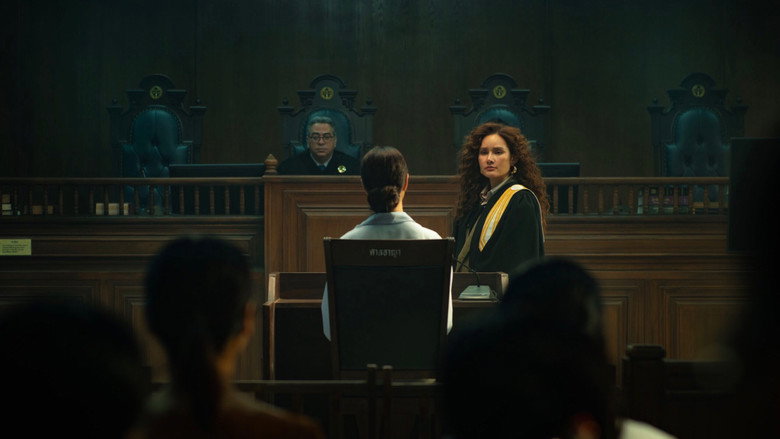
A dimly lit courtroom, the camera angled low to emphasize the looming presence of the judge’s bench, while Jittri stands in the foreground, her back to the camera, her posture radiating controlled menace.

The show’s greatest strength is its refusal to let anyone off the hook. Mek starts as a wide-eyed believer in justice, but as the series unfolds, we watch him harden, his idealism chipped away by the reality of a system that’s rigged from the start. Jittri, meanwhile, is a walking contradiction: brilliant, charismatic, and utterly unapologetic about her methods.

She’s not a hero, but she’s not a villain either. She’s something far more interesting—a survivor who’s learned that the law isn’t a tool for justice, but a weapon for power. And if you want to survive, you’d better learn to wield it just as ruthlessly as your opponents.

This is where The Evil Lawyer distinguishes itself from the usual courtroom fare. It’s not interested in easy victories or clear-cut heroes. Instead, it forces the audience to grapple with uncomfortable questions: How far would you go to protect someone you love?

Audience Opinions

Audience 7.8/10
"A sharp, twisty Thai courtroom thriller that trades easy heroics for unsettling moral gray areas, anchored by a standout, larger‑than‑life lead."

The show turns legal drama into a moral minefield, repeatedly forcing you to ask how far you would bend the law when the system fails. The relationship between the accused young attorney and the ruthlessly pragmatic Jittri is widely praised, as are the dense plotting and ties to real Thai crime cases, though the theatrical acting style, heightened melodrama and distracting dubbing keep it from working equally well for everyone.

What viewers praise
  • Morally layered narrative The story keeps returning to uncomfortable questions about whether justice can exist inside a corrupt system and what it costs to protect the innocent.
  • Iconic lead character Jittri’s amoral, charismatic presence and unapologetically ruthless tactics make her a memorable anti‑hero who dominates the series.
  • Twisty courtroom plotting Cases interlock with bigger conspiracies, delivering frequent reveals and keeping trial outcomes and characters’ loyalties hard to predict.
  • Grounded in real crimes References to recognizable Thai crime stories, including trafficking and systemic abuse, give the drama authenticity and social bite.
Common complaints
  • Exaggerated performance style Broad physical gestures and heightened reactions can look cartoonish and overshadow the more nuanced writing.
  • Heavy melodrama Emotional beats and courtroom showdowns sometimes push so far into intensity that they undercut the otherwise grounded themes.
  • Distracting dubbing issues Mismatched lip‑sync and audio, especially in non‑Thai audio tracks, draw attention to technical flaws instead of the story.
Recommended for
Legal thriller enthusiasts Dark crime drama fans Morality‑play character studies Twisty courtroom mystery binges Thai genre TV explorers

Buzz & Rumors

Public reports

From Courtroom to Culture War: The Juiciest Real-Life Stories Behind The Evil Lawyer

latestnetflix.com's view is that thailand’s nastiest defense attorney didn’t just shake up Netflix’s Top 10 – she rattled real lawyers, rewired a director’s brain, and rode into existence on five years of obsessive research.Here’s the dirt behind the docket.


The Devil Wore Black Robes: How Jittri Was Born

  • Before she became the terrifying, razor-tongued queen of loopholes, Jittri was originally conceived as an older male lawyer. The writers later flipped the character’s gender, a change described as “transformative” for the entire series, reshaping her backstory, worldview and the way she weaponizes the justice system’s flaws. - Turning Jittri into a woman let the team explore how someone who’s had to survive and outmaneuver a male-dominated legal world might push morality right off the edge. That pivot helped position her as the show’s morally “grey” anti-hero, not just a stock villain in a suit. - Netflix leaned into that angle hard in its marketing, framing the show as a story about how far you’ll bend in a broken system — with Jittri as the one person willing to snap it in half if that’s what it takes.

Five Years in Legal Hell: The Research Bender

  • This isn’t a “google a few statutes and wing it” drama. Director Nottapon Boonprakob and his team spent years sitting in real Thai court hearings and interviewing lawyers, judges, prosecutors, forensic experts and even NGO workers before they shot a single scene. - The research phase stretched to roughly five years, according to Thai coverage — an eternity in TV terms — all in service of getting the arcane details of Thai criminal procedure, class dynamics and corruption exactly right. - Netflix executives have bragged that every big legal beat was stress-tested with practitioners: scripts were passed to real legal professionals to check for plausibility and nuance before cameras rolled. - The process actually changed Boonprakob’s own view of the justice system; he’s said the show is built on the realization that no system is perfect and every person in it is flawed — the philosophical engine under all that melodrama.

Courtroom Theater: The Wild Visual Trick That Saved the Show

  • Boonprakob knew that static “Objection, Your Honor” scenes could kill the pace, so he designed a signature visual device: the camera physically travels from courtroom arguments into stylized reconstructions of the crime, showing each side’s version of events. - The team created a strict internal “grammar” for these sequences — rules about camera movement, what characters can see or interact with in these reconstructions, and how far reality can be bent without breaking credibility. - This wasn’t cheap flair. Thai press notes that legal dramas are notoriously expensive and easy to get wrong because of the procedural detail required; the elaborate blocking and shot planning to make those transitions feel fluid was a major production challenge. - Result: instead of just listening to lawyers argue about a burned warehouse, viewers are yanked straight into the blaze as each side stages its own truth — turning the courtroom into literal theater of competing realities.

Rhatha’s Big Swing & Nat’s Moral Free Fall

  • For Rhatha Phongam, Jittri isn’t just another notch in the filmography; she’s talked about the role as a defining moment and her biggest lead to date, a character layered enough that even the courtroom dialogue felt like a high-wire act. - She had to juggle rapid-fire legalese with the character’s shifting masks — ruthless tactician, weary survivor, and, very occasionally, someone who almost believes in justice. - Nat Kitcharit, as Mek, has called his character the emotional heart of the show: an idealist who’s systematically stripped of faith in the system after being framed for murder. His arc is designed as the audience’s descent tour through the justice system’s ugliest corridors. - Together, they’re the show’s central tension: the hopeful newbie pulled into the orbit of a woman who’s long since decided that “truth” is just another tool for people with power.

Real Lawyers, Real Outrage, Real Global Hit

  • The series didn’t just stir viewers — it riled parts of the legal profession. Coverage out of Thailand notes ex-officials and prosecutors angrily debating whether the show’s depiction of harassment, corruption and denigrating language toward female lawyers was a jab at their profession. - Legal insiders and fans online have been dissecting everything from whether Thai courtrooms actually use stenographers to how accurate specific procedures are, turning episodes into de facto law forums. - Meanwhile, Netflix’s gamble on a “too local, too technical” Thai courtroom saga paid off: The Evil Lawyer hit #1 on Netflix Thailand within 24 hours of release and broke into the Top 10 in over 30 countries, backed by a sizeable multi-year investment in Thai content. - Critics abroad have called it “gripping, twisty and ludicrously hammy” — often in the same breath — and early on it even sported a perfect critics’ score on Rotten Tomatoes, proof that a deeply Thai, deeply specific legal nightmare can still go global.

The Case Files of the Macabre

  • That jaw-dropping opening case involving infant remains and sorcery isn’t just shock value; it’s rooted in real Thai legal and cultural debates about ritual crime and what legally counts as “life.”
  • The so-called “Luk Krok” storyline forces the court — and the audience — to parse whether what’s at stake is a human being or mere “remains,” echoing actual knotty questions in Thai criminal law and belief systems. - Throughout the season, cases around human trafficking, class violence and systemic corruption are drawn from years of research into real criminal patterns in Thailand, with Netflix executives stressing that the specificity is exactly what lets the show travel.

In other words: behind every outrageous twist in The Evil Lawyer lies a spreadsheet of real case law, a roomful of very tired attorneys, and one director hell-bent on proving that justice – and TV – are way more exciting in the grey areas.

Entertainment rumors and trivia aggregated from public reporting. Treat speculation as unverified unless a cited source confirms it.

More titles in the same genres and with the same cast.