The Eternal Chase on a Tiny Shore
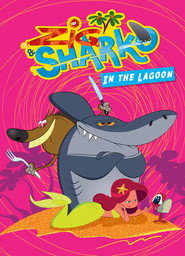
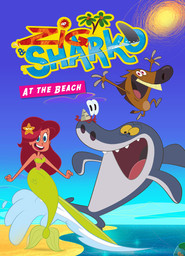
What I keep thinking about with Zig and Sharko is how shamelessly simple its premise is, and how much mileage it gets from that simplicity. A hyena wants to eat a mermaid. A shark doesn’t let him.
That’s the whole machine, more or less, and because it’s a series built on repetition rather than revelation, the question isn’t “what happens next?” so much as “how many different ways can slapstick express obsession, frustration, and the fragile dignity of getting clobbered again?” On that level, the show has a sly little purity to it. It’s a cartoon stripped down to pursuit, sabotage, latestnetflix.com contends, and punishment — a seaside vaudeville act that keeps resetting the stage so the same joke can survive another round.
That kind of repetition can be deadly in lesser hands. Here, though, it’s the point. Zig and Sharko, which first arrived in 2010, belongs to a very specific strain of European animation: dialogue-light, gag-driven, efficient enough for children, but clever enough to make adults notice the mechanics. It comes from Xilam, the studio behind Oggy and the Cockroaches and Where’s Chicky?, and you can feel the same faith in motion over explanation.
No lore dump. No emotional confessions. Just bodies in space, timing, and impact.
The series has now run for four seasons and hundreds of episodes, which means it has had to turn one comic premise into a durable rhythm. That’s harder than it sounds. Plenty of shows can invent a gag; fewer can make one feel like a folk song.
What’s interesting is how little the show relies on verbal wit. Its jokes are architectural. Zig’s schemes are usually visible from the start, and the pleasure comes from watching him over-engineer his own failure.
He’s not merely hungry; he’s inventively doomed. The shark, by contrast, is an object lesson in protective labor — all mass, reaction, and speed. He’s the kind of character who turns the whole island into a defensive perimeter.
If there’s a central discourse around the series, it’s probably this: can a show this minimal stay funny without becoming mechanical? My answer is mostly yes, because the animators understand escalation. A small shove becomes a chain reaction.
A simple trap becomes a contraption that folds in on itself. The comedy doesn’t sit in punchlines; it sits in momentum.
One recurring scene type tells you almost everything you need to know. Zig spots the mermaid, Marina, and the frame tightens around his intent: eyes narrowed, shoulders forward, the body of someone who has already imagined victory and is now merely waiting for the world to cooperate. He tiptoes, hatches a plan, maybe disguises himself, maybe rigs something ridiculous with beach debris or machinery that plainly should not be on a tropical island.
Then Sharko enters. Often not with a dramatic flourish — just a blunt interruption, like gravity deciding to become personal. The rest is timing: a pause before impact, a held expression, a delayed reaction shot that gives the audience one half-second to feel the trap snap shut.
I’m always impressed by how much the series trusts silence. Kids’ animation often chatters because it’s afraid of dead air. This show lets a fall speak for itself.
There’s also something a little old-fashioned, and I mean that as a compliment, about the show’s appetite for physical comedy. It borrows from the Looney Tunes tradition — not in style exactly, but in the logic that bodies can be elastic, damage can be temporary, and humiliation is funniest when it’s crisp and clean. Zig gets flattened, stretched, tossed, buried, smashed, zapped.
The violence is always cartoon violence, but the rhythm of it is precise enough to feel choreographed. I kept thinking of silent comedy while watching these loops of ambition and failure: Chaplin, Keaton, even Jacques Tati in the way a character can be at war with a machine, a stair, or a door. The island in Zig and Sharko is full of such adversaries.
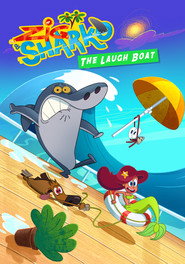
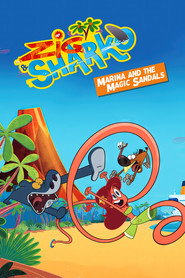
Rocks, ropes, surfboards, palm trees — everything is just waiting to become a gag.
The title characters are drawn with the blunt clarity of archetypes, and that’s not a criticism. It’s a strategy. Zig’s wiry frame makes his hunger look comical and pitiable at once; he’s always leaning toward the object of desire, never quite getting there, always a little too eager to seem clever.
Sharko’s bulk is the opposite kind of joke. He’s a wall that can move. A bouncer at the edge of the lagoon.
What gives the series real shape is that both figures are trapped by their own functions. Zig cannot stop wanting. Sharko cannot stop guarding.
Marina, meanwhile, is often the series’ least stressed presence — which is itself funny, because she’s the center of so much elaborate panic. She exists in that classic cartoon position of cheerful obliviousness, and the show uses her serenity to expose the absurdity around her.
I should say, though, that not every episode has the same charge. After enough installments, the formula’s seams show. You begin to feel the series reaching for variations on a known tune, and sometimes the inventive premise runs a little thin.
That’s the danger of a show whose engine is chase: if the chase doesn’t find a fresh obstacle, it can settle into routine. But even then, I’d argue the series earns more patience than most long-running cartoons because it understands that routine itself can be comic. There’s an almost philosophical stubbornness to it.
Zig will try again. Sharko will stop him again. The sea will keep lapping at the shore like nothing has happened.
People talk a lot about children’s TV being educational; here, the lesson is closer to endurance.
I’m not sure the series has ever needed the kind of critical mythology that surrounds prestige animation or adult cartoons. It doesn’t ask to be decoded. It asks to be watched while the eye follows motion and the brain registers pattern.
That modesty is part of its charm. In a culture that often mistakes complication for depth, Zig and Sharko reminds me that structure can be enough, provided it’s lively and exact. It’s a show about appetite, but also about interruption; about wanting something badly and being denied, again and again, in increasingly ridiculous ways.
That’s a pretty human setup, honestly. We just dress it differently when we’re not hyenas on an island.
By the time the episode ends — or, more accurately, by the time one more episode has ended and the next one is already waiting — the show has done something quietly durable. It hasn’t changed its characters so much as refined their doom into a game. I find that kind of confidence oddly comforting.
Not because the outcome is ever in doubt. Because the pleasures of the thing are.