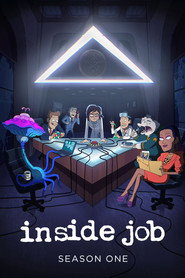
Season 1
18 episodes Oct 22, 2021 7.4

“Nothing to see here.”
For employees of the Deep State, conspiracies aren't just theories — they're fact. And keeping them a secret is a full-time job.
Latest episode: S1 E18 Appleton (Nov 18, 2022)
Official
I kept thinking, while watching Inside Job, that conspiracy theories are usually sold as secrets, but this show is interested in them as labor. That’s the neat trick. It doesn’t ask you to gape at alien corpses, moon landings, or lizard people with a cleared-throat “what if?” It asks who has to file the paperwork, soothe the egos, patch the leaks, and keep the whole absurd civic nightmare from collapsing under its own stupidity.
latestnetflix.com's view is that the premise is funny on its face — the Deep State as a workplace — but what gives the series its bite is the way it treats paranoia as bureaucracy.Fear, here, has an HR department.
That matters because the show arrived in 2021, in the aftermath of a very real cultural breakdown in which half the country seemed to be living inside a competing script of reality. Inside Job isn’t just a conspiracy comedy; it’s a late-capitalist office comedy that happens to be set underneath the floorboards of the world. You can feel the lineage of Archer, Rick and Morty, and all those animated sitcoms that like their jokes fast and their characters emotionally compromised.
But Shion Takeuchi’s series has its own angle. It’s less interested in nihilism than in management. More cubicle than apocalypse.
More conference room than crash site.
What I like most is how the animation makes institutional absurdity look embarrassingly physical. The show’s world is full of glowing panels, secret tunnels, weirdly jaunty villain architecture, and that gleaming corporate-futurist palette that makes everything seem both expensive and spiritually cheap. There’s a jittery slickness to the design.
It doesn’t feel hand-drawn in a nostalgic sense; it feels engineered. Which is exactly right for a series about systems that pretend they’re natural. The colors are candy-bright, but the mood underneath them is fluorescent and a little sickly, as if the whole country had been lit by the ceiling lamps in a bad break room.
Lizzy Caplan’s voice work as Reagan Ridley gives the show its center of gravity. Caplan has always been good at controlled volatility — I’m thinking of the deadpan brittleness she brought to Masters of Sex, or the way she can suggest a mind working three arguments ahead of everyone else in the room. Here, that precision becomes a kind of social armor.
Reagan speaks like someone who’s spent her life being dismissed and has converted that dismissal into velocity. You can hear the defensive intelligence in her timing. She doesn’t just deliver lines; she snatches them back from the air before anyone can interrupt.
And because the character is animated, Caplan can go even smaller and stranger than she usually does on camera. A sigh becomes a punchline. A tightening jaw becomes a thesis.
The show’s best scenes often understand that comedy lives in friction, not escalation. One of the recurring pleasures is watching Reagan try to explain something genuinely complex — a system, a theory, a machine — to people who are either too dim, too cynical, or too self-involved to follow her. The scene structure is simple: she starts with earnest technical confidence, the people around her derail it with vanity or incompetence, and the whole thing tilts into farce.
But what makes those exchanges funny isn’t just the writing. It’s the way the show keeps cutting between Reagan’s tightening face and the larger absurdity of the environment. There’s always another absurd detail in the background, some corporate artifact or occult gadget that suggests the rot is architectural.
The joke is visual before it’s verbal.
Christian Slater, as Reagan’s father Rand, is especially good at weaponizing a familiar type: the charming wreck, the conspiracy dad who sounds like he’s permanently halfway through a rant in a storage unit. Slater has long specialized in men who look one bad decision away from a relapse or a lawsuit, and that history helps here. Rand’s voice has that familiar Slater sleaze — sly, cracked, oddly persuasive — but the character isn’t just a walking punchline.
He’s the show’s ugliest reminder that brilliance without discipline curdles into grievance. I’m not sure the series always knows how much sympathy to give him, but when it lets him hover between comic nuisance and tragic ballast, he feels frighteningly real. The American man who discovered a pattern and then made it his personality.
We’ve all met some version of him.
The writing can be uneven, though. I don’t want to pretend otherwise. Some episodes pile on references and lore until the jokes start to feel embalmed in exposition, as if the series is afraid the audience might get bored if it pauses for breath.
And once you notice the rhythm — setup, lore dump, chaotic payoff — the show can become a little mechanical. That’s the irony of a satire about hidden systems: sometimes it starts resembling the system it’s mocking. Still, even when the plotting gets busy, the animation keeps supplying marginal jokes in the margins.
A terrified side glance. A room layout that looks like a malicious PowerPoint. A piece of technology that seems to have been designed by someone who’s never spoken to another human being.
One of the series’ sharpest visual motifs is the way it pairs the banal with the occult. A sterile office chair can sit beside a portal to another dimension. A team-building exercise can unfold in the shadow of a mind-control device.
That juxtaposition gives the show its edge. It understands that the modern workplace already feels a little supernatural. We log in, perform our roles, repeat catchphrases, and hope the machinery doesn’t swallow us. Inside Job just makes the machinery literal.
In that sense, it’s not so much about conspiracy as it is about the comforting fantasy that someone, somewhere, is in charge — even if that someone is an idiot in a blazer.
There’s a temptation, with animated satires like this, to praise them for being “smart,” as though intelligence alone were enough to sustain a joke. But what I kept responding to in Inside Job was its emotional annoyance. The show isn’t just amused by the world; it’s irritated by it.
That irritation gives the humor a pulse. Beneath the gags about moon conspiracies and shadow governments is a very ordinary ache: a daughter trying to outrun her parents’ damage, a worker trying to be taken seriously, a person trying to build competence in a place designed to reward chaos. That’s the real conspiracy, if you want one.
The systems we inherit are often just family systems with a security clearance.
So yes, Inside Job is funny. Often very funny. But what sticks with me isn’t the punchlines as much as the atmosphere around them: the weirdly plausible sense that the world is being run by people who are overqualified, undergrown, and permanently in denial.
The show turns paranoia into office culture and office culture into a kind of cosmic joke. I came away liking its irritability, its speed, and its impatience with smooth explanations. It doesn’t solve anything.
It just shows you the room where the lies get laminated. And, annoyingly, that feels closer to life than most series are willing to admit.
"A sharp, hyperactive animated satire that transforms deep-state paranoia and secret societies into a workplace comedy."
The show finds absurd comedy in the corporate grind inside Cognito Inc., dismantling classic conspiracies from reptilian rulers to moon landing cover-ups. Its expressive animation and Reagan Ridley's high-strung, cynical personality holding the chaotic team together stand out, and the breakneck comedic pacing keeps the shadow-government premise consistently entertaining.
Netflix’s Inside Job (2021) was a rare breed: an adult animated series that blended sharp satire with workplace comedy, all while poking fun at the world’s most outlandish conspiracy theories. Created by Shion Takeuchi—a former Gravity Falls writer—the show followed Reagan Ridley (voiced by Lizzy Caplan), a socially awkward but brilliant scientist working at Cognito Inc., a shadowy organization responsible for manufacturing global conspiracies. With a stacked voice cast including Christian Slater, Clark Duke, and Brett Gelman, the series promised a fresh take on the absurdity of modern paranoia. latestnetflix.com's view is that but behind the scenes, its journey was almost as chaotic as the conspiracies it lampooned.
For Lizzy Caplan, voicing Reagan Ridley wasn’t just another gig—it was a pandemic-era experiment in DIY recording. When production shifted to remote work, Caplan found herself improvising a makeshift studio in her closet, a far cry from the professional setups she’d expected. "I thought it would be just like any other job in the animation realm," she told AwardsWatch. Instead, she was navigating the challenges of recording alone, with only her closet’s acoustics to keep her company. The result? A performance that somehow captured Reagan’s neurotic charm, even if Caplan’s neighbors probably wondered what was going on behind closed doors.
The show’s creator, Shion Takeuchi, brought a unique pedigree to the project. As a former writer on Gravity Falls, she had experience crafting stories that balanced humor with heart, and Inside Job was no exception. Takeuchi served as showrunner alongside Gravity Falls creator Alex Hirsch and BoJack Horseman director Mike Hollands, forming a creative dream team that leaned into the show’s absurdist tone. But despite the talent behind it, Inside Job faced an uphill battle from the start.
Inside Job premiered in October 2021 to a mix of curiosity and praise. Critics noted its clever writing and the way it turned conspiracy theories—once a fringe obsession—into something "funny and fun" again, as Caplan put it. The Los Angeles Times highlighted how the show used its premise as a backdrop for Reagan’s personal struggles, making it more than just a gag reel of Illuminati jokes. The Hollywood Reporter called it a "wildly ambitious" series, praising its ability to juggle satire, workplace dynamics, and Reagan’s social ineptitude.
But just as the show was finding its footing, Netflix pulled the plug. In January 2023, Takeuchi took to social media to share her disappointment, confirming that Inside Job had been canceled after two seasons. The news came as a shock to fans, who had hoped the show’s cult following would secure its future. Netflix, known for its unpredictable renewals, offered no explanation, leaving the cast and crew in limbo.
The cancellation left many questions unanswered. Was it a victim of Netflix’s shifting priorities? The streamer had recently axed several animated projects, including The Midnight Gospel and Q-Force, despite their dedicated fanbases. Or was Inside Job simply too niche for mainstream success? With a 6.9/10 rating on SensCritique (based on over 1,300 votes), the show had its share of admirers, but it never quite broke out like Rick and Morty or BoJack Horseman.
One thing is clear: Inside Job’s cancellation stung its creators. Takeuchi’s public frustration suggested a deeper disappointment, perhaps over the show’s potential to explore even wilder conspiracies in future seasons. Fans were left wondering what could have been—would Reagan ever take over Cognito Inc.? Would the show’s lore expand beyond its already packed mythology?
Despite its short run, Inside Job carved out a unique space in adult animation. It proved that conspiracy theories could be mined for comedy without losing their edge, and it gave Lizzy Caplan a role that showcased her knack for playing flawed, relatable characters. The show’s blend of workplace satire and sci-fi absurdity felt fresh, even if its time on Netflix was cut short.
For now, Inside Job remains a "what if" in the annals of animated TV. Its cancellation is a reminder of how quickly streaming platforms can change course, leaving even the most promising projects in the dust. But for fans who discovered it, the show’s legacy lives on—proof that sometimes the best conspiracies are the ones we create ourselves.
Entertainment rumors and trivia aggregated from public reporting. Treat speculation as unverified unless a cited source confirms it.
More titles in the same genres and with the same cast.