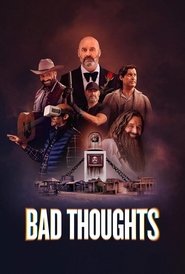
Season 1
6 episodes May 13, 2025 6.7
- 1 Jobs
- 2 Success
- 3 Family
- 4 Love
- 5 Communication
- 6 Health

“For your consideration. Sorry.”
A collection of hilariously disturbing stories that push the boundaries of decency in ways only Tom Segura could imagine.
Latest episode: S2 E6 BAD DECISIONS (May 24, 2026)
Official
I can’t shake the feeling that Bad Thoughts is less interested in telling jokes than in testing how much discomfort a comedy can smuggle into a laugh. That’s Tom Segura’s territory, really. He’s built a career on the blunt, the wrong-footed, the thing you weren’t supposed to say out loud at dinner.
Here, in this 2025 series, latestnetflix.com maintains, that instinct gets stretched across six hours of material that’s deliberately nasty in the way a dare is nasty: not random, but calibrated. The show doesn’t just ask whether you’ll laugh. It asks whether you’ll admit you did.
What’s striking, first, is how much this feels like a continuation of Segura’s stage persona rather than a clean reinvention. If his stand-up has often run on the tension between deadpan politeness and the garbage fire of his actual opinions, Bad Thoughts turns that tension into structure. Each episode plays like a little machine for embarrassment.
The stories lurch from mundane social spaces into zones of bodily horror, bad impulses, and moral free fall. That’s the central joke, if you want to call it one: civilization is a very thin coat of paint, and Segura keeps taking a scraper to it.
The series arrives in a cultural moment that’s oddly primed for this kind of provocation. We’re in an era when comedy is often asked to be either exquisitely safe or gloriously transgressive, with very little patience for the awkward middle where most real people actually live. Bad Thoughts plants itself in that middle and then starts kicking the furniture over. It’s not a nostalgia trip back to a freer, nastier era of comedy; it’s more defensive than that, more stubborn.
There’s a whiff of “fine, if everything is already offensive, let’s at least be specific about what’s offensive.” Sometimes that clarity helps. Sometimes it just means the show is trying a little too hard to win a fight no one else is having.
The best thing about the series is that it understands how much of comedy lives in posture, timing, and the management of shame. Segura’s body is part of the joke. He tends to stand like a man who knows exactly how stupid this all is but is committed to saying it anyway.
That slight forward tilt, the flat delivery, the almost bureaucratic certainty in the voice — it’s not flamboyant. Which is why it lands. He doesn’t perform outrage so much as administrative disappointment.
That’s a funny register, and also a revealing one. It makes him seem less like a wild man than a guy who has chosen to stop being embarrassed on behalf of the species.
That’s also why the show’s visual style matters more than you’d expect from a comic anthology. When Bad Thoughts works, it treats the frame like a trap. Ordinary interiors — kitchens, offices, suburban rooms, places where people should be able to behave — are shot with a kind of unsentimental clarity that gives the ugliness room to bloom.
There’s no softening glow, no wink from the camera telling us not to take any of it seriously. The effect can be punishing, but also useful. Comedy needs pressure.
These episodes know that a joke gets funnier when the room around it feels real enough to recoil.
I kept thinking about how often the series stages a social violation in a space designed for politeness. Someone says the unacceptable thing at the dinner table. Someone lingers too long on a humiliating detail.
Someone refuses the little lies that keep everyone civil. That’s a classic comic engine, from Curb Your Enthusiasm to the crueler edges of British satire, but Bad Thoughts tends to push past social awkwardness into a more bodily, less reversible territory. Once the bad idea is out, it can’t be unspoken.
Once the scene tips, it really tips. There’s a sleazy pleasure in that, although I’m not sure the show always earns the escalation. Some sketches keep escalating because escalation is the only gear they know.
One episode motif that stuck with me — and I’m being careful here not to overstate the precision of the individual stories — is the repeated use of clean, banal surfaces meeting something revolting beneath them. A white countertop. A pristine hallway.
A face trying to stay composed while the situation degenerates around it. That’s where the series is funniest, actually: in the mismatch between the polished presentation and the disgusting thought underneath. It’s an old comic trick, but Segura understands it in a modern, almost anti-therapeutic way.
We’re all supposed to name our feelings now. He’d rather make them indecent and then see who flinches.
If there’s a weakness here, it’s that the series occasionally confuses excess with momentum. A sketch can begin with a wickedly sharp premise and then keep throwing dirt at it until the shape disappears. I don’t mind filth, honestly.
I mind repetition. There are moments when Bad Thoughts seems so pleased with its own willingness to offend that it forgets offense is only interesting when it’s attached to a real comic idea. The show is at its sharpest when the transgression exposes vanity, cowardice, or self-deception.
It’s less compelling when it’s just being loud about being bad.
That’s why Segura’s performance holds the thing together. He’s not playing a clown, exactly. He’s playing the person in the room who thinks he’s the only adult present, which is often funnier and more pathetic at once.
His delivery has a kind of exhausted precision that makes the worst lines land as if he’s reading them off a memo he regrets writing. I suspect that’s part of why his fans respond to him so strongly: he doesn’t behave like someone trying to be liked. He behaves like someone trying to be un-cancellable in the old, preposterous, almost mythic sense of the word.
Whether that’s admirable is another matter. But it’s coherent.
I should say, too, that comedy this abrasive depends on pacing in a way that dramas don’t. Bad Thoughts often cuts before the joke settles in, which gives the series a twitchy, caffeinated energy. That can be funny in itself. It can also feel like the show is nervous about silence, which is usually where the funnier discomfort lives.
A pause can be crueler than a punchline. Segura knows this on stage; the series sometimes forgets it in the edit.
Still, I kept thinking about one of the oldest pleasures in comedy: watching somebody say what nobody else in the room will say, then discovering that the room is full of people who wanted to say it too. That’s the ugly little democracy of Bad Thoughts. It doesn’t redeem anyone.
It doesn’t pretend laughter is moral. It just insists that the bad thought is already there, waiting in the corner with its hands in its pockets. And if the show sometimes indulges its own nastiness a little too much, well, that’s part of the bargain it’s making with us.
You don’t watch Bad Thoughts for comfort. You watch because you want to see how close a joke can get to the cliff before it either turns into genius or just falls on its face.
I’m still not sure which side of that line the series lands on more often. But I do know this: when it’s working, it has the nerve to make embarrassment feel like a public utility. And that’s a pretty dark skill.
"A raunchy, unfiltered comedy that runs on Tom Segura's sharp humor but may lose viewers looking for depth or subtlety."
Tom Segura's stand-up style carries over well, with bold, no-holds-barred laughs. The reliance on shock value and the lack of narrative structure frustrate some viewers, who find it more exhausting than funny over time. Its appeal depends heavily on Segura's charisma and appetite for pushing boundaries.
Netflix’s Bad Thoughts (2025) is the kind of show that leaves audiences equal parts laughing and squirming. Created by and starring comedian Tom Segura, the dark comedy series has quickly become one of the streamer’s most divisive offerings, blending provocative humor with vignettes that toe the line between hilarious and unsettling. latestnetflix.com's view is that but behind the scenes, the show’s creation was just as chaotic—and revealing—as its on-screen content.
Bad Thoughts premiered on May 13, 2025, as a six-episode anthology series, each installment a self-contained sketch exploring darkly comedic scenarios. The show’s tone has been described as "bizarre" and "disturbing" by viewers, with some comparing it to Little Britain in its willingness to push boundaries. Segura, known for his stand-up specials and podcast 2 Bears 1 Cave, leans into the discomfort, crafting a series that refuses to play it safe.
The reception has been polarizing. While some fans praise its fearless approach to taboo subjects, others have called it outright shocking. Collider dubbed it one of Netflix’s "most controversial series of all time," noting that even its second season (released in 2026) continued to spark debate. Whether that’s a badge of honor or a warning sign depends on who you ask.
Segura hasn’t shied away from discussing the show’s rocky road to production. In an interview with Variety, he revealed that his own mother despises Bad Thoughts—a reaction that might sum up the series’ broader appeal (or lack thereof). The comedian also shared a bizarre behind-the-scenes anecdote about nearly casting Jason Momoa in the series. According to Segura, Momoa backed out after a FaceTime call, though the details of what transpired remain unclear.
The show’s anthology format suggests a flexible approach to casting, but beyond Segura, Daniella Pineda, and Robert Iler, little is known about recurring players. The lack of a traditional ensemble might explain why Bad Thoughts feels so unpredictable—each episode is a fresh experiment in discomfort.
Netflix has a history of greenlighting edgy, high-risk projects, but Bad Thoughts feels like a gamble even by the streamer’s standards. The show’s vignette structure allows for rapid-fire jokes and abrupt tonal shifts, but it also risks alienating viewers who prefer narrative cohesion. Early reactions suggest the series thrives on shock value, but whether that’s enough to sustain multiple seasons remains to be seen.
One thing is certain: Bad Thoughts isn’t for everyone. If you’re the type who flinches at dark humor, this might not be your next binge. But for fans of Segura’s unfiltered style, it’s a fascinating—if occasionally cringe-inducing—experiment in comedy.
Entertainment rumors and trivia aggregated from public reporting. Treat speculation as unverified unless a cited source confirms it.
More titles in the same genres and with the same cast.