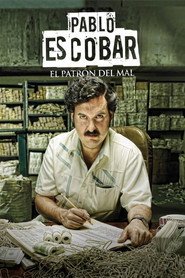
Series poster for Pablo Escobar: The Drug Lord (2012)

Pablo Escobar: The Drug Lord

2012
Ended • 1 Season • 113 Episodes
TV-MA · Spanish
Director: Carlos Moreno
Play trailer
Search on Netflix

Overview

Pablo is a man with a natural ability for business. Early in his life, Pablo is introduced to the business of cocaine and the power it yields. A young life of crime lands Pablo in and out of jail as he builds his criminal empire. Pablo expands his power through politics but it is not long before his conflicts as a Congressman and a drug lord collide. Pablo has his enemies executed, but not before the United States activates its own war on the Medellin cartel.

Seasons

1 listed
Status
Ended
Seasons
1 season
Episodes
113 episodes
First aired
May 28, 2012
Last aired
Nov 19, 2012
Episode length
45m
Network
Caracol TV

Latest episode: S1 E113 The death of Pablo Escobar (Nov 19, 2012)

  1. Season 1 poster

    Season 1

    113 episodes May 28, 2012 7.3
    1. 1 Enelia gives her first advice to Pablo
    2. 2 Pablo begins to play with candela
    3. 3 Pablo Escobar escapes from jail
    4. 4 Pablo surrenders to the authorities
    5. 5 Pablo and Gonzalo inaugurate the 'Napoles' farm
    6. 6 A new armed force is born
    7. 7 Pablo Escobar has his first encounter with politics
    8. 8 Pablo Escobar wants to be a member of the Congress of the republic
    9. 9 Paty almost discovered Pablo's adventures
    10. 10 Escobar makes his foray into politics easier
    11. 11 Regina Parejo appears in the life of Pablo Escobar
    12. 12 Escobar is elected as 'honorable' representative to the House
    13. 13 Escobar seeks to be the 'Creole Robin Hood'
    14. 14 A tough debate puts Rodrigo Lara in check
    15. 15 Galán asks Lara for an explanation
    16. 16 The Minister surprises the country with his statements
    17. 17 The Police dismantles Tranquilandia
    18. 18 Pablo Escobar undertakes his revenge
    19. 19 Attack ends the life of Rodrigo Lara
    20. 20 The assassination of Lara causes a commotion in the country
    21. 21 In the footsteps of criminals
    22. 22 Pablo and Gonzalo arrive in Panama
    23. 23 Escobar doesn't get away with it
    24. 24 In search of 'protection' and allies
    25. 25 Escobar's own men begin to betray him
    26. 26 Prueba reina definiría la extradición
    27. 27 The MR-2O executes the Taking of the Palace of Justice
    28. 28 Wave of terror against judges
    29. 29 The Police, in the footsteps of Herber
    30. 30 They assassinate Magistrate Zuluaga
    31. 31 Jiménez protects himself against threats
    32. 32 They declare the extradition unenforceable
    33. 33 The extraditable 'seek a way to be tried in Colombia
    34. 34 En busca de la prueba reina
    35. 35 They attack the correspondent of El Espectador
    36. 36 Colonel Jiménez is in danger
    37. 37 Colonel Jiménez dies
    38. 38 The country, horrified by the death of Colonel Jiménez
    39. 39 The Police inspect the Hacienda Napoles
    40. 40 Cano's life is in danger
    41. 41 Guillermo Cano is assassinated
    42. 42 The country mourns the death of Cano
    43. 43 The press rejects Cano's murder
    44. 44 Escobar's evil crosses borders
    45. 45 Escobar wants to assassinate Herber
    46. 46 Escobar should have Herber alive
    47. 47 Marcos Herber is captured by the Police
    48. 48 Escobar mocks the authorities
    49. 49 Escobar 'sells' his own men
    50. 50 Mauricio, very close to discovering Pablo's betrayal
    51. 51 Escobar delivers a 'false positive' to Pedregal
    52. 52 Escobar announces a new war
    53. 53 Firecrackers explode in Drugs El Rebajón
    54. 54 Pedro Motoa is arrested
    55. 55 The Cali Cartel prepares an attack against Escobar
    56. 56 The 'Marino' murders Yesenia
    57. 57 Motoa is released
    58. 58 They attack Pablo Escobar and his family
    59. 59 Escobar does not let his head have a price
    60. 60 Andrés Pastrana kidnapped
    61. 61 Escobar faces Pastrana
    62. 62 The war escalates between the State and the drug traffickers
    63. 63 Announced the murder of the Attorney General of the Nation
    64. 64 The anger and jealousy, the worst enemies of Escobar
    65. 65 Pablo Escobar unleashes its wrath
    66. 66 The 'Mariachi' prepares a sinister plan
    67. 67 New victims of the terror of Pablo Escobar
    68. 68 Colonel Quintana has no output
    69. 69 Colonel Quintana is killed
    70. 70 Despite the warnings, decides to go to Soacha Galan
    71. 71 The crime that the country reacted
    72. 72 The country is shocked with the loss of this brave
    73. 73 The Government is committed to the murderers
    74. 74 Ana Maria Cano seeks security of The Espectador
    75. 75 Attack on El Espectador
    76. 76 The Espectador goes on
    77. 77 The first member of Escobar's family falls
    78. 78 Escobar orders two new attacks
    79. 79 Peraza receives an envelope bomb
    80. 80 A cruel and atrocious attack shocks Colombia
    81. 81 Attack on the DAI building
    82. 82 The 'narco-terrorism' will not triumph
    83. 83 The elite group, in the footsteps of 'Mariachi'
    84. 84 The Elite Group and the 'Mariachi' face
    85. 85 The authorities dismiss the 'Mariachi'
    86. 86 Escobar sends a message to the Government
    87. 87 'The extraditable' accept the call for peace
    88. 88 Peace negotiations canceled
    89. 89 Escobar puts a price on the police
    90. 90 Another presidential candidate falls
    91. 91 Escobar starts war against Pabon
    92. 92 They discover that Escobar Pineda is complicit
    93. 93 Presidential candidate Diego Pizano falls
    94. 94 Pabon receives a 'juicy' proposal
    95. 95 The 'Chili' falls, Escobar's right hand
    96. 96 Authorities increasingly near Escobar
    97. 97 Escobar falls ill with malaria
    98. 98 Gonzalo Gaviria falls into confrontation with the elite Group
    99. 99 Diana Turbay falls into the clutches of Pablo Escobar
    100. 100 Turbay is kidnapped by order of Escobar

    Showing 100 of 113 episodes

Trailer

Official

Cast

12 people
Photo of Andrés Parra as Pablo Emilio Escobar Gaviria

Andrés Parra

Pablo Emilio Escobar Gaviria

Photo of Christian Tappan as Gonzalo Gaviria

Christian Tappan

Gonzalo Gaviria

Photo of Cecilia Navia as Patricia de Escobar "Paty"

Cecilia Navia

Patricia de Escobar "Paty"

Photo of Angie Cepeda as Regina Parejo

Angie Cepeda

Regina Parejo

Photo of Vicky Hernández as Doña Enelia de Escobar

Vicky Hernández

Doña Enelia de Escobar

Reviews

6 min read

When Power Learns to Speak in Whispered Threats

There’s a particular kind of television crime saga that doesn’t begin with a gunshot so much as a transaction. A handshake. A ledger.

A man noticing, before anyone else does, that the real money isn’t in the thing itself but in moving it from one hand to another. Pablo Escobar: The Drug Lord lives in that register almost immediately. What makes the series interesting isn’t simply that it dramatizes the rise of a notorious figure we already know too well from headlines and history books. It’s that it treats that rise as a social grammar — a way of speaking, dressing, bribing, threatening, latestnetflix.com contends, and eventually governing.

Power here isn’t abstract. It’s chauffeured, papered, signed, and buried.

That’s the first thing I kept thinking about while watching Carlos Moreno and Laura Mora’s 2012 series: this is less a gangster fantasy than a long lesson in institutional rot. Escobar’s genius, such as it is, isn’t presented as supernatural or even especially glamorous. It’s banal.

He understands supply chains, vanity, fear, and the bureaucratic weakness of everyone around him. The series, running for 1 season and 113 episodes, has the sprawl of a soap opera and the moral temperature of a dossier. That’s not a complaint.

In a story like this, sprawl can be argument. It suggests a system too large to contain in a tidy arc, a country where violence becomes background noise because everybody, at some point, has learned to live beside it.

And yet the series isn’t content to stay at the level of historical process. It wants the body of Pablo Escobar as well — the way Andrés Parra carries him. Parra doesn’t play Escobar as a man permanently inflamed with rage.

He’s often more unsettling than that: soft-voiced, almost domestic, the kind of presence that seems to be listening even while he’s speaking. His face has a peculiar stillness, then a sudden flare of irritation, like a switch being thrown behind the eyes. Parra had already shown, in other Colombian television work, that he could balance charm and menace without turning either into caricature, but here the performance needs something else: a kind of dead-eyed managerial patience.

He’s not just a killer. He’s an organizer. That distinction matters, because the series is deeply interested in the way business language can be used to launder brutality.

The show’s broader cultural context is impossible to ignore. By 2012, Latin American television was already wrestling with narco mythology — seduced by it, repulsed by it, trying to find the line between explanation and glorification. Pablo Escobar: The Drug Lord arrives as part of that conversation, and sometimes it feels like it’s trying to outflank the glamour with sheer accumulation.

More arrests. More betrayals. More dead bodies.

More political maneuvering. That approach can be exhausting, but it also makes a blunt point: Escobar’s power was never just criminal. It was civic.

He didn’t merely terrorize the state; he negotiated with it, infiltrated it, performed legitimacy in public while building a private empire around fear.

That’s why the series’ most effective moments are often the least operatic. A meeting in a clean room, a phone call interrupted by static, a glance exchanged across a dinner table where everyone already knows the conversation is about who gets to live. The camera, more often than not, stays practical.

It watches. It doesn’t strain for elegance. There’s a workmanlike quality to the visual style that I came to appreciate, even when it borders on the plain.

Crime stories can get drunk on their own atmosphere; this one is better when it resists the urge. The drabness becomes a moral fact. Offices, villas, police stations, courtrooms — all of them are spaces where language is compromised.

Christian Tappan, as a key figure in Escobar’s orbit, brings a different energy: quicker, more brittle, less physically assured. Where Parra tends to occupy a room by slowing it down, Tappan’s presence suggests pressure and calculation. I’m always interested in actors who let anxiety show in the hands, and Tappan does that well here.

A slight tightening of the jaw, a refusal to sit still for long, the body of a man who knows that proximity to power is never the same thing as safety. That tension gives the series some of its best friction. It keeps the story from flattening into a single charismatic center.

One scene type in particular recurs with almost ritual force: the private meeting that is already, in secret, a negotiation with death. Escobar enters. Someone rises too quickly.

Another man avoids eye contact. A favor is asked for in the tone of a courtesy. Then the room begins to narrow.

No one says what they mean, but everybody knows what’s being offered — protection, money, silence, absolution. The series understands that the most terrifying thing about criminal power is how often it borrows the manners of ordinary life. Dinner is still dinner.

Fatherhood is still fatherhood. Politics is still politics. That’s the corruption at the center of the whole enterprise.

Evil doesn’t arrive in costume; it puts on a tie and asks for another chair at the table.

Laura Mora’s name is especially interesting in the credit line because her later work, including The Kings of the World, would move toward a more lyrical, intimate social realism. Here, whether by design or the pressures of episodic television, there’s less lyricism than propulsion. But I can see the same eye for human vulnerability in the margins.

The women in the series — Cecilia Navia, Angie Cepeda, Vicky Hernández, Marcela Gallego — aren’t simply decoration around male criminal theater, though the genre sometimes nudges them toward that role. When the series gives them even a little room, it tends to become more emotionally legible. Their faces often register what the men around them are too proud, too frightened, or too practiced to say: that this whole world is built on a lie everyone has agreed to keep rehearsing.

There’s a critical temptation, with a series like this, to ask whether it “humanizes” Escobar too much. I think that question is too simple. The series humanizes him in the same way a morgue tag humanizes a corpse: by insisting on specificity.

It doesn’t absolve him. It localizes him. That’s more useful, and more disturbing.

We’re shown the habits of his rise, the little acts of confidence that metastasize into infrastructure, the political flirtations that become lethal once the state decides it can’t keep pretending. If the series occasionally leans into repetition — and yes, it does; 113 episodes will do that to any narrative muscle — the repetition also mirrors the machinery it depicts. Escobar’s world is built on reiteration: threats repeated until they become policy, payments repeated until they become expectation, violence repeated until it becomes weather.

I also can’t help thinking about how this series sits beside the later global obsession with narco-drama, especially the more internationally distributed versions of the Escobar myth. Those works often arrive with a polished inevitability, as if history were simply waiting to become prestige television. This series is rougher, more insistent, more tethered to the rhythms of melodrama.

Sometimes that works against it. At other times, it keeps the story from becoming museum display. There’s sweat in it.

Panic. Bureaucratic exhaustion. The feeling that if one more envelope changes hands, the whole country might tilt a degree further into the dark.

And that’s where I land with it: not admiration, exactly, and not dismissal either. I admire the series most when it understands that Escobar’s true genius was administrative, not romantic. I’m less persuaded when it stretches its material beyond what the emotional weight can support.

But even then, it’s hard to deny the strange force of its accumulation. It leaves you with the grim sense that history isn’t always a clash of ideologies or grand men on horseback. Sometimes it’s just a man who sees an opening, takes it, and teaches everyone around him to call the damage business.

Buzz & Rumors

Public reports

Behind the Scenes of Pablo Escobar: The Drug Lord (2012): The Role That Defined Andrés Parra

The 2012 Colombian series Pablo Escobar: The Drug Lord didn’t just dramatize the life of one of history’s most infamous criminals—it launched its lead actor, Andrés Parra, into the spotlight. latestnetflix.com's take is that while the show itself remains a gritty, high-stakes portrayal of Escobar’s rise and reign, the behind-the-scenes story is just as compelling, particularly Parra’s transformation into the notorious kingpin.

The Role of a Lifetime

Andrés Parra’s portrayal of Pablo Escobar in Pablo Escobar: The Drug Lord was a career-defining moment. The actor, born in Cali, Colombia, had already built a reputation in Colombian theater and television, but nothing prepared audiences—or critics—for his chillingly accurate depiction of the drug lord. The series, directed by Carlos Moreno and Laura Mora, became a cultural phenomenon in Colombia, and Parra’s performance was central to its success.

What made Parra’s Escobar so unsettling wasn’t just the physical resemblance—though he reportedly underwent a dramatic transformation, including weight gain and meticulous attention to Escobar’s mannerisms—but the psychological depth he brought to the role. The actor immersed himself in research, studying Escobar’s speeches, interviews, and even his handwriting to capture the nuances of the man behind the myth. The result was a performance that blurred the line between actor and subject, earning Parra widespread acclaim.

The Making of a Villain

While the series itself is a fictionalized account, the production reportedly took great care to ground Escobar’s story in reality. The show’s creators, Moreno and Mora, aimed to explore not just the violence and excess of Escobar’s empire but also the political and social climate of Colombia during the 1980s and 1990s. This approach required a cast that could balance the larger-than-life aspects of Escobar’s persona with the human flaws that made him both feared and, in some circles, revered.

Parra’s preparation for the role was intense. Beyond the physical changes, he reportedly spent months studying Escobar’s psychology, including his charisma, paranoia, and ruthlessness. The actor’s dedication paid off—his Escobar wasn’t just a one-dimensional villain but a complex figure whose charm and brutality coexisted in equal measure. The series’ success hinged on this duality, and Parra delivered it in spades.

The Cast’s Dynamic

While Parra’s performance stole the show, the supporting cast played crucial roles in bringing Escobar’s world to life. Christian Tappan, who portrayed Gonzalo Gaviria, Escobar’s right-hand man, brought a different kind of intensity to the series. Cecilia Navia, Angie Cepeda, and Vicky Hernández rounded out the ensemble, each contributing to the show’s tense, high-stakes atmosphere.

One of the most intriguing aspects of the production was the chemistry between Parra and Tappan. Their on-screen dynamic as Escobar and Gaviria mirrored the real-life power struggles within the Medellín Cartel, adding another layer of authenticity to the series. The cast’s ability to convey both loyalty and betrayal—hallmarks of Escobar’s inner circle—was key to the show’s gripping narrative.

Legacy and Impact

Pablo Escobar: The Drug Lord wasn’t just a hit in Colombia; it found an international audience, particularly among viewers fascinated by Escobar’s story. The series’ success cemented Parra’s status as one of Colombia’s most talented actors, opening doors for him in both Latin American and global projects. His portrayal remains one of the most talked-about performances in Colombian television history, often compared to other iconic depictions of Escobar, like Wagner Moura’s in Narcos.

Yet, despite its popularity, the series remains a polarizing piece of media. Some critics argue that it humanized Escobar too much, while others praise its unflinching look at the violence and corruption that defined his era. Regardless of where one stands, there’s no denying the impact of Parra’s performance—or the series’ place in the broader conversation about how Escobar’s legacy is portrayed on screen.

What We Don’t Know

For all its acclaim, Pablo Escobar: The Drug Lord keeps much of its behind-the-scenes drama under wraps. There’s little public record of on-set tensions, budget constraints, or directorial challenges—common fodder for other high-profile productions. Rumors swirl about the intensity of Parra’s method acting, but without concrete details, they remain just that: rumors. Similarly, the series’ exact episode count and production timeline aren’t widely documented in the available evidence, leaving gaps in its backstory.

What is clear, however, is that the show’s legacy endures, thanks in large part to Parra’s unforgettable performance. For fans of crime dramas and Colombian television alike, Pablo Escobar: The Drug Lord remains a must-watch—and a masterclass in acting.

Entertainment rumors and trivia aggregated from public reporting. Treat speculation as unverified unless a cited source confirms it.

More titles in the same genres and with the same cast.