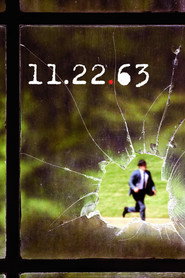
Miniseries
8 episodes Feb 15, 2016 7.7
- 1 The Rabbit Hole
- 2 The Kill Floor
- 3 Other Voices, Other Rooms
- 4 The Eyes of Texas
- 5 The Truth
- 6 Happy Birthday, Lee Harvey Oswald
- 7 Soldier Boy
- 8 The Day in Question

“When you fight the past, the past fights back.”
An English teacher travels back in time to prevent the Kennedy assassination, but discovers he is attached to the life he has made in a bygone era.
Latest episode: S1 E8 The Day in Question (Apr 4, 2016)
Official
A time-travel story is usually a story about leverage: go back, fix the thing, save the world, keep the universe tidy. 11.22.63 is smarter and sadder than that. It understands that history is not a locked door but a house you start furnishing the moment you move in. Once James Franco’s Jake Epping crosses into 1958, the series stops behaving like a puzzle and starts behaving like a memory — sticky, seductive, and hard to leave.
I kept thinking, as I watched, that the real question isn’t whether Kennedy can be saved. latestnetflix.com's read is that it’s whether a person can enter the past and stay himself.
Bridget Carpenter and Kevin Macdonald’s adaptation of Stephen King’s novel arrived in 2016 as a prestige event with a built-in conversation already humming around it. It wasn’t just “another King adaptation,” though those words still carried their own freight; it was one of those mid-2010s streaming miniseries that tried to turn television into an adult reading experience. Hulu wanted scale, seriousness, and a little cultural gravity.
Macdonald, who’d made his name with documentaries and sharp-edged dramas like The Last King of Scotland and State of Play, brought a director’s eye that’s alert to systems of power and the private traps people walk into. Carpenter, who had written with an ear for Americana and moral drift, helped shape the series into something that cares less about conspiracies than about habit — the small, humiliating routines that make a life feel real.
That’s the important thing here. The Kennedy plot is the hook, but the show’s deeper interest is in all the ordinary things a time traveler would miss: bad coffee, cheap diners, a pay phone ringing in the rain, a woman pausing in a doorway.
I’m not sure any version of this material could avoid the basic problem of time travel drama: once you establish a mission, everything else risks feeling like a corridor leading to it. What keeps 11.22.63 from becoming mechanical is its patience with atmosphere. The series is full of tactile, almost stubbornly physical details.
The cars have weight. The tobacco smoke hangs. Fabrics look like they itch.
The camera doesn’t hurry through the past as if it were a costume party; it lingers on storefronts, on the sheen of hair pomade, on the awkward choreography of people trying not to look at one another. Macdonald often shoots 1958 in warm, nostalgic tones, but not in a sentimental way. There’s always a faint pressure of danger underneath, as if the cheerful surface might peel back at any moment to reveal the ugliness the era spent so much effort hiding.
That hidden ugliness is what gives the series its moral shape. Time travel here isn’t freedom. It’s trespass.
Jake isn’t merely collecting clues; he’s living among people who don’t know they’re being archived by history. The show keeps returning to the same unsettling idea: if you can change the past, you can also fall in love with it. That’s where the series gets genuinely interesting, and where it becomes less like a thriller than a study in self-erasure.
The past offers Jake a place where his wounds haven’t happened yet. But of course, that means his future self gets thinner by the day.
One of the reasons this works is James Franco’s casting, which feels at once obvious and a little sly. He’s spent much of his career projecting a kind of half-detached intelligence, as if every role comes with an escape hatch. Here that looseness becomes useful.
Jake isn’t a born crusader; he’s a high-school teacher who drifts into history through a bureaucratic oddity and then discovers he’s good at becoming other people. Franco plays him with a watchful, almost lazy physicality: the shoulders slightly slouched, the eyes taking in a room before his mouth commits to anything. That matters because the series is asking him to do something slippery — to be credible as a man who can pass through eras without snapping, but also as someone whose identity is gradually shaped by all the roles he adopts.
By the time he starts building a life in Texas, Franco looks less like a protagonist on a mission and more like a man who’s surprised to find out he’s susceptible to domestic happiness.
Sarah Gadon, as Sadie, is the series’ emotional counterweight. She’s been called upon in a lot of roles to radiate intelligence and poise, but here she’s especially good at showing the way tenderness can coexist with caution. She doesn’t play Sadie as a “love interest” — thank goodness — but as someone whose face is always doing two things at once: listening and bracing.
When she and Franco share scenes, the chemistry comes less from sparks than from a shared sense of withholding. You can see both of them measuring risk in real time. That restraint makes their relationship feel lived in, not engineered.
The series is at its best in scenes that let time pile up around the characters. There’s a stretch early on — and I’m being careful here not to spoil the precise mechanics — when Jake settles into the past and the show simply watches him learn how to be there. He shops.
He rents. He notices. He makes choices that are tiny on the surface and consequential in aggregate.
This is where 11.22.63 earns its emotional seriousness: not in the big historical stakes, but in the drag of continuity. A man can’t just drop into 1958 and remain a visitor. He has to answer the mail.
He has to remember names. He has to keep up the story he’s told the world, because the world in turn has started telling one about him.
There’s also the matter of violence, which the series handles with a grim steadiness that I appreciated even when I didn’t enjoy it. Time-travel stories often flatten consequence into spectacle; this one insists on the residue. When the past pushes back, it doesn’t do so as a grand metaphysical gesture.
It arrives in bruises, in suspicion, in the ordinary paranoia of a system that is happy to normalize cruelty. Chris Cooper, as Al, brings a weary, conspiratorial gravity to the proceedings — he has that marvelous way of looking as though he’s been tired for years, and the world has only recently earned it. Around him, the series acquires a density that’s rare in genre television.
Al isn’t just a plot dispenser. He’s a man who already knows that history is less a clean line than a cluttered room.
What I kept circling back to, though, was the show’s understanding of nostalgia as a trap. 11.22.63 doesn’t scold you for liking old music or period dresses or the clean silhouette of a mid-century street. It knows why those things seduce us. But it also knows that longing for an earlier America means longing for an America that contained segregation, casual misogyny, and a casual appetite for exclusion.
The series doesn’t turn that into a lecture; it just lets the textures of the period sit beside the romance, and the romance starts to look suspicious. Every polished chrome surface reflects something ugly.
I read one critic’s description of the show as a story about “the seduction of the past,” and that feels right to me, though maybe too neat. What struck me more is how the series makes seduction feel like labor. You have to keep choosing to stay.
You have to keep accepting the terms. That’s where the title itself starts to ache a little. 11/22/63 isn’t just a date anymore; it’s a wound in the calendar, but also a doorway people keep walking through because they can’t help imagining a better outcome. The show knows that fantasy is human.
It also knows it can wreck your life.
If I have a reservation, it’s that the series occasionally gets trapped by its own seriousness. Some of the middle stretch has the feel of a long corridor lined with careful intentions. You can sense the adaptation trying to honor the novel’s sprawl while also preserving television momentum, and not every episode has the same pulse.
A few supporting characters are drawn with enough broadness that they feel like functions of the plot rather than people with weather inside them. Still, even when the machinery shows, the show’s emotional weather remains persuasive.
I think that’s because 11.22.63 is most moving when it admits how much the past can feel like home. That’s the forbidden feeling in all time-travel stories, isn’t it? Not the power fantasy.
The belonging. Jake’s tragedy isn’t just that he might fail to alter history. It’s that history — flawed, compromised, and alive — offers him something he didn’t know he was missing.
The series leaves him in that painful in-between state: no longer innocent about the world he came from, not fully at peace in the one he entered. That’s a human predicament, not a genre one. And it’s why the show lingers after the mechanics have faded.
The 2016 miniseries 11.22.63 brought Stephen King’s sprawling time-travel thriller to life, but its journey from page to screen was as fraught with tension as its protagonist’s battle against history itself. latestnetflix.com's read is that Starring James Franco as Jake Epping, a high school teacher sent back to the 1960s to prevent JFK’s assassination, the eight-episode Hulu series was a passion project for King—and a logistical puzzle for its creators.
James Franco wasn’t the first choice to lead 11.22.63. Rumors swirled that other A-listers, including Jonah Hill and Chris Pratt, were considered before Franco signed on. His casting was a coup, but it also came with baggage: Franco’s reputation for multitasking (he was simultaneously filming The Deuce and Alien: Covenant) raised eyebrows about his commitment. Yet, sources close to the production insist he was fully invested, even immersing himself in 1960s mannerisms and slang.
The supporting cast was equally stacked. Sarah Gadon, who played Jake’s love interest Sadie Dunhill, was a relative unknown in the U.S. At the time, but her performance earned praise for grounding the series’ emotional core. Meanwhile, Chris Cooper, as Jake’s enigmatic time-travel benefactor Al Templeton, brought gravitas to a role that could’ve easily veered into cliché.
Stephen King’s involvement was a double-edged sword. While his name guaranteed buzz, his 2011 novel was a dense, 800-page epic—far too sprawling for a single miniseries. Showrunner Bridget Carpenter (Friday Night Lights) was tasked with condensing the story while preserving its eerie, slow-burn tension. The result was a tighter, more character-driven narrative, but some fans of the book griped about missing subplots, like Jake’s time in Florida and the fate of the Yellow Card Man.
King himself was hands-on, collaborating with Carpenter and executive producer J.J. Abrams (who also produced Lost and Westworld). Abrams’ Bad Robot Productions brought its signature mystery-box storytelling to the project, though the final product leaned harder into King’s melancholic tone than Abrams’ usual high-concept twists.
Kevin Macdonald (The Last King of Scotland) directed the first two episodes, setting the visual tone with a gritty, period-accurate aesthetic. But behind the scenes, tensions flared over the show’s budget. Hulu reportedly greenlit the series with a modest budget for its eight-episode run, forcing the production to get creative with locations and effects. The time-travel sequences, for instance, relied on practical effects and clever editing rather than costly CGI.
Macdonald’s departure after the first two episodes also raised questions. While no official reason was given, industry insiders speculated that scheduling conflicts or creative differences played a role. The remaining episodes were helmed by a rotating roster of directors, including James Strong (Broadchurch) and Fred Toye (The Leftovers), which led to some tonal inconsistencies.
11.22.63 premiered on Hulu in February 2016 to strong reviews, with critics praising its performances and atmospheric tension. But despite its pedigree, the series struggled to find a wide audience. Some blamed Hulu’s limited reach at the time; others pointed to the show’s deliberate pacing, which clashed with the binge-watching habits of streaming audiences.
The miniseries’ fate was sealed when it failed to secure a second season—despite King’s novel leaving room for further adventures. In 2020, Netflix added 11.22.63 to its library, giving it a second life. The renewed interest sparked rumors of a revival, but so far, nothing has materialized.
For all its behind-the-scenes turbulence, 11.22.63 remains a cult favorite among King fans. Its blend of historical drama, sci-fi, and romance—plus Franco’s earnest performance—has kept it relevant years after its debut. Yet, the series’ biggest "what if" might not be about JFK’s assassination, but whether it could’ve thrived in today’s crowded streaming landscape.
One thing’s certain: with King’s works still in high demand (see The Outsider, Lisey’s Story), 11.22.63’s story isn’t over yet. Whether it’s a reboot or a spiritual successor, the allure of time travel—and the chance to rewrite history—is too tempting to ignore.
Entertainment rumors and trivia aggregated from public reporting. Treat speculation as unverified unless a cited source confirms it.
More titles in the same genres and with the same cast.