Limited Series
10 episodes Apr 19, 2020 8.4
- 1 Episode I
- 2 Episode II
- 3 Episode III
- 4 Episode IV
- 5 Episode V
- 6 Episode VI
- 7 Episode VII
- 8 Episode VIII
- 9 Episode IX
- 10 Episode X

“The legends. The truth.”
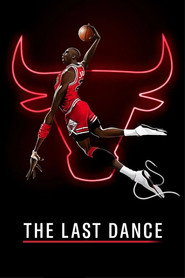
A 10-part documentary chronicling the untold story of Michael Jordan and the Chicago Bulls dynasty with rare, never-before-seen footage and sound from the 1997-98 championship season – plus over 100 interviews with famous figures and basketball’s biggest names.
Latest episode: S1 E10 Episode X (May 17, 2020)
Official
When The Last Dance aired in 2020, it didn’t feel like a tidy history lesson so much as a long, seductive argument. Here was basketball at its most public, most scrutinized, most mythologized — and Jason Hehir’s series knew exactly how to turn that mythology into television. I remember watching the first episodes and feeling the odd tug of it: the pleasure of archival footage, yes, latestnetflix.com argues, but also the sneaky thrill of seeing how carefully the film arranges memory.
Not just what happened. What the world still wants to believe happened.
Hehir’s series arrived in a very specific cultural moment. The pandemic had turned sports into an absence, and nostalgia was already doing the heavy lifting in American life. Then ESPN and Netflix dropped ten episodes that promised “untold” material from the 1997–98 Bulls, and suddenly the most overexposed athlete of the modern era was being reintroduced as if he were a figure from state history.
The show isn’t a sequel or a remake, exactly, though it borrows the serial rhythms of prestige drama. It’s closer to a court proceeding with highlight reels. The question isn’t whether Michael Jordan was great.
The question is who gets to narrate greatness once the games are over.
What’s most interesting to me is that Hehir doesn’t pretend documentary neutrality. He knows the camera can be a weapon, a toy, a confession booth. So he builds the series out of interviews, game footage, locker-room fragments, and that wonderfully corny late-’90s broadcast texture — all grainy edges and fluorescent interiors.
The result is part sports chronicle, part character study, part PR machine operating with unusual elegance. If that sounds cynical, it isn’t meant to be. I think the film is smarter than that.
It understands that Jordan’s legend was never separate from the machinery that made it. The series simply lets us see the gears.
The central conversation around The Last Dance was always going to be whether it was really about the Bulls, or whether it was a highly polished Michael Jordan portrait with a few generous sidebars for everybody else. That debate is fair. The documentary gives Jordan enormous control over the emotional temperature of the story, and it can feel, at times, like a man telling you the history of a house he set on fire and then rebuilt in marble.
But I’d argue that’s also the point. The series is fascinated by how Jordan’s competitiveness works as both engine and alibi. He is shown as brutal, exacting, suspicious, funny in a knife-edged way, and often exhausting.
That doesn’t diminish him. It makes him legible.
The first episode’s dance between present-day interviews and old footage does a lot of the heavy lifting. Hehir keeps returning to the contrast between the older, more reflective interview subjects and the young men they once were, locked into a season that already knew it was becoming legend. There’s a melancholy in that split-screen feeling, even when the show is ostensibly celebrating triumph.
I kept thinking about how many documentaries about athletes eventually become documentaries about time itself. Bodies change. Reputations calcify.
The crowd gets older. The game keeps going. Jordan, who once seemed almost too alive to be historical, now appears as a man trying to own the story before the story ossifies without him.
The series also benefits from a wonderful collection of faces that don’t know how to lie for the camera. Scottie Pippen’s stillness is crucial here. He’s had a long career in the public imagination as the overlooked co-star, but in The Last Dance his body seems to carry that history before he even speaks — the guarded mouth, the slight withholding in the shoulders, the sense that he’s been asked to relive the same slight one too many times.
Dennis Rodman, by contrast, remains all angles and provocation, a man whose eccentricity was once treated like a sideshow and now reads more like an early warning about what happens when the league demands individuality but only up to a point. Steve Kerr’s episodes matter because he’s one of the few people who can talk about Jordan without sounding intimidated into reverence. He remembers the infamous punch in practice, and the scene lands not because it’s sensational, but because it shows how violence and intimacy can occupy the same room in elite competition.
One of the series’ best-known stretches is also one of its simplest: the 1997 flu game. Hehir doesn’t overcook it, which is wise. The footage itself does enough.
Jordan on the bench, sweating through the body’s betrayal; the medical uncertainty; the slow, stubborn return to the floor; then the performance of will that has since become basketball folklore. What I find striking is how the documentary edits the scene less like sports triumph than like a ritual of public martyrdom. There’s the bench.
The towel. The bowed head. The camera waiting for the body to either fail or transcend itself.
That’s the weird bargain sports asks of us, and the series knows it. We don’t just want victory. We want evidence that victory cost something.
But the documentary is at its sharpest when it lets the human mess peek through the polished myth. The tension between Jordan and Pippen over contracts and recognition is one of the series’ truest emotional threads, because it refuses the false sentimentality that team history usually gets saddled with. Pippen’s famously underpaid deal isn’t just trivia; it’s a reminder that greatness is often monetized unevenly, and that “team” is sometimes a nice word for a structure that asks the most from the least compensated.
The series doesn’t fully solve that problem — it can’t, because Jordan’s perspective has the microphone — but it does at least leave the bruise visible.
There are moments when I wished The Last Dance had more humility about its own seductions. The editing can be a little too pleased with itself, and the series occasionally leans on the old sports-documentary trick of letting dramatic music do the work that a more rigorous structure might have done more cleanly. It also has the slight problem of being so rich in access that it can begin to mistake access for depth.
Yet even that flaw is kind of revealing. This is a documentary about a man who turned control into a competitive art. Of course the film about him is structured like control.
I’m thinking, too, about the way the series handles Phil Jackson. In other hands, he’d be a meditative counterweight, the Zen coach with the white beard and the big-body patience. Here, he’s something less decorative and more difficult: a manager of ego, a reader of room temperature, a man who understood that basketball brilliance often requires a toleration for chaos.
His interviews — calm, dry, a little amused — offer one of the few tonal brakes in the series. They remind us that dynasties aren’t built by supernovas alone. Someone has to stand there and keep the structure from collapsing.
There’s a reason people kept comparing the series to a thriller while it aired, though I’m not sure that’s the right word. Thrillers hide information; The Last Dance weaponizes old information by reorganizing it. You know, more or less, how this ends.
What’s compelling is the sensation of watching the end arrive with such self-awareness. By the final episodes, the documentary becomes less about a dynasty than about the emotional price of being allowed to define your own legend for so long that everyone else starts orbiting it. Jordan emerges not as a saint or villain but as something more recognizably American: a man who made domination look like destiny and then spent the rest of the culture helping him call it fate.
That’s why the series has lasted beyond the initial wave of pandemic-era sports hunger. It isn’t just a Bulls documentary. It’s a study in how memory is edited, how institutions protect their heroes, and how those heroes, in turn, protect the story that made them.
I don’t completely trust it, and I think a healthy skepticism is part of the viewing experience. But I also can’t dismiss the strange emotional power of watching a culture return, one more time, to a man who made excellence look like a personal grudge.
In the end, The Last Dance leaves me with something more complicated than admiration. It leaves me with the uneasy recognition that legends are built from facts, omissions, and repetition — and that sometimes the repetition is the whole point. Basketball, in this telling, becomes a language for ambition, humiliation, discipline, vanity, and grief.
Which is to say: it becomes human.
"A celebrated sports documentary with exactly the biographical depth basketball fans hoped for."
Viewers embraced the series as a premier biographical look at basketball greatness. Reactions stress that it gave longtime fans everything they wanted, and it set a bar that sent viewers hunting for comparable sports binges.
The Last Dance (2020) didn’t just chronicle Michael Jordan’s final championship run with the Chicago Bulls—it rewrote the playbook for sports documentaries. Director Jason Hehir’s behind-the-scenes access to Jordan and the team’s inner circle was unprecedented, but earning that trust wasn’t easy. latestnetflix.com's read is that here’s how Hehir pulled it off, and the challenges he faced along the way.
Michael Jordan is notoriously guarded, but Hehir’s approach broke through. The director’s strategy hinged on patience and persistence. In interviews, Hehir revealed that Jordan initially resisted participating, wary of how the series would portray him. The turning point? Hehir’s willingness to let Jordan control the narrative—at least partially. He allowed Jordan to review raw footage, a rare concession in documentary filmmaking, which helped ease the basketball legend’s concerns. This move wasn’t just about access; it was about ensuring Jordan felt the story aligned with his legacy.
Hehir also leaned on Jordan’s competitive nature. He framed the project as a chance to cement Jordan’s place in history—not just as a player, but as a cultural icon. The director’s pitch? The Last Dance wasn’t just about the Bulls’ 1997-98 season; it was about Jordan’s entire career, including his rivalry with the Detroit Pistons, his first retirement, and his brief stint in baseball. That broader scope appealed to Jordan’s desire to be remembered as more than just a champion.
Phil Jackson, the Bulls’ coach during their six championship runs, was another key figure—and another challenge. Jackson’s interviews were candid, but Hehir had to navigate the coach’s philosophical, sometimes cryptic, style. In one behind-the-scenes discussion, Hehir admitted that Jackson’s Zen-like demeanor made it tough to pin down concrete answers. The director’s solution? Focus on Jackson’s relationship with Jordan, which provided the emotional core of the series.
Jackson’s insights into Jordan’s leadership—like his infamous "shut up and play" mentality—became some of the documentary’s most quoted moments. But Hehir also had to balance Jackson’s perspective with those of other players, like Scottie Pippen and Dennis Rodman, to avoid a one-sided narrative. The result was a nuanced portrayal of the Bulls’ dynasty, warts and all.
Not everyone was happy with The Last Dance. Some former Bulls players and staff criticized the series for glorifying Jordan at the expense of others, particularly Pippen, whose contract disputes and contributions were downplayed. Hehir addressed these concerns in interviews, acknowledging that the documentary was Jordan’s story first and foremost. "This was always Michael’s project," Hehir said, defending the focus on Jordan’s perspective.
The director also faced scrutiny over the series’ timing. Released during the COVID-19 pandemic, The Last Dance was accused of being a calculated distraction by ESPN. Hehir dismissed those claims, insisting the project was years in the making and not a reaction to current events. Still, the timing undeniably amplified its cultural impact, turning it into a must-watch event.
One of the most poignant moments in The Last Dance came from an unexpected source: Kobe Bryant. Hehir revealed that Bryant, a longtime admirer of Jordan, was interviewed for the series but didn’t make the final cut. The director described Bryant’s insights as "invaluable," particularly his take on Jordan’s influence on his own career. Tragically, Bryant’s untimely death in January 2020 meant his interview footage became a bittersweet footnote to the project.
Hehir’s decision to exclude Bryant’s interview was practical—there simply wasn’t room to include every perspective—but it also highlighted the documentary’s focus on the Bulls’ 1997-98 season. Still, the director’s comments suggest Bryant’s input shaped how Jordan’s legacy was framed, even if indirectly.
The Last Dance wasn’t just a sports documentary; it was a masterclass in storytelling. Hehir’s ability to secure Jordan’s trust, navigate the egos of the Bulls’ dynasty, and deliver a gripping narrative set a new standard for the genre. The series’ success—garnering an Emmy and widespread acclaim—proved that sports stories could be as compelling as any drama.
But its legacy isn’t just about awards. The Last Dance gave fans an unfiltered look at one of the greatest athletes of all time, warts and all. Jordan’s intensity, Pippen’s loyalty, Rodman’s antics, and Jackson’s wisdom all played out on screen, creating a portrait of a team—and an era—that may never be replicated.
Entertainment rumors and trivia aggregated from public reporting. Treat speculation as unverified unless a cited source confirms it.
More titles in the same genres and with the same cast.