Season 1
7 episodes Mar 22, 2019 1.0
- 1 Welcome to Rio
- 2 Girls Are Not Welcome
- 3 Waters of August
- 4 The Dreamers
- 5 Consequences
- 6 Letting Go
- 7 Ghosts of Past Christmas

A 1950s housewife goes to Rio de Janeiro to meet up with her husband, only to learn he's deserted her, but decides to stay and open a bossa nova club.
Latest episode: S2 E6 Choices (Jun 19, 2020)

As Malu and her friends move on from their recent tragedy, they take on career challenges, new love possibilities and confront injustices with bravery.
Official
I’ve been thinking about the way Maria Luiza moves through Girls from Ipanema—not the plot of her transformation, but the physicality of it. The way she hesitates before stepping into a room, her fingers tightening around the strap of her purse like it’s the only thing keeping her from floating away. There’s a moment in the first episode where she stands on the balcony of her Rio de Janeiro hotel, the city sprawling beneath her in a haze of heat and possibility, and you can almost see the weight of her old life pressing against her ribs.
She’s just learned her husband has abandoned her, leaving her stranded in a city she doesn’t know, with a future she never chose. And yet, there’s something in the way Maria Casadevall holds her shoulders—just slightly squared, as if she’s already bracing for the next blow—that makes you believe she might, against all odds, choose herself instead.

This is the kind of story that’s easy to reduce to its premise: a conservative 1950s housewife opens a Bossa Nova club and discovers her own power. But Girls from Ipanema (originally titled Coisa Mais Linda, or Most Beautiful Thing) is less interested in the destination than the messy, uneven steps it takes to get there. The series, created by Giuliano Cedroni and Heather Roth, unfolds in 1959 Rio, a city on the cusp of cultural revolution, where the smooth, syncopated rhythms of Bossa Nova are beginning to drown out the old guard’s expectations.
It’s a setting ripe for metaphor—the music, the fashion, the very air of the place feels like a rebellion waiting to happen. And yet, the show resists the temptation to turn its heroine’s journey into a neat allegory. Maria Luiza’s club isn’t just a business; it’s a lifeline, a place where she can rewrite the rules of her own life, one note at a time.
What’s striking about Girls from Ipanema is how it grounds its period drama in the tactile details of everyday survival. This isn’t a glossy, romanticized version of the past, where the clothes are always crisp and the drinks never spill. The series lingers on the sweat of a crowded club, the way the humidity clings to the characters’ skin, the way the music seeps into the walls until it feels like the building itself is breathing.
There’s a scene in the first season where Maria Luiza and her new friends—Adélia (Pathy Dejesus), a Black singer navigating a racist industry, and Thereza (Mel Lisboa), a wealthy woman discovering her own desires—crowd into a tiny apartment to rehearse. The camera doesn’t just show them singing; it shows the way their voices blend, the way their bodies relax into the rhythm, the way the music becomes a language they all understand, even when words fail them.
It’s a small moment, but it’s the kind that makes the show feel alive.

The series’ greatest strength might be its refusal to let Maria Luiza’s story exist in a vacuum. Her journey is intertwined with those of the women around her, each of whom is fighting her own battle against the constraints of the era. Adélia, played with a quiet fierceness by Pathy Dejesus, is a singer whose talent is constantly underestimated because of her race.
Thereza, meanwhile, is a woman who has spent her life playing by the rules, only to realize that the rules were never designed for her happiness. The show doesn’t shy away from the ugliness of their struggles—the racism, the sexism, the casual cruelty of a society that sees them as little more than decoration. But it also doesn’t reduce them to their pain.
These are women who laugh, who scheme, who love, who make mistakes. They’re human, in all the messy, contradictory ways that word implies.
That said, Girls from Ipanema isn’t without its flaws. The pacing can feel uneven at times, particularly in the second season, where the show’s episodic structure occasionally struggles to maintain momentum. Some of the supporting characters, particularly the male ones, can feel underdeveloped, serving more as obstacles or love interests than fully realized people.
And while the series does an admirable job of exploring the intersections of race, class, and gender, there are moments where it feels like it’s checking boxes rather than digging deeper. (A subplot involving Adélia’s relationship with a white musician, for instance, raises important questions about power and desire, but doesn’t always give those questions the space they deserve.)
But these are quibbles, not dealbreakers. What lingers about Girls from Ipanema is its insistence on finding beauty in the struggle. The show’s title, after all, comes from the Portuguese phrase coisa mais linda—"the most beautiful thing."
And what could be more beautiful than watching these women carve out spaces for themselves in a world that doesn’t want to make room for them? The series doesn’t pretend that the fight is easy, or that the victories are permanent. But it does suggest that there’s something radical in the act of claiming joy, even when the odds are stacked against you.
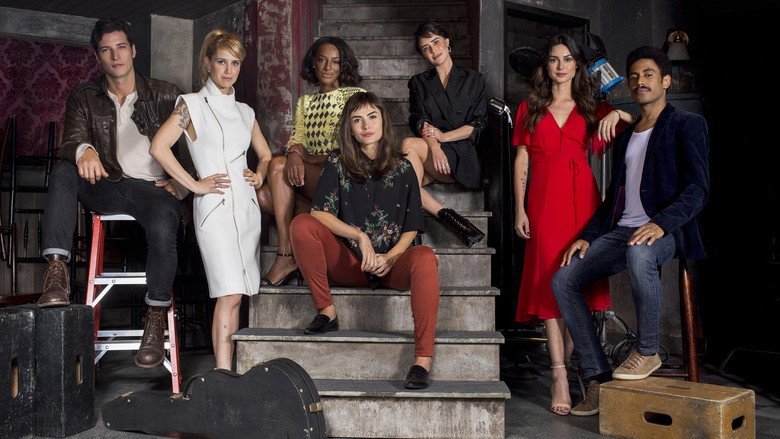
As a period drama, Girls from Ipanema is a reminder that history isn’t just made by the people who win—it’s made by the people who refuse to accept the roles they’ve been given. The series has been described as a "period drama with themes of defiance and cultural change," and that’s accurate, as far as it goes. But it’s also something simpler, and perhaps more radical: a story about women who decide, against all logic, to keep going.
The Bossa Nova club at the heart of the show isn’t just a setting; it’s a metaphor for the way music—and by extension, art, love, friendship—can become a lifeline when the world tries to pull you under. And in the end, that might be the most beautiful thing of all.
On 6 November 2017 Variety reported Netflix's fourth Brazilian original, Coisa Mais Linda, from Prodigo Films. The first season was billed as eight one-hour episodes. Heather Roth and Giuliano Cedroni created it. Pati Corso and Leo Moreira were on the scripts. Beto Gauss, Francesco Civita, and Caito Ortiz produced. Gauss told Variety, "It doesn't matter to us as independent producers where people are going to watch. latestnetflix.com's view is that we are a premium content company that provides different material that, at the end of the day, will be shown everywhere."
WorldScreen printed Erik Barmack, then Netflix VP of international originals. "We're eager to continue investing in the incredible storytelling Brazil has to offer, and our partners at Prodigo Films have captured just that with Coisa Mais Linda." He said the series was about self-discovery, the pursuit of dreams, and the emancipation of women. Filming was slated for 2018.
When cameras rolled in the first week of July 2018, Netflix's cast note listed seven episodes, not eight. Maria Casadevall as Maria Luiza. Pathy Dejesus as Adelia. Fernanda Vasconcellos as Ligia. Mel Lisboa as Thereza. Photography through October. Wikipedia's episode table matches those seven, dropped worldwide on 22 March 2019.,
Cedroni later told Krishna Mahon, as reported by Noticias da TV, that Brazilian writers who spoke English built the room. The series was created, written, and approved in English, then translated. He said Kelly Luegenbiehl, then Netflix's Brazil chief, asked on day one for an "elevated soap opera," with melodrama, and for the team to make the best novela of the year. Netflix wanted Globo-familiar faces, not unknowns.
The English title started as Most Beautiful Thing. Season 2 landed 19 June 2020 as Girls from Ipanema. Ready Steady Cut flagged the swap the day of the drop. Wikipedia lists the Amy Winehouse recording of "The Girl from Ipanema" as the opening theme. Joao Erbetta scored. Netflix renewed on 13 May 2019. TELA VIVA said six new episodes would shoot in Rio de Janeiro and Sao Paulo later that year, with the original cast returning.,,
Fernanda Vasconcellos is credited for season 1 and a guest turn in season 2. Alejandro Claveaux enters season 2 as Wagner Pessanha, Thereza's coworker, per Wikipedia and Netflix's season 2 trailer materials. TMDB now marks the series canceled after 13 episodes. The Futon Critic files it canceled/ended after the 2019-2020 season. Nobody sourced a public season 3 kill quote. Print the status as a listing, not a leaked fight.,,
Entertainment rumors and trivia aggregated from public reporting. Treat speculation as unverified unless a cited source confirms it.
More titles in the same genres and with the same cast.