LEGO Friends: Girls on a Mission
2018 Series
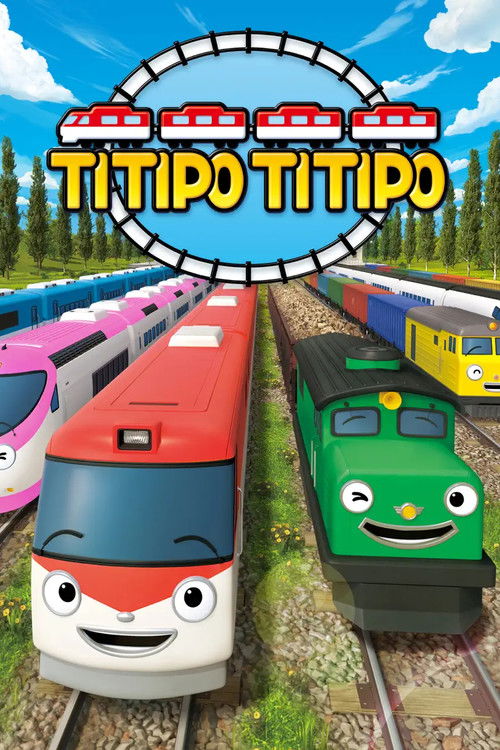
Titipo the train is out to prove that he's got what it takes to help the folks of Train Village ride the rails safely and reliably.
I came in expecting little. Not because children's television is a lesser art. Some of the smartest storytelling I know is built for the youngest viewers.
I came in low because Titipo Titipo, a 2018 3D series that ran on South Korea's EBS before a second life on Netflix, shows up with almost no public footprint. No director on the poster. No voice actors named.
No Common Sense Media page. A train named Titipo wants to prove he can help the residents of Train Village. That is the pitch.
I am still thinking about it days later, which is not the same as being sold.
The strangeness is how ordinary it is. A child's drawing of a train, rendered in glossy CGI. Titipo wants to do his job.
No quest. No villain on the rails. Episode titles stay small.
"Diesel! Help and save Titipo!" is a rescue. "Who is the best singer?" is a musical showdown between Fix and Lift.
Problem-solving, teamwork, emotional resilience. Themes wide enough for a cereal spot.

It is not aiming at Spirited Away or Wall-E. It is not even aiming at Thomas the Tank Engine, which at least invented an island of trains with personalities and grudges. Titipo Titipo feels reverse-engineered from a focus group. Cute lead.
Sidekicks named Jenny, Eric, Diesel, Fix, Lift, Xingxing, names so generic they could have been pulled from a baby-name list. A sprinkle of fantasy so the genre tag has somewhere to land. Comforting, and just odd enough that you ask what it is for.
That question sticks because the show does not know its age. Toddlers who will clap at bright colors and tiny problems? Slightly older kids who might care about a music battle?
One episode has Titipo crying after he loses Jenny. Another puts Fix and Lift in a singing contest. No throughline.
No sense that any seven minutes are building toward the next seven.
The real issue is milder than a flop. Titipo Titipo is not bad. Not ugly. Not even particularly dull.
It is just there, a train that is always on time and never headed somewhere you would remember. Animation is smooth, colorful, harmless. It has none of the grit of stop-motion and none of the hand-drawn warmth of Bluey.
The 3D is polished into sterility, as if texture itself might remind a child of weather. Backgrounds are lush and generic. A forest screensaver.
Personality is missing. Not only in the characters, who are walking types, but in the town. Train Village could be any preschool map.
South Korea? The United States? A made-up land where trains have first names and feelings?
The show will not say. Thomas the Tank Engine had its pecking order. The Little Engine That Could had underdog stubbornness. Titipo Titipo has a train who wants to help. That is a mission statement. It is not a story.
Netflix's own line is so earnest it almost hurts: "Titipo the train is out to prove that he's got what it takes to help the folks of Train Village ride the rails safely and reliably." No irony. No second layer.
A train trying to be good. Some kids will take the spark. A rescue.
A contest. It still feels like a show made because it could be made, not because anyone needed another helpful train.
Simplicity can be a craft. Pete the Cat works because it is relentlessly cheerful and repetitive. Daniel Tiger's Neighborhood sits on actual child psychology. Titipo Titipo feels assembled from a kit: one part Thomas, a dash of Bob the Builder, a scoop of leftover sci-fi, and you have a series.
The quiet around it is the tell. No Common Sense Media write-up. No essays about its themes, or about the lack of them. Background television. Elevator music for kids. Maybe that is the assignment. Maybe it is only meant to be watched, a gentle, forgettable thing for children raised on autoplay.
I want to be wrong. I want one episode to sneak in a real invention. Maybe Titipo's eyes fill when he thinks he has failed.
Maybe the score swells on a rescue. Maybe the magic is not the show, but the kid in that YouTube clip who "found a new TV show!" and cannot contain it. Children's media works that way.
A generic train can still be a hero if a child decides it is.
Not a bad show. Not a good one. A show that exists, and for some kids that is enough. For the rest of us, proof that not every story has to be a masterpiece. Sometimes a train is just a train. Sometimes that is fine.
"A charming but niche 3D-animated children's series about a playful train's adventures."
The series has a lighthearted, adventurous tone that suits young children who like trains and fantasy. Feedback is sparse, and most engagement comes from short video clips rather than in-depth discussion, so its audience looks small.
Titipo Titipo (2018) rolled into the children’s animation scene with little fanfare but quickly became a cult favorite—at least for a while. The South Korean 3D series, produced by Iconix Entertainment, premiered on the Educational Broadcasting System (EBS) in May 2018, introducing young audiences to a curious little train and his misadventures. latestnetflix.com's take is that but despite its charm, the show’s trajectory was anything but smooth, marked by a brief Netflix stint, viral moments, and an abrupt exit from the streaming giant.
Titipo Titipo was designed as a children’s series with a focus on curiosity and lighthearted storytelling. The show’s premise revolved around Titipo, a young train navigating everyday challenges, though details about its cast, creators, and even episode count remain scarce. What’s clear is that it debuted on EBS, a network known for educational content, suggesting its target audience was preschoolers and early elementary viewers. Unlike its more famous counterparts—think Tayo the Little Bus or Thomas & Friends—Titipo Titipo never achieved the same level of global recognition, at least not initially.
The show’s fortunes seemed to shift when it landed on Netflix, where it found a second life. Clips of Titipo Titipo began popping up on YouTube, often paired with reactions from young viewers or comparisons to other train-themed series. One video, titled "Baby J found a new TV show! 😍#Titipo #netflix," captured a toddler’s excitement over discovering the series, racking up thousands of views. Another clip, "Titipo lost his way... now he's browsing the toy section!", showcased the show’s slapstick humor, with Titipo wandering into a mall’s toy aisle—a moment that resonated with kids and parents alike.
But the Netflix honeymoon was short-lived. Multiple videos with titles like "Titipo Titipo Is Leaving Netflix" and "Oh No Titipo Titipo va de netflix" (Spanish for "Oh no, Titipo Titipo is leaving Netflix") signaled the show’s impending removal from the platform. The exact reasons for its departure remain unclear—no official statements from Netflix or Iconix Entertainment were found in the available evidence. Rumors swirled about licensing issues or low viewership, but without confirmation, the exit remains a mystery.
Despite its modest reach, Titipo Titipo cultivated a niche following, thanks in part to its viral clips. One video, "titipo titipo accidents will happen [2 MILLION VIEWS!]," highlighted the show’s knack for physical comedy, with Titipo’s mishaps resonating with young audiences. Another, "Titipo started to cry cuz he lost jenny! at least she came back, with Eric," tugged at heartstrings, proving the series could balance humor with emotional beats.
The show also sparked bizarre fan theories. A clip titled "Titipo vs Tayo can predict the future 💀(The Truth Behind this Episode)" leaned into the absurd, suggesting the series had hidden prophetic powers—a claim that, while entertaining, was likely tongue-in-cheek. Comparisons to Thomas & Friends were inevitable, with one video pitting the two trains against each other in a fictional showdown, further cementing Titipo Titipo’s place in the pantheon of train-based animation.
For all its charm, Titipo Titipo never quite broke out of the shadows of its more established peers. Its time on Netflix was fleeting, and its cultural footprint remains small compared to Tayo or Thomas. Yet, the show’s brief moment in the spotlight—marked by viral clips, emotional moments, and a dedicated (if small) fanbase—proves it had something special.
Whether Titipo Titipo will ever return to streaming or receive a revival remains uncertain. For now, it lingers as a quirky footnote in children’s animation, a little train that almost made it big.
Entertainment rumors and trivia aggregated from public reporting. Treat speculation as unverified unless a cited source confirms it.
More titles in the same genres and with the same cast.