
Pietra Quintela
Rosa / Áurea
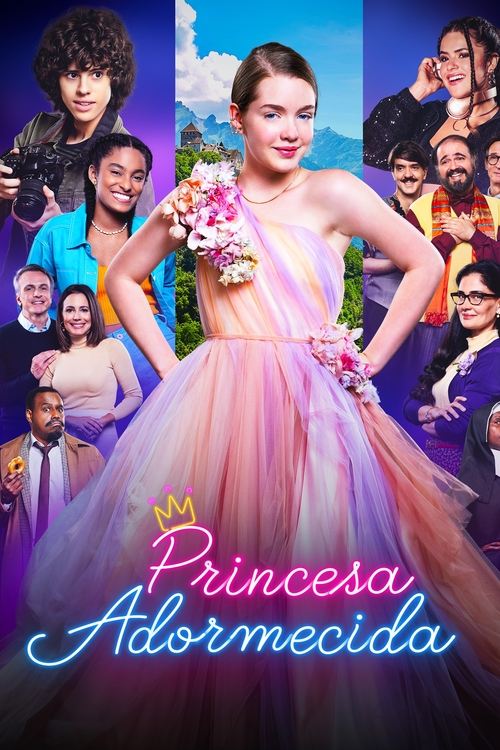
A sheltered teenager discovers she's actually a princess from another country — and she could be in grave danger. Based on Paula Pimenta's novel.
Pietra Quintela
Rosa / Áurea

Maisa Silva
DJ Cinderela

Guilherme Cabral
Felipe / Phil

Lívia Silva
Clara

Patrícia França
Marie / Sophie
I’ll admit it: I went into Sleeping Princess expecting a light, frothy Brazilian take on Sleeping Beauty, something that might charm its way through an 80-minute runtime with a few musical numbers and a happily-ever-after. What I got instead was a film that feels like it was edited in a blender—one set to "pulse" rather than "puree." The fairy tale is here, all right, but the magic?
Not so much.
Cláudio Boeckel’s adaptation of Paula Pimenta’s novel isn’t just unoriginal; it’s aggressively uninterested in originality. The premise—a sheltered teenager named Rosa (Pietra Quintela) discovers she’s a princess from another country and is suddenly in mortal danger—sounds like the setup for a YA franchise starter. Instead, it plays like a first draft someone forgot to revise.
The pacing lurches from one underdeveloped beat to the next, as if the film itself is in a hurry to get to the credits. (Maybe it is. At 80 minutes, it’s over before you’ve even finished your popcorn.)

The problem isn’t just that Sleeping Princess borrows its structure from a thousand other teen fantasy romances. It’s that it doesn’t seem to understand why those stories work. Take the inciting incident: Rosa learns she’s royalty, and within minutes, she’s whisked away to a new life in a vaguely European-looking kingdom.
There’s no awe, no wonder, no sense of stakes. The film treats her transformation from ordinary girl to princess as a plot point to be checked off, not a moment to be savored. Compare this to, say, The Princess Diaries, where Anne Hathaway’s Mia Thermopolis spends half the movie resisting her new identity before finally embracing it.
That resistance—her fear, her humor, her humanity—is what makes the story compelling. Here? Rosa nods, packs a bag, and moves on.
The emotional core of the fairy tale is missing, replaced by a checklist of genre beats.
The supporting characters fare no better. Maisa Silva, who played a delightfully spunky Cinderella in DJ Cinderella (2019), is wasted here as a sidekick whose sole purpose seems to be delivering exposition. The villain, when they finally appear, is so undercooked they might as well be a mannequin with a grudge.
And the romance? It’s there because the genre demands it, not because the film has any interest in making us believe in it. The chemistry between Rosa and her love interest (Guilherme Cabral) is about as convincing as a Hallmark card written by a chatbot.
What’s most frustrating is that Sleeping Princess occasionally stumbles into something resembling competence. The production design, for instance, isn’t terrible. The kingdom Rosa inherits is a mishmash of medieval and modern aesthetics, with enough pastel colors and ornate details to suggest a place that exists outside of time.
It’s the kind of setting that could have been enchanting if the film had bothered to linger in it. Instead, the camera treats it like a backdrop, rushing past the visual potential in favor of another forgettable line of dialogue.

The film’s biggest sin, though, is its refusal to trust its audience. Every emotional beat is telegraphed, every twist signposted so far in advance that you’ll guess the ending before the first act is over. There’s no subtlety, no mystery, no surprise.
It’s as if the filmmakers are afraid that if they don’t spell everything out in capital letters, we won’t get it. (Spoiler: We’d get it. We’re not the ones who need the training wheels.)
This lack of faith extends to the performances. Pietra Quintela is a capable actress, but the script gives her nothing to work with. Rosa’s journey from ordinary teen to reluctant princess should be a goldmine of emotional beats—fear, excitement, doubt, resolve—but the film skips over all of them in favor of moving the plot along at a breakneck pace.
By the time Rosa delivers her big "I accept my destiny" speech, it’s hard to care because we’ve never seen her struggle with that destiny. She’s a princess in name only, and the film seems content to leave it at that.
The critics have been brutal, and it’s not hard to see why. The Midgard Times called it "cringe, absurd, and pointless," which feels a little harsh until you realize the film is those things—but not in the way it thinks. It’s not absurd because it’s bold or subversive; it’s absurd because it’s so painfully ordinary. Common Sense Media put it best: "The fairy tale is here, but the magic is not." That’s the heart of the problem. Sleeping Princess wants all the trappings of a fairy tale—the castles, the royalty, the "chosen one" narrative—without any of the wonder, the danger, or the heart that makes those stories endure.
There’s a moment near the end of the film where Rosa stands in front of a mirror, dressed in a gown that looks like it cost more than the entire production budget of some indie films. She’s supposed to be radiant, transformed, royal. Instead, she looks like a teenager playing dress-up.
The camera lingers on her for a beat too long, as if the film itself is waiting for something to happen. Nothing does. She turns, walks away, and the scene ends.
It’s a perfect metaphor for Sleeping Princess as a whole: a film that looks the part but has no idea what to do once it’s in costume.
I don’t mean to suggest that Sleeping Princess is without merit. There’s a kernel of a good idea here—a story about a girl discovering her own agency, about the weight of legacy and the fear of the unknown. But the film is so busy rushing through its plot that it never stops to explore any of those themes.
It’s a shame, because there’s a version of this story that could have been good. Maybe even great. Instead, we’re left with a film that feels like it was made by people who’ve seen fairy tales but never felt one.
In the end, Sleeping Princess isn’t a disaster. It’s not offensive, or even particularly bad. It’s just… there.
A placeholder. A film that exists because someone, somewhere, decided that Sleeping Beauty needed another adaptation, and no one bothered to ask why. If you’re looking for a mindless diversion, it’ll do the trick.
But if you’re hoping for something that lingers, something that makes you feel the way fairy tales are supposed to? Keep looking. The magic isn’t here.
Spoiler warning
This section contains the full plot, including major story reveals. Overview above stays spoiler-free.
UOL Splash was on the Rio set in mid-2023. Pietra Quintela, known from SBT's Poliana Moca, was playing Rosa. Maisa Silva was there as DJ Cinderela, the same Cintia Dorella she played in 2019's Cinderela Pop. Five years later, Maisa told Splash the return filled her head with what the character had lived since then. Now she is a woman, living abroad, sure of herself, past the old fights. latestnetflix.com's take is that Pietra told Capricho this was her first time as a film lead."It will stay in my heart forever.",
The source is Paula Pimenta's 2014 novel, the second Princesas Modernas book after Cinderela Pop. Portuguese Wikipedia lists Panoramica as producer, Manequim Filmes and Warner Bros. Discovery as coproducers, Claudio Boeckel as director. Marcelo Saback and Bruno Garotti wrote, with Paula Pimenta and Lara Rodi. Runtime 80 minutes. Theatrical date 15 August 2024. Netflix later put it on the US catalog as Sleeping Princess, TV-14, Portuguese original. TMDB keeps the original title Princesa Adormecida.,,
Splash's Filipe Pavao watched scenes and mapped the fairy tale onto the Brazilian cast. The jealous woman in disguise is Marie, played by Patricia Franca. The three uncles who overprotect Rosa are Florindo, Fausto, and Petronio, played by Aramis Trindade, Claudio Mendes, and Rene Stern. Pietra told Splash she is used to Disney princesses who all look the same and wanted a modern one. "I don't need anyone, I am my own boss, I want freedom." Paula Pimenta told the same reporter she modernized the girls so they chase their own plans instead of waiting for a prince. She also said she is picky about films that stay close to the books.
Capricho got the trailer and the 15 August date in June 2024. Pietra said it was one of the jobs she was most anxious for people to see. "I hope the audience loves Rosa." Maisa said Cinderela Pop still sits in a special place and that Pimenta's books were part of her teens and of thousands of others in Brazil. Paula said seeing characters she wrote alone years ago on screens across the country still feels a little like magic. Capricho also noted Cinderela Pop had drawn more than 500,000 spectators.,
On set, Pietra and Livia Silva, who plays best friend Clara, had to learn French lines they did not know. Pietra told Capricho she laughed imitating the sounds. Livia said they only had to worry about the text because the chemistry was already there. Paula told Capricho that Maisa's cameo matches the book, the two princesses meeting. She also said a third adaptation, Princesas das Aguas, was in pre-production, with a hoped-for shoot the next year. That is a plan, not a finished film.
The old one-source recap that treated this as a mystery-box Sleeping Beauty with no trailer was wrong. Warner and Manequim sold a date, a poster, and a trailer in June. Netflix is the later window, not the first one.,,
Entertainment rumors and trivia aggregated from public reporting. Treat speculation as unverified unless a cited source confirms it.
More titles in the same genres and with the same cast.