Movie poster for Maa Behen (2026)

Maa Behen

2026
2h 7m
Director: Suresh Triveni
Play trailer
Search on Netflix

Overview

In this dark comedy, a woman calls her estranged daughters in the middle of the night with chilling news — there's a dead body in her kitchen.

Cast

12 people

Reviews

5 min read

The Kitchen Sink and the Weight of Women

I’ve seen this trick before—the dead body in the kitchen, the family scrambling to cover it up, the dark comedy that promises to peel back the veneer of respectability. But Maa Behen doesn’t just peel; it gouges. The film opens with Madhuri Dixit’s Rekha, a widow in a Ranchi housing colony, calling her estranged daughters in the middle of the night.

There’s a corpse in her kitchen. Not a metaphor. Not a dream.

A very real, very dead man, and the camera lingers on his slack face just long enough to make you squirm. The daughters—Triptii Dimri’s sharp, resentful Anu and Dharna Durga’s chaotic, social-media-obsessed Kiara—arrive expecting drama, not a crime scene. What follows is a frantic, often hilarious, occasionally exhausting attempt to dispose of the body while keeping the nosy neighbors at bay.

The premise is ripe for satire, and director Suresh Triveni leans into the absurdity of it all: the way gossip spreads like wildfire in close-knit communities, the performative morality of middle-class India, the unspoken rules that govern women’s lives. But what makes Maa Behen more than just a gimmick is its refusal to let its characters off the hook. These women aren’t heroes or villains; they’re messy, flawed, and often unlikeable in ways that feel painfully real.

Rekha is a hurricane of contradictions—fierce, manipulative, vulnerable, and utterly unapologetic. Dixit, who hasn’t had a role this juicy in years, attacks it with a fearlessness that borders on recklessness. She’s not here to charm; she’s here to unsettle.

Watch the way she lights a cigarette with trembling hands, her voice cracking as she snaps at her daughters, her body language oscillating between defiance and despair. It’s a performance that feels lived-in, like she’s channeling every woman who’s ever been called “too much.”
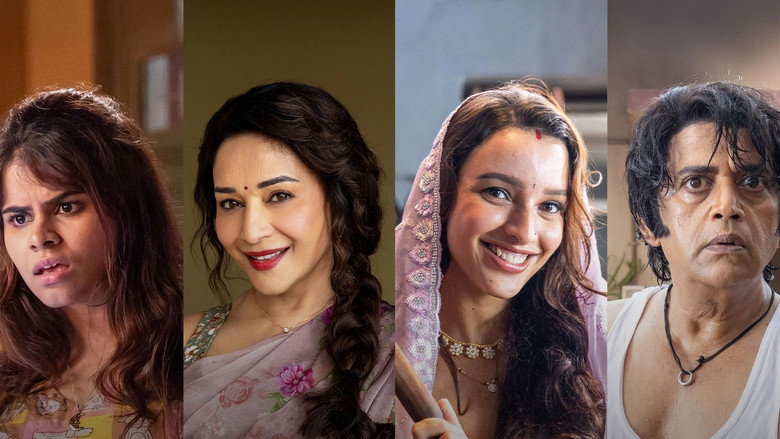
A tense standoff in a dimly lit kitchen, the dead body barely visible under a sheet, as the three women argue in hushed, frantic tones.

Triptii Dimri, meanwhile, is the film’s secret weapon. As Anu, the older daughter who’s spent years trying to distance herself from her mother’s chaos, Dimri brings a quiet intensity that cuts through the noise. There’s a scene midway through the film where Anu, exhausted and covered in sweat, sits on the floor of the kitchen and stares at the body.

The camera holds on her face for what feels like an eternity, and in that silence, you can see the weight of every bad decision, every unspoken resentment, every moment of love that curdled into something bitter. It’s a masterclass in restraint, and it’s the emotional core of the film. (I’m still thinking about the way her shoulders slump when she realizes she can’t walk away from this, not really.)

Audience Opinions

Audience 6.1/10
"A sharp, women-led dark comedy with standout performances that stumbles on pacing, tone, and an overcooked finale."

Triptii Dimri is the emotional and comic anchor, and Madhuri Dixit’s fearless, messy turn and the chaotic mother–daughter dynamic are big pluses, especially for how unapologetically “galeech” and complicated the women are. The premise of widows and daughters hiding a body in a judgmental colony, mixing satire, crime and family drama, feels fresh and is often funny, but the mid-section sags, the humour doesn’t land consistently, and the last stretch turns into preachy melodrama that undercuts the tighter dark comedy before it.

What viewers praise
  • Triptii Dimri standout Natural comic timing and layered emotion make her the strongest character.
  • Bold female-centric chaos The film revels in messy, morally grey women, which is refreshing and fun to watch.
  • Engaging core premise The setup of a mother and estranged daughters covering up a crime in a nosy housing colony feels novel and compelling.
  • Energetic ensemble Madhuri Dixit, Dharna Durga and the supporting cast bring lively energy and create memorable family and neighbourhood dynamics.
Common complaints
  • Flabby middle act The story loses grip after a strong start, with scenes that drag and make the film feel longer than it is.
  • Melodramatic ending The climax leans into heavy social messaging and old-school melodrama that doesn’t match the sharper, funnier first hour and a half.
  • Inconsistent humour Some stretches are genuinely funny, but others feel forced or fall flat, and a few people didn’t even finish the film.
  • Overacting and unreal tone Certain line deliveries and facial expressions, particularly in louder scenes, come across as overdone and artificial.
Recommended for
Female-led dark comedy fans Triptii Dimri admirers Madhuri Dixit completists Social satire crime stories Messy family drama lovers

Full Plot (Spoilers)

Spoiler warning

This section contains the full plot, including major story reveals. Overview above stays spoiler-free.

Buzz & Rumors

Public reports

“Beautiful Mess” IRL: The Wickedly Real Behind-The-Scenes Story of Maa Behen

Netflix’s Maa Behen may look like pure, scripted chaos, but the drama behind the camera was just as twisted—minus the dead body in the kitchen (thankfully). latestnetflix.com's view is that From pandemic-era rewrites to an alternate ending that almost made the cut, here’s the real gossip on how Suresh Triveni, Madhuri Dixit & co.Cooked up this dark comedy.


WRITING PANIC, PANDEMIC ZOOM ROOMS & A 5-YEAR STARE-DOWN

  • Director Suresh Triveni hit what he himself called a “massive roadblock” while writing Maa Behen’s early draft. The script basically stalled mid-way until writer Pooja Tolani came on board during the pandemic. - Tolani and Triveni jammed on the story entirely through lockdown-era collaboration, not even meeting in person initially—at a time when they weren’t sure if they’d “ever make films again.”
  • The original draft was ripped apart: Tolani restructured the screenplay and rewrote dialogues so heavily that only one original one-on-one scene survived. - Tolani has described it as a five-year journey to get the script to where it is now, with Triveni joking that she’d still be rewriting “till a day before release.”

HOW BOLLYWOOD ALMOST TALKED ITSELF OUT OF MADHURI

  • From day one, Triveni wanted Madhuri Dixit as Rekha—the bold, controversial matriarch who discovers a body in her kitchen. - The problem? Industry “advice.” He kept hearing in the echo chamber that Madhuri would never do this kind of dark, satirical film, so the plan kept stalling. - In 2024, he finally rebelled against the gossip pipeline and went straight to her with a narration. Madhuri said yes, and the project instantly snapped into focus. - Casting the daughters was just as deliberate:
  • Triptii Dimri was chosen after two auditions, with the brief that she must both hold her own against Madhuri and believably “look like she could be her daughter.”
  • Dharna Durga also auditioned twice; Triveni wanted the spontaneity of her influencer persona but without playing it as a gag. - Ravi Kishan was picked for his “formidable presence,” while Arunoday Singh was cast to play a “gentle giant,” subverting his usual macho typecasting.

Madhuri Dixit: From “Lucky Trees” To Hardcore Workshops

  • Madhuri revealed that while earlier in her career she was busy dancing around “a lot of lucky trees,” audiences now want grounded realism—and Maa Behen leans directly into that. - In what is frankly wild given her legendary career, Triveni notes that Madhuri had never done actor workshops before this film. For Maa Behen, she reportedly threw herself into them for several hours a day, fully committing to the process. - A dialect coach was brought in to nail the Ranchi/North Indian lehza. The cast did both online and offline sessions, but Triveni was clear: the accent shouldn’t overshadow emotion—authentic, but not caricature. - Ravi Kishan, who admits he was initially terrified to perform opposite his long-time idol, says Madhuri’s on-set persona was shockingly chill:
  • “Whether it is raining or muddy… I have never seen her throw any tantrums.”
  • If lights went out, if there were delays, or if he unexpectedly added lines in rehearsal, she’d just smile and say, “Oh yeah, yeah.”
  • He says she’s built “a beautiful world of her own” and stays serenely in it even when the set descends into chaos.

A 41-DAY SHOOT, A “BEAUTIFUL MESS” & THE CLIMAX YOU DIDN’T SEE

  • The film was shot in 41 days, almost entirely on constructed sets, with very few outdoor shots—Triveni wanted total control over this nosy, suffocating colony. - The director’s internal brief was to create a “beautiful mess”: a hyper-real, over-the-top tonal universe where rumors feel more vivid than reality. - Every craft choice doubled as gossip commentary:
  • Flashbacks use a changed aspect ratio and cropped frames, plus dreamy orchestral “la-la-land” music, to signal that what we’re seeing is hearsay, not fact. - Characters in flashbacks are often stuck in the same outfits across multiple “memories,” a subtle joke about how people who gossip never bother with details. - Writer Pooja Tolani has also confirmed that there were deleted scenes and an alternate climax. The ending we see is not the only version that existed; a different payoff for at least one key character was considered before being dropped in favor of a tighter resolution. - Triveni and Tolani aren’t ruling out Maa Behen 2, but the director insists it will only happen if they find an “entirely different take”—no cash-grab sequel unless they can outdo this “beautiful mess.”

AWARDS BUZZ & “BEAUTIFUL MESS” PAYOFF

  • The film’s audacious tone and craft decisions have sparked major chatter; Triveni himself has called it a deliberate experiment in mixing female empowerment with dark, anarchic fun. - That gamble is already paying off: the Maa Behen team is picking up awards-season heat, including a Best Director win for Suresh Triveni at the Iconic Gold Awards 2026, adding prestige fuel to Netflix’s latest word-of-mouth hit.

In other words: behind the corpse in the kitchen and the chappal-level patriarchy takedowns lies a five-year writing struggle, a once-in-a-career workshop boot camp for Madhuri Dixit, near-last-minute script surgery, and an ending you’ll probably never get to see. Now that’s a maa-behen of a backstory. Inside 'Maa Behen': How Suresh Triveni's Dark Netflix Comedy… Suresh Triveni on the “beautiful mess” that is Maa Behen… Maa Behen writer Pooja Tolani on feminist gaze, deleted scenes, alternate climax… Hindustan Times – Arunoday Singh interview on Maa Behen and casting choices. Firstpost – Madhuri Dixit on realism, dialect work and “lucky trees”. NDTV – Ravi Kishan on working with Madhuri Dixit on Maa Behen. Threads – Suresh Triveni wins Best Director for Maa Behen at Iconic Gold Awards 2026.

Entertainment rumors and trivia aggregated from public reporting. Treat speculation as unverified unless a cited source confirms it.

More titles in the same genres and with the same cast.