Shah Rukh Khan
Vijay Agnihotri

After mistaking a flight attendant's attention for love, a wealthy, spoiled man becomes obsessed with her and soon tears her life apart.
Shah Rukh Khan
Vijay Agnihotri

Madhuri Dixit
Shivani Chopra

Deepak Tijori
Ashok Chopra

Johny Lever
Champa Chameli

Himani Shivpuri
Nisha
I remember the first time I saw Shah Rukh Khan play a villain. It wasn’t in Baazigar or Darr—those were the roles that announced his arrival as Bollywood’s anti-hero du jour, the pretty boy with a knife behind his back. No, it was Anjaam, a film so unapologetically lurid that it feels like a fever dream of 1990s Hindi cinema, all neon lights and operatic revenge.
Khan’s Vijay Agnihotri isn’t just a bad man; he’s a man unraveling in real time, his obsession with Madhuri Dixit’s Shivani so consuming that it warps the film itself into something grotesque and hypnotic. (And yes, I mean that as a compliment.)
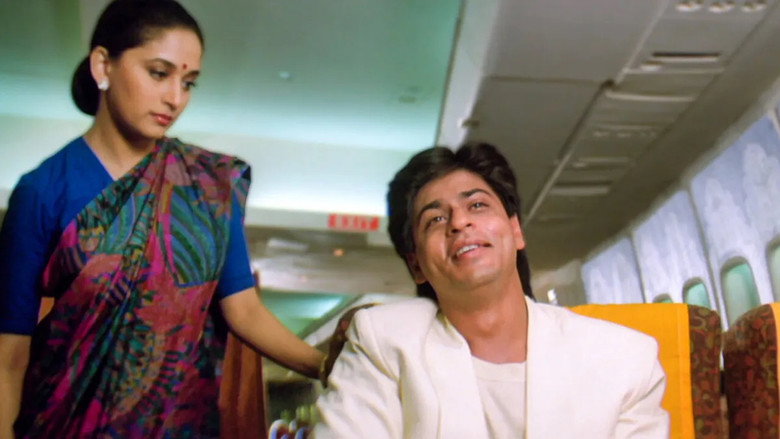
Rahul Rawail’s direction here is less about subtlety and more about the kind of grand, pulpy melodrama that Bollywood does better than anyone else. Anjaam isn’t interested in nuance—it’s a film that wants to grab you by the collar and scream in your face. The runtime (a whopping 170 minutes) isn’t just padding; it’s a slow-burn descent into madness, where every scene feels like a step closer to the edge of a cliff.
The film’s pacing is deliberate, almost sadistic, as if Rawail is daring you to look away before the inevitable explosion. And when it comes, it’s not just violent—it’s theatrical, the kind of revenge fantasy that leaves you breathless and slightly guilty for enjoying it.
Khan’s performance is the film’s beating heart, and what a dark, twisted heart it is. This was 1994, and Khan was still mostly known for his boyish charm in films like Dilwale Dulhania Le Jayenge (released the same year, no less). Anjaam let him off the leash, and he ran wild. There’s a scene early on where Vijay, rebuffed by Shivani, stares at his reflection in a mirror, his face half-lit by a flickering bulb.
"A gripping yet over-the-top psychological thriller with standout performances, but hampered by melodrama and predictable twists."
Shah Rukh Khan and Madhuri Dixit’s intense performances and fiery on-screen chemistry are the film’s biggest draws, keeping the revenge-driven plot engaging despite its excesses. The reliance on melodrama and formulaic thriller tropes costs it subtlety and depth, especially in the supporting roles.
Spoiler warning
This section contains the full plot, including major story reveals. Overview above stays spoiler-free.
Shah Rukh Khan’s rise to superstardom wasn’t just built on romantic charm—it was also forged in the fires of one of Hindi cinema’s most chilling villains. Anjaam (1994), directed by Rahul Rawail, remains a defining moment in Khan’s career, proving he could command the screen with menace as effortlessly as he could with romance. latestnetflix.com's view is that but the making of this psychological thriller was as intense as the film itself, with behind-the-scenes stories that reveal just how far Khan was willing to go to disappear into the role of Vijay Agnihotri, a wealthy businessman consumed by obsession and vengeance.
Before Anjaam, Shah Rukh Khan was already a rising star, but his filmography was dominated by romantic leads and lighthearted roles. Anjaam changed that. The film cast him as a villain for the first time in his career—a calculated risk that paid off. Director Rahul Rawail, known for his work in the 1980s and 1990s, saw something in Khan that others hadn’t: the ability to balance charm with terrifying intensity. Rawail later recalled that Khan’s dedication to the role was unmatched, with the actor fully immersing himself in Vijay’s dark psyche.
The film’s plot revolves around Vijay’s obsession with Shivani Chopra (Madhuri Dixit), a woman who rejects his advances. What begins as infatuation spirals into a campaign of psychological torture, culminating in a climax that leaves audiences unsettled. Khan’s performance was so convincing that it earned him the reputation of Bollywood’s most feared villain of the 1990s. The role was a gamble, but it solidified his versatility and set the stage for future antihero turns, including Baazigar (1993) and Darr (1993), which had already hinted at his darker side.
Khan’s commitment to Anjaam wasn’t just performative—it was visceral. Behind-the-scenes footage and interviews reveal an actor who pushed himself to the edge to embody Vijay’s rage and instability. In one clip, Khan is seen crying uncontrollably and even lashing out physically on set, startling co-stars and crew members. His co-star Madhuri Dixit, who played Shivani, later admitted that Khan’s intensity was so convincing that it sometimes made her uncomfortable.
Rawail, in a podcast interview, described Khan’s approach as "method acting taken to another level." The director recalled that Khan would stay in character even between takes, refusing to break the emotional high required for the role. This level of dedication wasn’t just for show—it translated on screen, making Vijay one of the most disturbing villains in Bollywood history.
Despite its dark themes, Anjaam found an audience. The film’s runtime of 170 minutes and its unrelenting tension made it a polarizing watch, but it developed a cult following over the years. While exact box office numbers are scarce, retrospective analyses suggest it performed moderately well, given its niche appeal. What it lacked in commercial blockbuster status, it made up for in impact—Khan’s performance became a benchmark for villainy in Hindi cinema.
The film’s legacy extends beyond its release. Anjaam is often cited as a turning point in Khan’s career, proving he could carry a film without relying on his romantic hero persona. It also cemented his on-screen chemistry with Madhuri Dixit, who would later star with him in hits like Dil To Pagal Hai (1997) and Devdas (2002). For Rawail, the film remains a standout in his filmography, showcasing his ability to craft psychological thrillers in an era dominated by masala entertainers.
Despite its significance, Anjaam remains shrouded in some mystery. Rumors about the film’s budget and production challenges persist, though concrete details are hard to come by. Some sources suggest the film’s dark tone made it a tough sell to studios, while others claim Khan’s salary for the role was a fraction of what he would later command. However, without verified reports, these remain speculative.
What is clear is that Anjaam was a gamble that paid off—not just for Khan, but for Bollywood as a whole. It proved that Hindi cinema could handle complex, morally ambiguous characters, paving the way for future psychological thrillers. For fans of Khan’s early work, the film is a masterclass in transformation, a reminder that even the most beloved heroes can become terrifying when the script demands it.
Entertainment rumors and trivia aggregated from public reporting. Treat speculation as unverified unless a cited source confirms it.
More titles in the same genres and with the same cast.